•
•1mo ago
Your Shopify Bundle Lifted AOV. Did It Leave More?
POV: You are reviewing a new Shopify bundle.
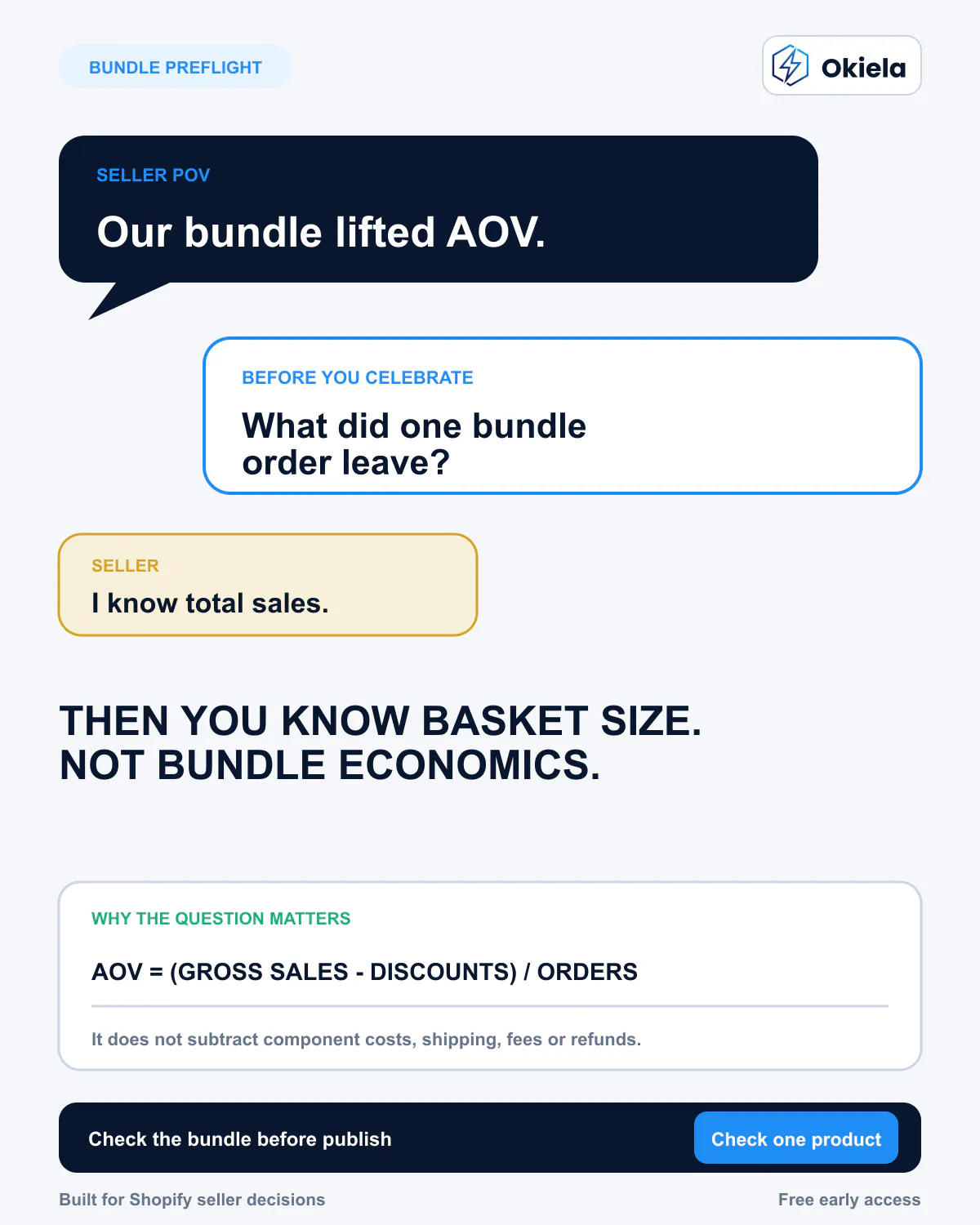
Seller: Our bundle lifted AOV.
Me: What did one bundle order leave?
Seller: I know total sales. I have not added every component cost yet.
Then we know basket size.
We do not know bundle economics.
Shopify defines AOV as product revenue after discounts divided by orders.
Useful metric. Different question.
Before publishing a bundle, I would write down:
- bundle selling price
- combined cost of every component and quantity
- bundle discount
- shipping the store pays
- payment fees
- refund allowance
What remains before ads is the number I would want beside AOV.
A higher AOV can leave more or less per order. The costs decide which.
I am testing the current free Okiela beta around one product or offer before it goes live.
For a bundle today, it expects one combined product cost. It does not import component SKUs or calculate that combined cost for you.
The product question I need real Shopify merchants to answer:
Would you trust one combined bundle-cost input, or would you need to see every component and quantity before trusting the result?
#Shopify #Okiela #bundle #AOV
 •
•1mo ago
Your 20% Shopify Sale Might Be an Offer Stack
Seller: I'm about to run 20% off.
Me: Can it combine with a welcome code?
•1mo ago
3.0x ROAS: Should You Scale Your Shopify Ads?
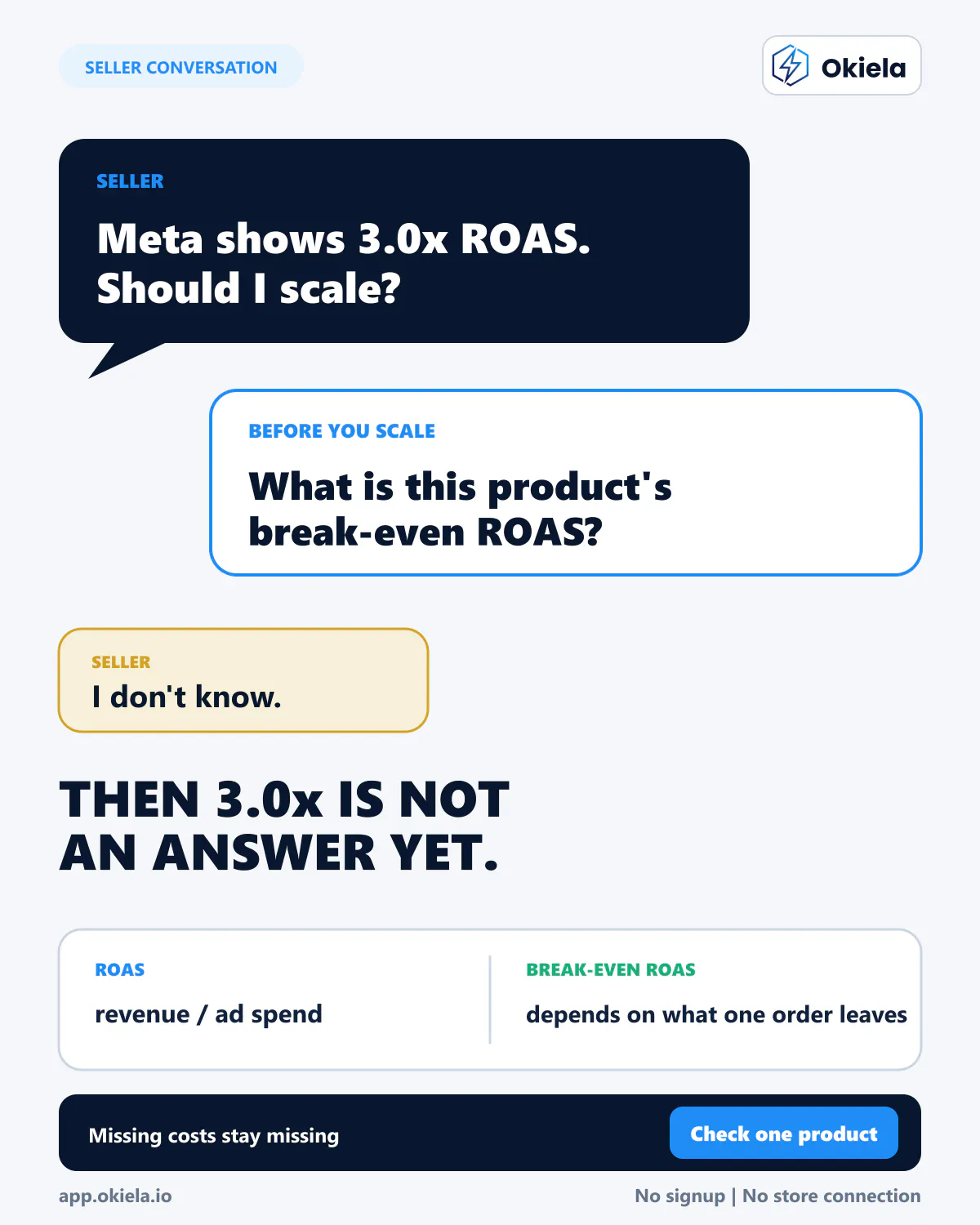
Seller: Meta shows 3.0x ROAS. Should I scale?
Operator: What is this product's break-even ROAS?
Seller: I don't know.
Then 3.0x is not actionable yet.
ROAS tells you revenue attributed to ads divided by ad spend.
It does not tell you what the order kept.
That answer starts lower in the order:
Price
- discount
- product cost
- shipping
- payment fees
- refund allowance
= what one order leaves before ads
Only then can you calculate the ad-spend boundary for that product.
Two Shopify sellers can both see 3.0x ROAS and face opposite decisions because their order economics are different.
One important caveat:
Break-even ROAS is a boundary, not a recommendation to scale. Attribution, overhead, cash flow, and repeat purchase still matter.
But if you do not know the boundary, you are asking an ad dashboard to make a business decision it cannot make.
Before your next budget increase, check one product at app.okiela.io.
No signup. No store connection.
For sellers running paid ads: what do you check first before scaling, platform ROAS, blended ROAS, break-even CPA, or cash contribution per order?
 •
•1mo ago
Stop copying your competitor’s free-shipping line.
Stop copying your competitor s free-shipping line.
Their threshold was built from their product costs, payment fees, and shipping rates-not yours.
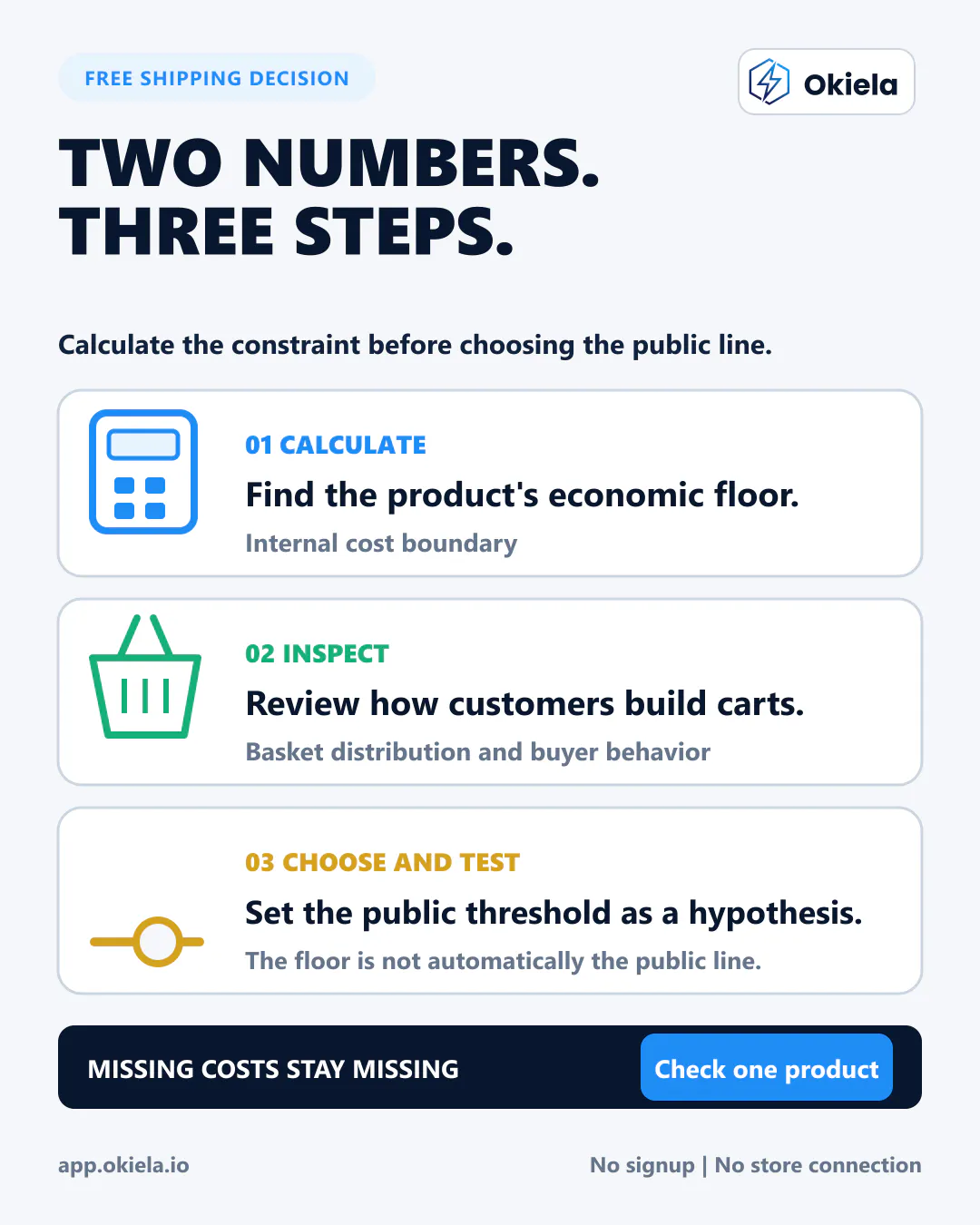
Before publishing a free-shipping offer, find your economic floor:
The order value where the amount left after product cost and payment fees can still absorb the shipping you pay.
That gives you a boundary for the offer.
But it does NOT automatically give you the number to put in the announcement bar.
Your economic floor is an internal constraint. Your public threshold is a merchandising decision.
The second decision also needs evidence about basket distribution and customer behavior. A lower threshold may convert more orders. A higher threshold may produce better economics per visitor.
That is why copying a competitor-or deriving the line from store-wide AOV-skips the question that matters:
CAN this product afford the shipping promise attached to it?
Okiela s current free early-access check is deliberately narrow: test one Shopify product or offer before it goes live and see what one order leaves, break-even ROAS, and the discount ceiling.
NO signup or store connection is required for the first check. Missing costs stay missing instead of quietly becoming zero.
How did you choose the free-shipping line currently on your store: unit economics, basket data, or competitor convention?
 •
•1mo ago
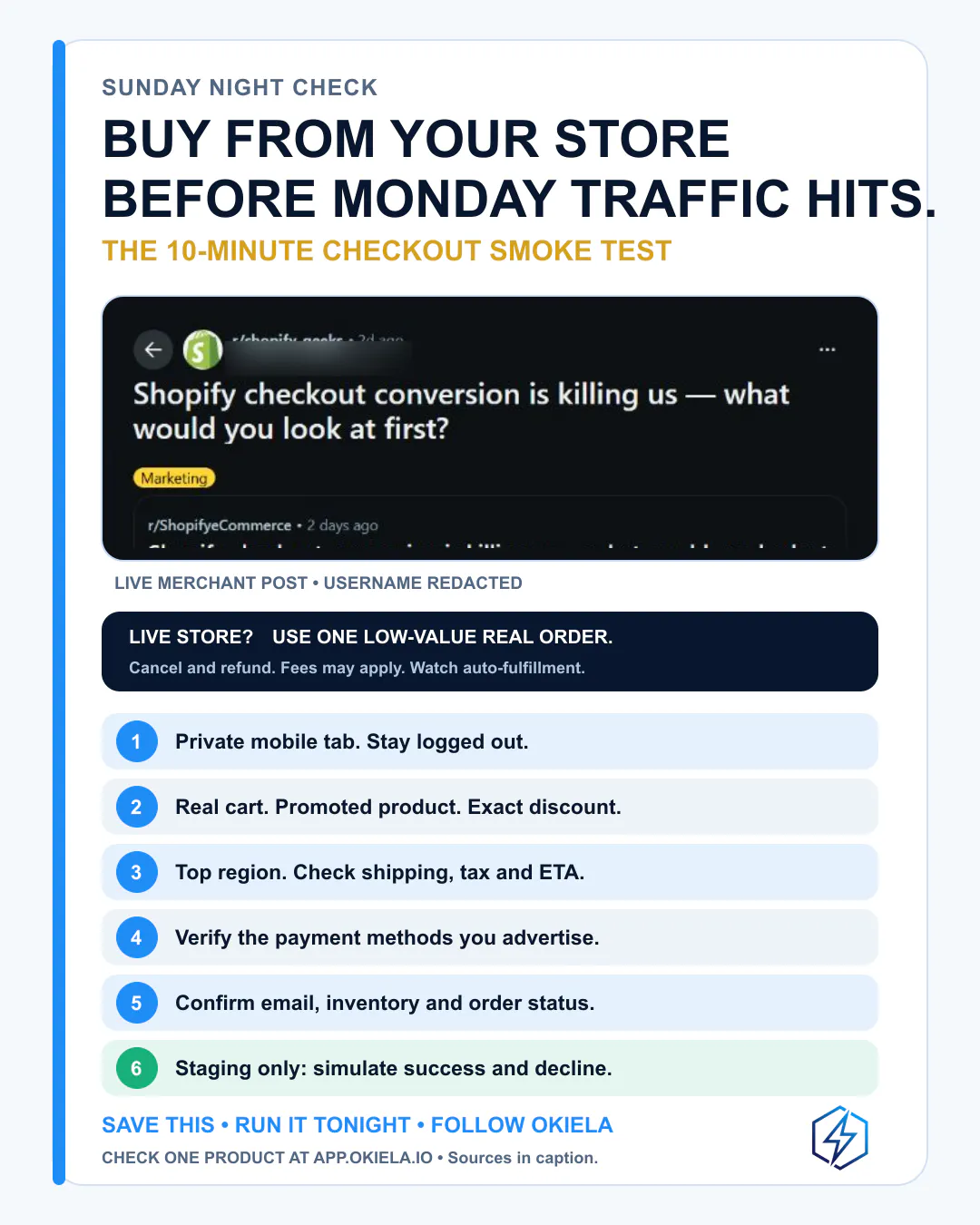
TRAFFIC MONDAY? TEST CHECKOUT SUNDAY.
Before Monday traffic hits your Shopify store, buy from it.
Not as the owner. As a customer on a phone, in a private tab.
A merchant posted this weekend: 8 people reached checkout. 1 completed the purchase.
That sample is too small to declare a conversion crisis. It is large enough to justify a checkout smoke test.
Run this tonight:
1. Build a realistic cart with your bestseller and the product in tomorrow's promotion.
2. Apply the exact discount code you are advertising.
3. Ship to the region where most of your customers live.
4. Watch when shipping, tax or duties change the total.
5. Check the delivery estimate and the payment methods you advertise.
6. On a live store, complete one low-value real order, then cancel and refund it. Fees may apply. Watch any auto-fulfillment.
7. Confirm the order email, inventory change, order status page and fulfillment routing.
Use a development or staging store to simulate successful and declined payments.
Do not casually enable Shopify Payments test mode on a production store. Shopify warns that customers cannot place live orders while payment providers are in test mode.
What was the last checkout step you personally tested: payment, email or fulfillment?
Save this. Run it tonight.
Follow Okiela for useful Shopify checks and ready-to-use merchant templates.
#Shopify #ShopifyMerchant #EcommerceOperations #CheckoutOptimization #Okiela
 •
•1mo ago
Shopify | Never Share Your Password
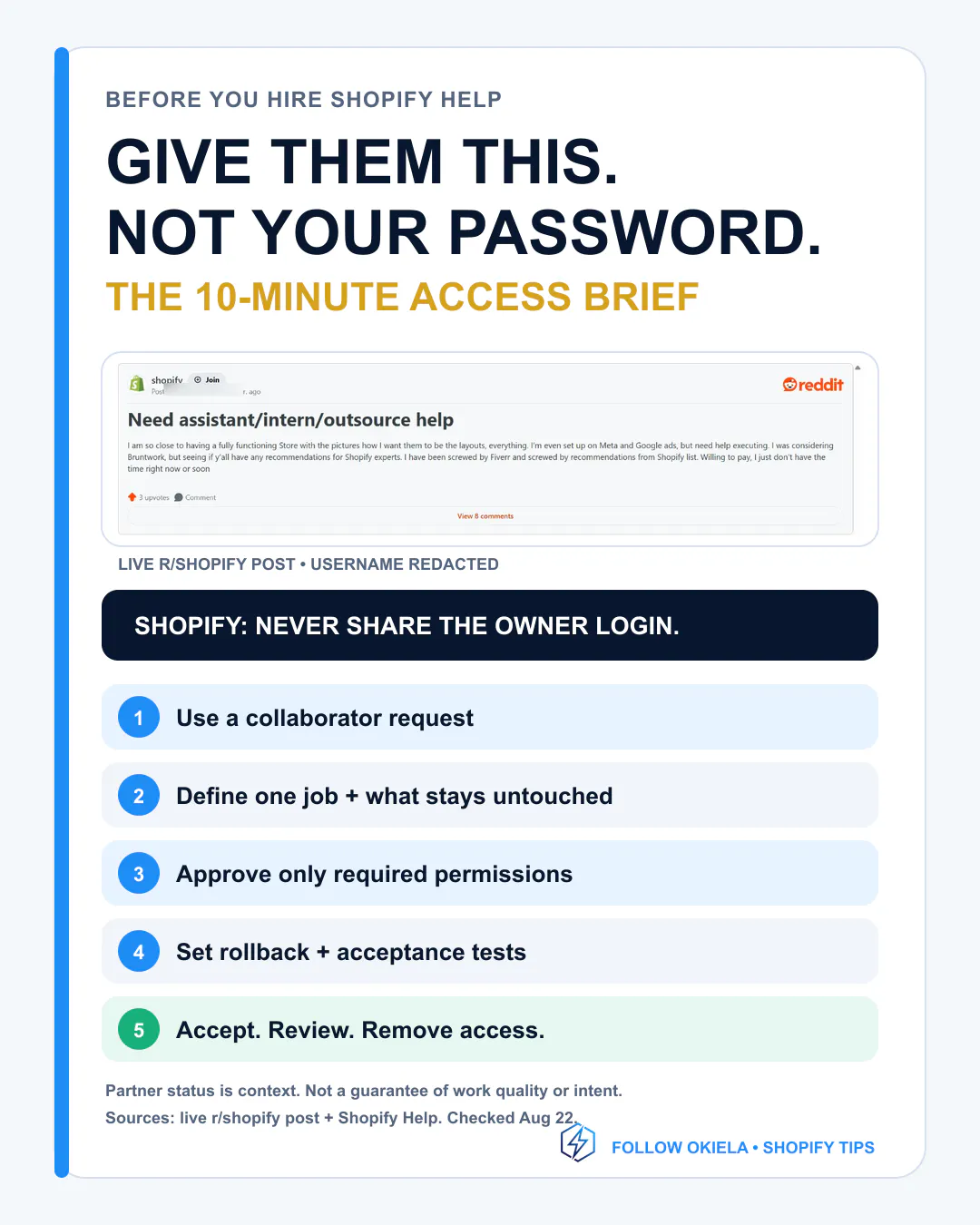
Do not send a Shopify freelancer your password.
Send them an access brief.
A merchant posted today that they need execution help after being burned by previous hires. They are willing to pay. They just do not have the time to keep guessing who can be trusted.
The hiring platform is not the control layer.
Your scope, permissions, acceptance test, and access closeout are.
Before anyone touches your store, write down:
1. The one job they own.
2. What they must change.
3. What they must not touch.
4. The exact Shopify permissions requested and why.
5. Who will actually access the store.
6. The last-known-good theme or rollback point.
7. The tests that prove the job is done.
8. The date access will be removed.
Then use a Shopify collaborator request. Do not share the owner's login.
Shopify says collaborator accounts are the recommended route for Partners working on client stores. Merchants control store permissions, and collaborators must use two-step authentication.
One important guardrail: a Partner account is not proof of good work. Shopify says the details shown on a collaborator request do not guarantee identity, work quality, or intent.
Save the brief. Send it before your next developer, designer, VA, agency, or app support handoff.
Follow #Okiela for practical #Shopify checks and merchant-ready templates.
---
Im testing a small profit preflight for #Shopify discounts.
If you re about to run one, send price, unit cost, shipping cost, fee %, and discount %.
I ll return Go / Review / Stop with the math. No store connect: app.okiela.io
#ShopifyMerchants #EcommerceOperations #EcommerceSecurity #ShopifyPartner
 •
•1mo ago
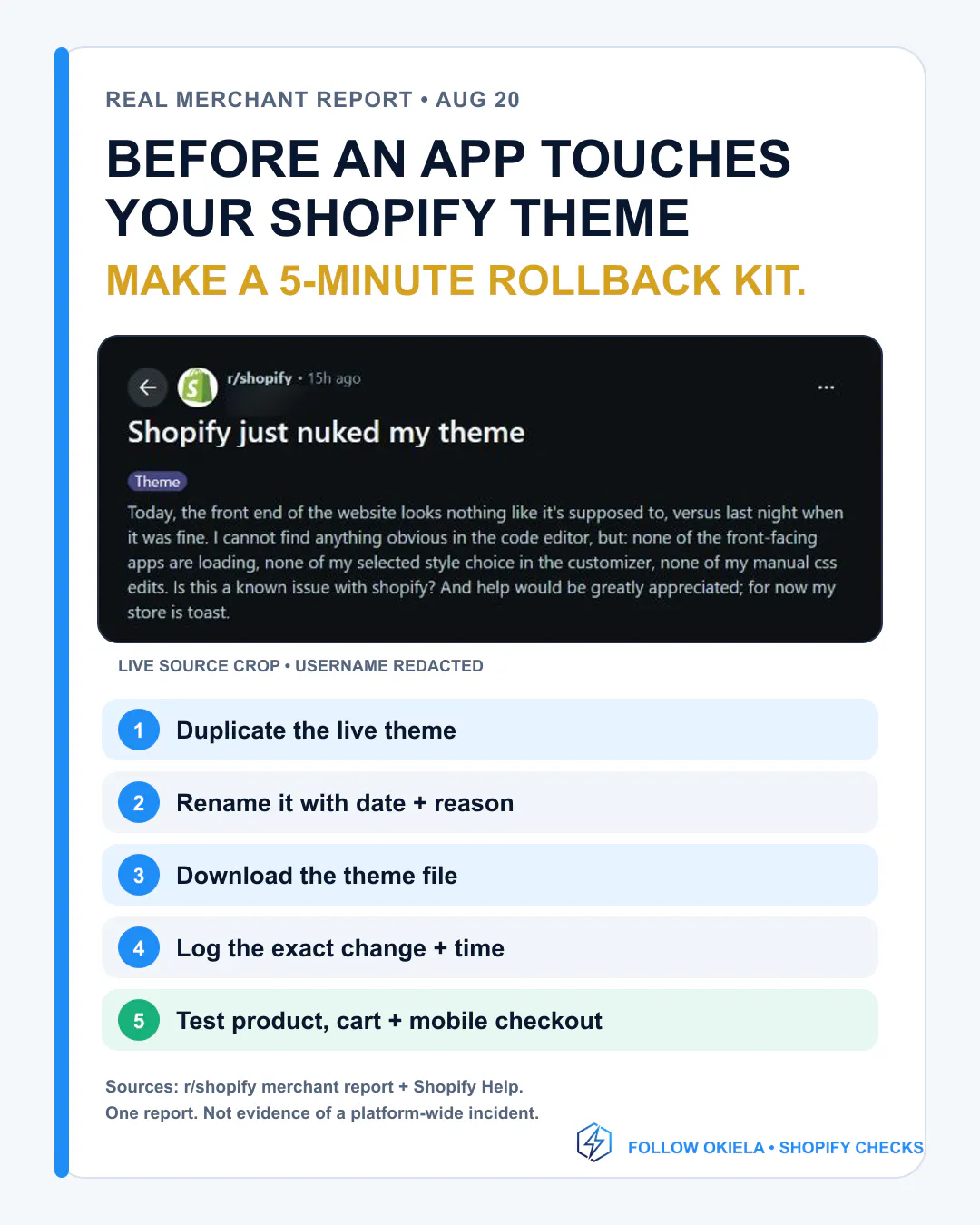
A Shopify merchant woke up to a storefront that no longer looked like it had the night before...
A Shopify merchant woke up to a storefront that no longer looked like it had the night before.
The theme settings appeared gone. App output was missing. Manual CSS was no longer showing.
The most useful takeaway is not the app name.
It is this: before an app install, theme update, developer handoff, or AI code change, build a rollback point.
My 5-minute Shopify rollback kit:
1. Duplicate the current live theme.
2. Rename it with the date and reason.
3. Download the theme file.
4. Record the exact change, owner, and start time.
5. Test six paths: home, collection, product and variants, add to cart, cart, mobile checkout handoff.
If subscriptions, bundles, quick add, or Markets matter to your store, test those too.
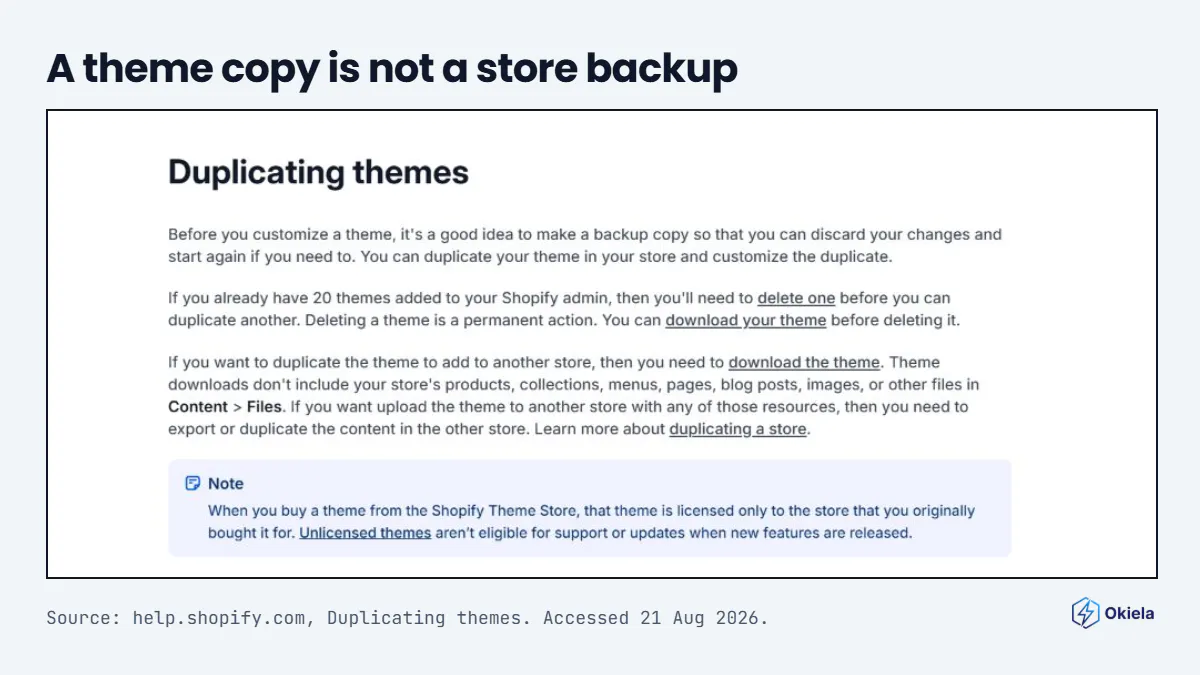
One limit worth knowing: a theme copy is not a full-store backup. Shopify says theme downloads do not include products, collections, menus, pages, blog posts, images, or Content files.
And code Timeline is not a full restore button. It restores one existing file at a time, its history is finite, and it cannot recover deleted files.
The Reddit post is one merchant report, not proof of a platform-wide incident. The backup guidance is confirmed in Shopify's own Help Center.
Save this before your next storefront change. Send it to whoever touches your theme.
Follow Okiela for practical Shopify checks merchants can use today.
Sources: Shopify in comments.
---
Also, I m testing a quick preflight for that exact check.
No store connect. Just price, unit cost, shipping, fee %, discount % and it returns Go / Review / Stop with the math: app.okiela.io
#Shopify #ShopifyTips #EcommerceOperations #Storefront #ShopifyMerchants #Okiela
 •
•2mo ago
Traffic is up. Sales are not.
A Shopify merchant asked a question many store owners recognize:
Is the website the problem, or are we bringing in the wrong traffic?
Do not redesign the store yet.
Open Shopify Analytics. Choose one date range. Filter `Human or bot session` to `Human` where available, then write down:
1. Sessions
2. Sessions with cart additions
3. Sessions that reached checkout
4. Sessions that completed checkout
Split the same view by referring channel and find the largest drop.
If the drop happens before cart, investigate the source promise, landing page, product page, and offer first.
If carts stall before checkout, investigate the cart drawer, unexpected shipping or tax, forced upsells, and the checkout button.
If checkouts stall before purchase, test payment methods, shipping availability, errors, and the mobile checkout yourself.
The largest drop does not prove the cause. It gives you a better first place to investigate.
This is a public community question, not an Okiela customer claim.
Source: public r/shopify discussion, August 2026
https://lnkd.in/gsAZBvnN
Follow Okiela for practical Shopify checks you can run inside your store.
#Okiela #Shopify #traffic
 •
•2mo ago
Essential Shopify Food Brand Tools
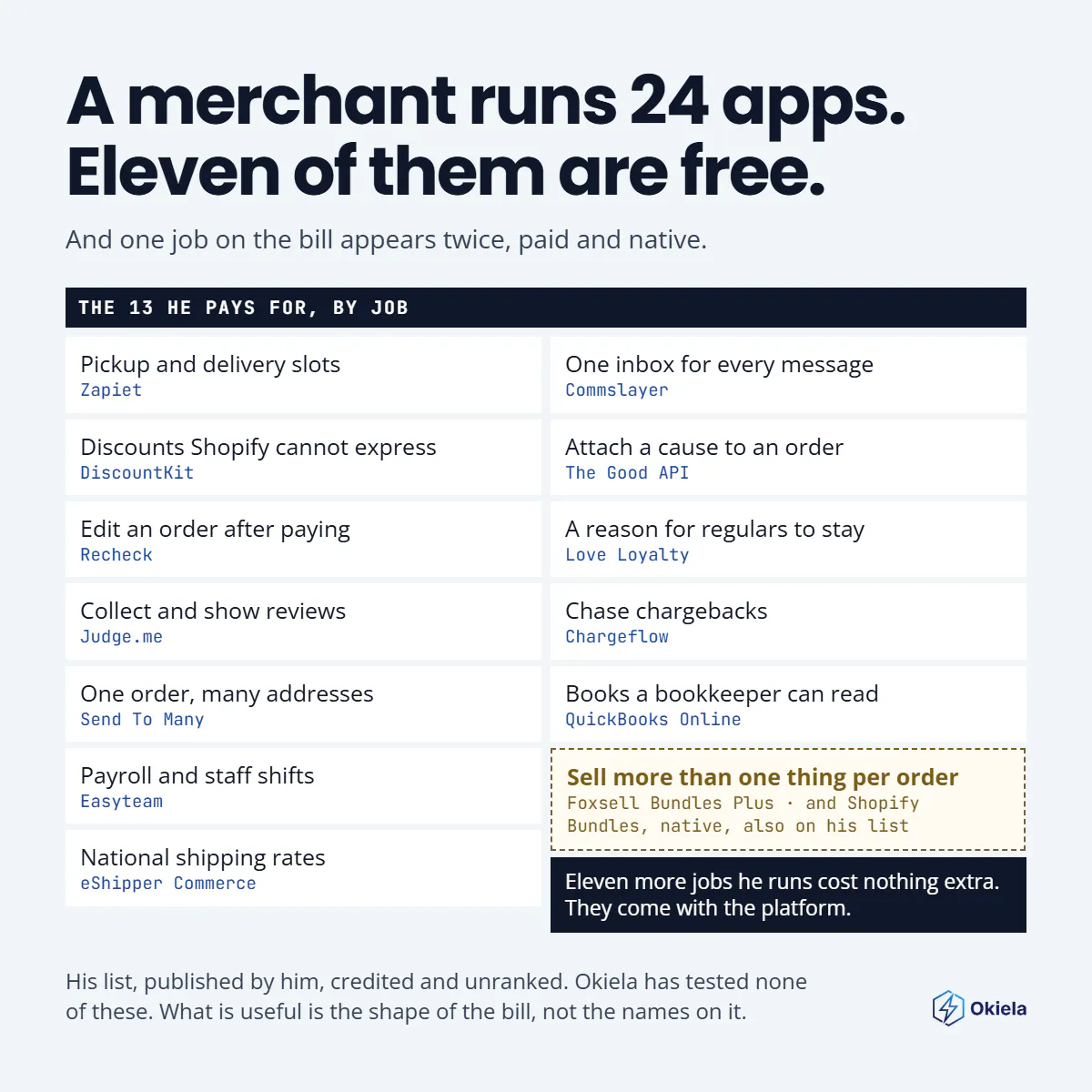
Open your Shopify bill and read the app names. Most people cannot say what two or three of them are for any more.
A merchant running a food brand published his whole stack this week, twenty four apps grouped by what they do. His post is tagged in the first comment.
I laid it out by job instead of by app, and two things fell out.
11 of the 24 are Shopify's own, included, no extra bill. Translate, Messaging, Forms, Search, Bundles, Subscriptions, Digital Products, Order Printer, Planet, Flow, Collabs. Plenty of stores pay an app to do one of those without knowing.
Then the odd one. He runs Shopify Bundles, which is free, and he pays for a bundles app as well. Both are in his own post. One job, two lines on the bill.
Which of the two he should drop, I have no idea, and neither does anyone reading from outside. The paid one may handle a case the free one cannot, or it may be a leftover from before the free one existed. Those look identical from here.
So check your own bill for that shape. A paid app doing a job the platform quietly started doing.
I take one line out of the Shopify admin each week and check what it costs. Follow if that is useful.
#Okiela #Shopify #tools
 •
•2mo ago
When AI Can’t Read Your Product Page !!!
A customer asks what it is made of and you answer in three seconds, because you know.
So I let a machine answer instead. One product page, made up for this. Link into an assistant, one rule: use nothing except what is on that page. Then the questions customers actually ask.
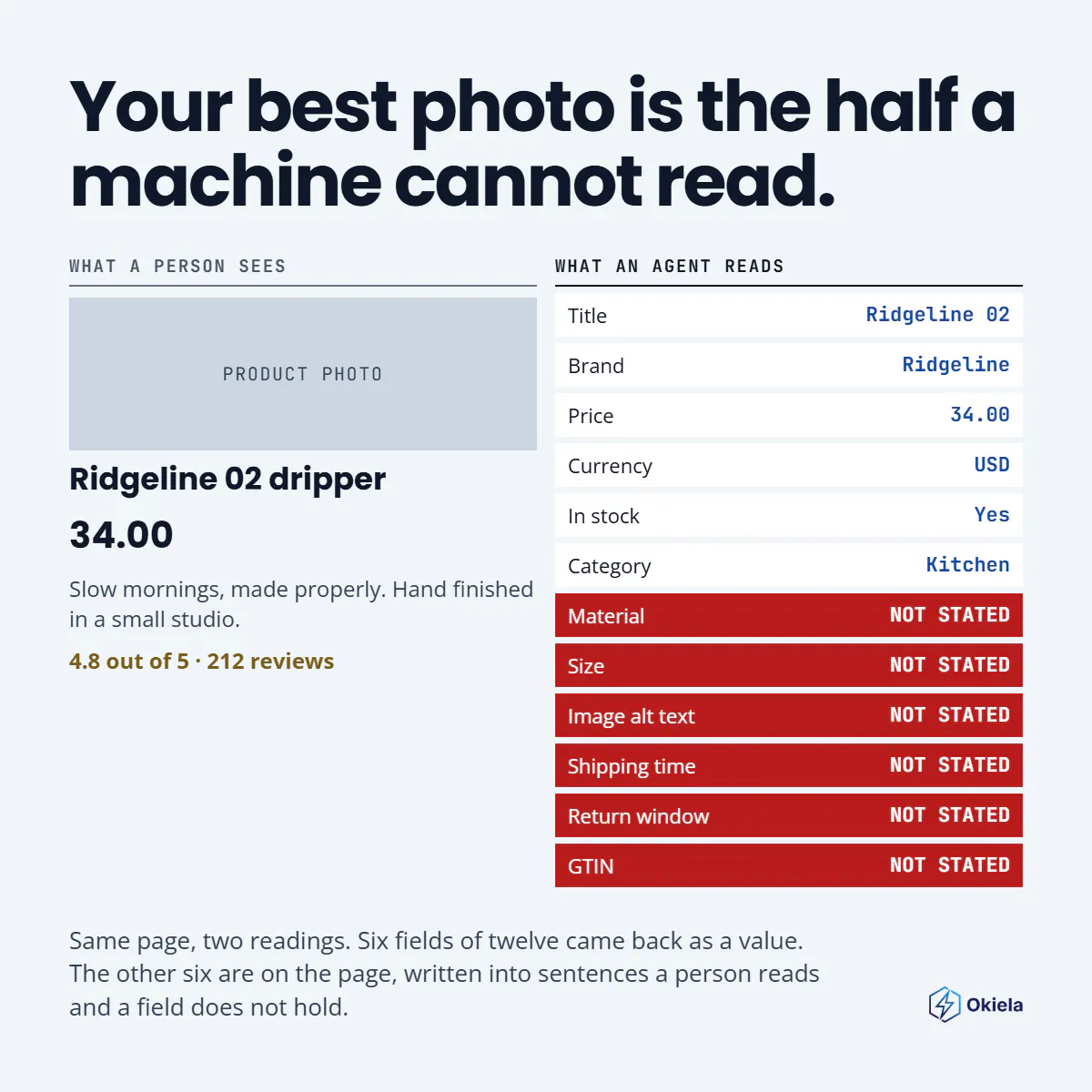
Price, brand, still in stock. Straight back.
What it is made of, how big it is, how long delivery takes, how many days to send it back. Not stated, all four.
They were on the page. Material was in the third paragraph, the size printed on the second photo, the returns line two clicks away in the policy. A person picks all that up without thinking. A machine looks for a field, and an empty one means it does not exist.
Twelve questions in, six answers out.
Shopify's docs say it flatter: agents read fields, not layouts, and how complete they are decides whether your product gets into the conversation.
What those blanks cost me in orders I do not know, and I will not guess. Agent orders and ordinary orders sit in one pile in the admin.
Ten minutes each. "Prompt" in the first comment.
I take one line out of Shopify's own docs each week and check what it costs. Follow if that is useful.
#Okiela #Shopify #conversion