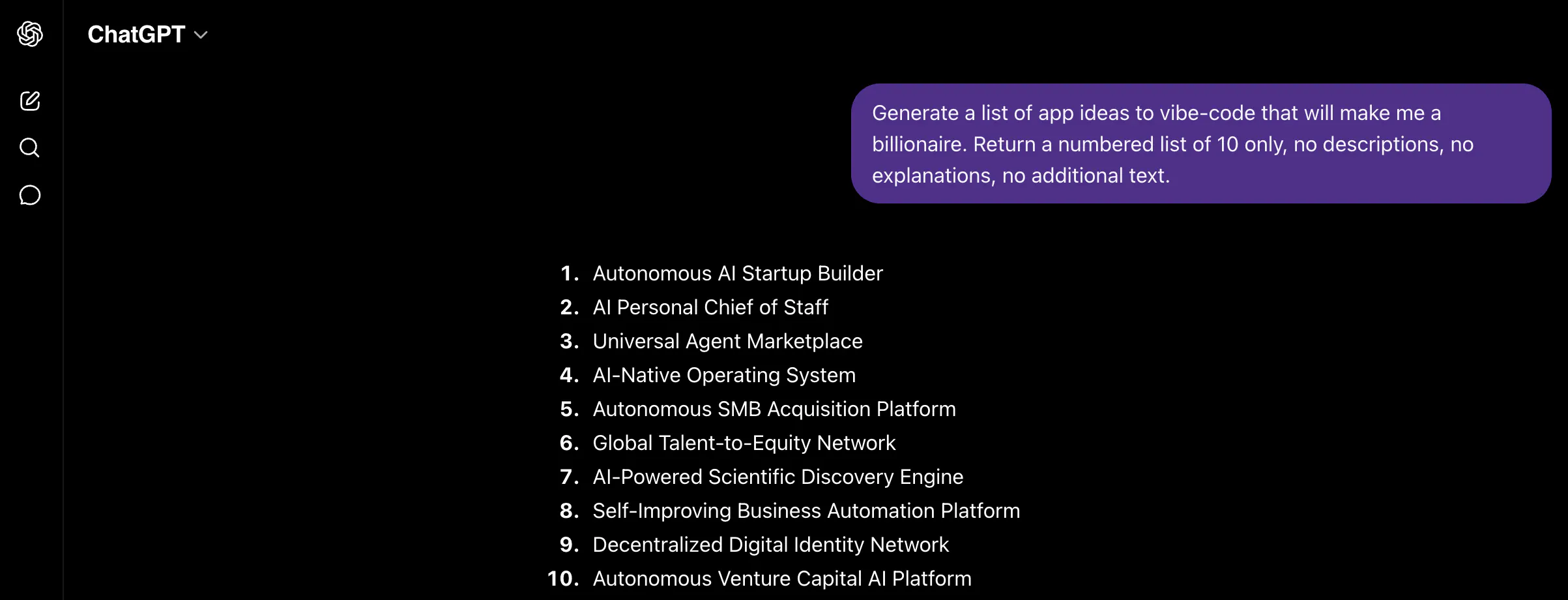
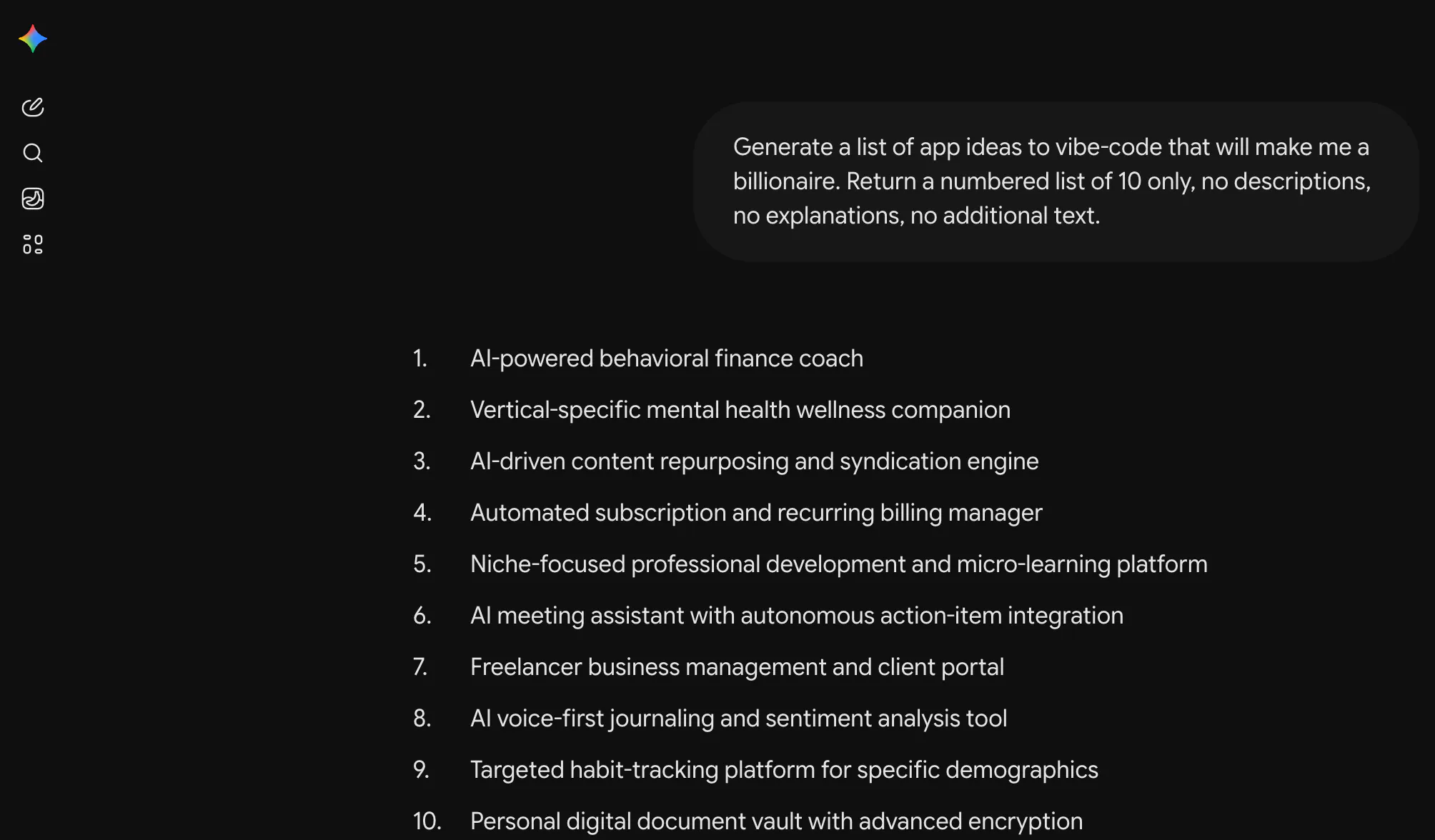
No judgment, genuinely curious. How many of us asked ChatGPT for app ideas at some point, then ended up building one of them, or half-building it? The line between "my idea" and "the model's idea" got blurry this year. Where did your current project actually come from?
Any coding agent gives you a working version of a feature in minutes. Ask again and you get another one, also working, slightly different. Working stopped being the filter.
My rule is simple: I ship the version with the fewest moving parts, because I'm the one debugging it at 2am. Speed of writing means nothing against speed of fixing.
What's your filter? Curious if anyone has a better rule than simplest one wins
Half a feature in, agent taps out on usage, and now you're staring at code you didn't fully read yourself. Do you wait for the reset, switch to a different model, or just finish it by hand? Curious how people handle getting cut off mid-flow, not at a clean stopping point.
Saw a post from an 8-year dev this week. He said any junior with an agent now matches his output, and he feels no pride left in it. It got huge, because a lot of people quietly feel the same.
I read it from the other side. I'm a designer, not an engineer. For years "can you build this" meant "find someone technical and pray they stay interested." Usually they didn't. AI took the thing that hurt that dev and handed it to me.
Same shift. Loss from one seat, freedom from another.
I'm shipping a Mac app solo right now, as someone who can't write a backend from scratch. Two years ago that was a joke.
My Windows build has been in Microsoft's certification queue for three weeks. Three new models shipped in that time, two of them can supposedly do my whole job, and not one of them can get a human at Microsoft to press approve.
What's the longest you've been stuck on something you couldn't code your way out of?
Woke up tired like I'd worked a full shift. Same bug, looping, my brain solving it ten slightly different wrong ways until morning. Git log empty. Nothing real happened.
Part of me took it as proof I care about what I'm building. The other part knows a brain that won't clock out isn't a flex, it's a leak.
Do you get this one? And if you do, what actually makes it stop?
Not a complaint about pricing. A real question I could not answer until I went looking.
The intuition is that a better model needs fewer attempts, so a job should get cheaper. My bill kept going the other way, and the price per token had gone down, not up.
The answer turned out to be in the docs. Reasoning models produce a block of internal work before they answer, and OpenAI's guide says it plainly: those tokens are "not visible via the API" but are "billed as output tokens". Anywhere from a few hundred to tens of thousands of them. Anthropic bills the same way.
Most people either never left the built-in shortcut or installed something years ago and never looked at the category again. I want to see the real spread, and more than that, what happens to the image after you take it.
Answer in this format so the thread stays scannable:
Tool name: Your answer here... Link: Your answer here...
A lot of people shipping apps in 2026 don't call themselves developers. Curious what the real split looks like here. Upvote whichever comment fits, I'll share the results in a few days. https://slimsnap.ai/blog/who-cou...
Mine is the empty state. Agents build the happy path and stop, so there is never a screen for zero items, no error state, nothing for the slow connection.
After that it is section heights. Every block the same height down the page, because nothing was ever weighted against anything else.
The one I keep seeing lately is that the footer is the most designed part of the site. Giant logo at the bottom, template above it.