•
•2mo ago
Why Your Sales Strategy Might Be Eating Your Profits ?
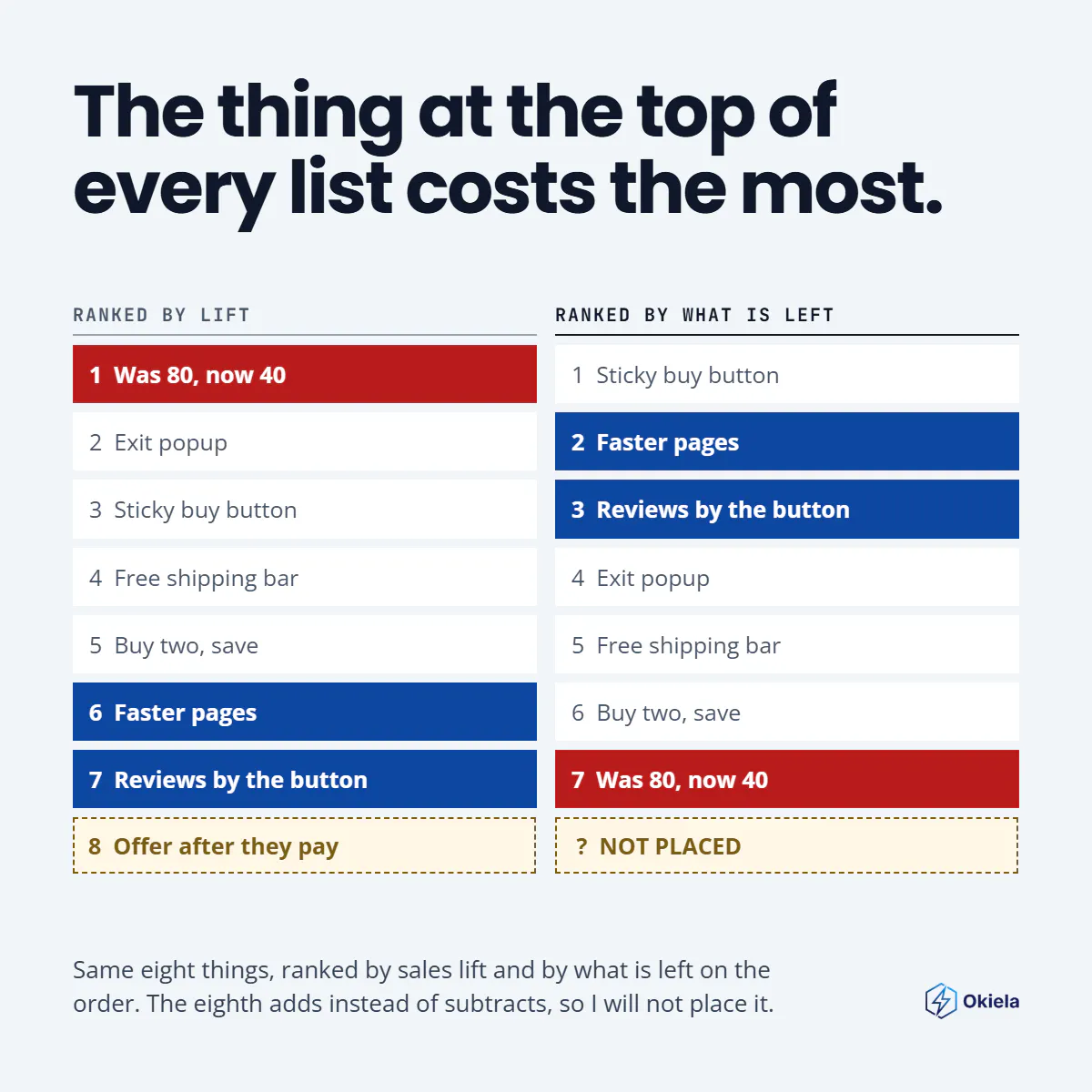
Take the eight things every Shopify guide tells you to install. Rank them by what is left on the order instead of by how much they lift sales.
The list turns upside down.
On a 50 product, after you pay for the goods, the packing, the shipping you cover and the card fee, you have 21.75 left.
Sticky buy button on mobile: 0.00.
Faster pages: 0.00.
Reviews and a delivery date next to the button: 0.00.
Popup with 10% off when they try to leave: 5.00.
Free shipping over a threshold: 6.40.
Buy two save 15%: 7.50.
Was 80 now 40 at 20% off: 10.00.
That last one is first on most published lists. It takes nearly half of what you had.
The three that cost nothing sit at the bottom of those lists. Not because they work less. Because they take weeks of unglamorous work, and a discount takes an afternoon.
One thing I will not rank: the offer on the thank you page. It is the only one that adds instead of subtracts, so it could be first or last depending on the margin of what you upsell. I do not know that about your store.
This is my opinion about money, not a claim about whether each thing works.
I read Shopify and Google docs and post what I find. Follow if that is useful.
#Shopify #CRO #Okiela #conversion
 •
•2mo ago
Shopify Chargebacks Can Still Hurt You After You Win
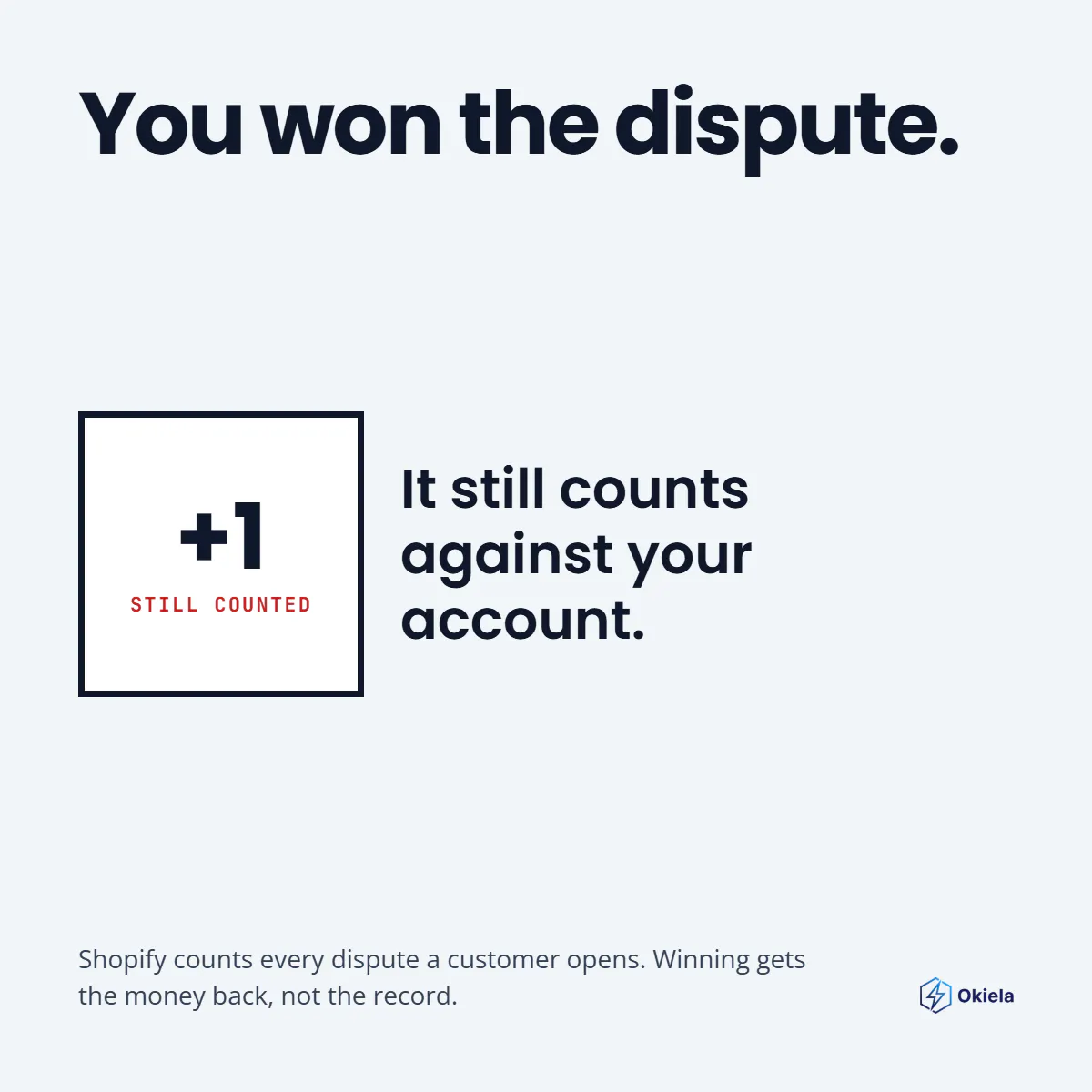
You won the dispute. It still counts against you.
Here is the sentence, from Shopify's own help page: winning a chargeback doesn't remove it from your chargeback rate.
So a shop can spend a whole afternoon gathering tracking numbers, win the case, get the money back, and be in exactly the same position with Shopify as a shop that lost.
That changes what the work is.
Winning cases protects your cash. Only one thing protects your account, and that is the customer never calling the bank in the first place.
Shopify lists the five reasons people call. They did not recognise the name on their statement. The order was flagged as risky and you shipped it anyway. It never arrived. It was damaged. It was a subscription charge they had forgotten about.
Read your last ten disputes and one of those five will keep showing up. That one is your whole job this month.
Now the number. Every guide online says 1% gets your store shut down. Shopify does print 1.00% on that page, but as the level you have to get back under to have a reserve lifted, and hold for thirty days.
That is the way out, not the way in. Which means trouble starts somewhere below 1%, and they do not say where. So do not aim at the line. Aim low and treat any climb as the warning.
Your own number is in Settings, Payments, Chargeback monitoring. Ten minutes.
I take one line out of Shopify's own docs each week and work out what it costs. Follow if that is useful to you.
#Shopify #Okiela #payment
 •
•2mo ago
Why AI Traffic Shares Can Be Misleading ?
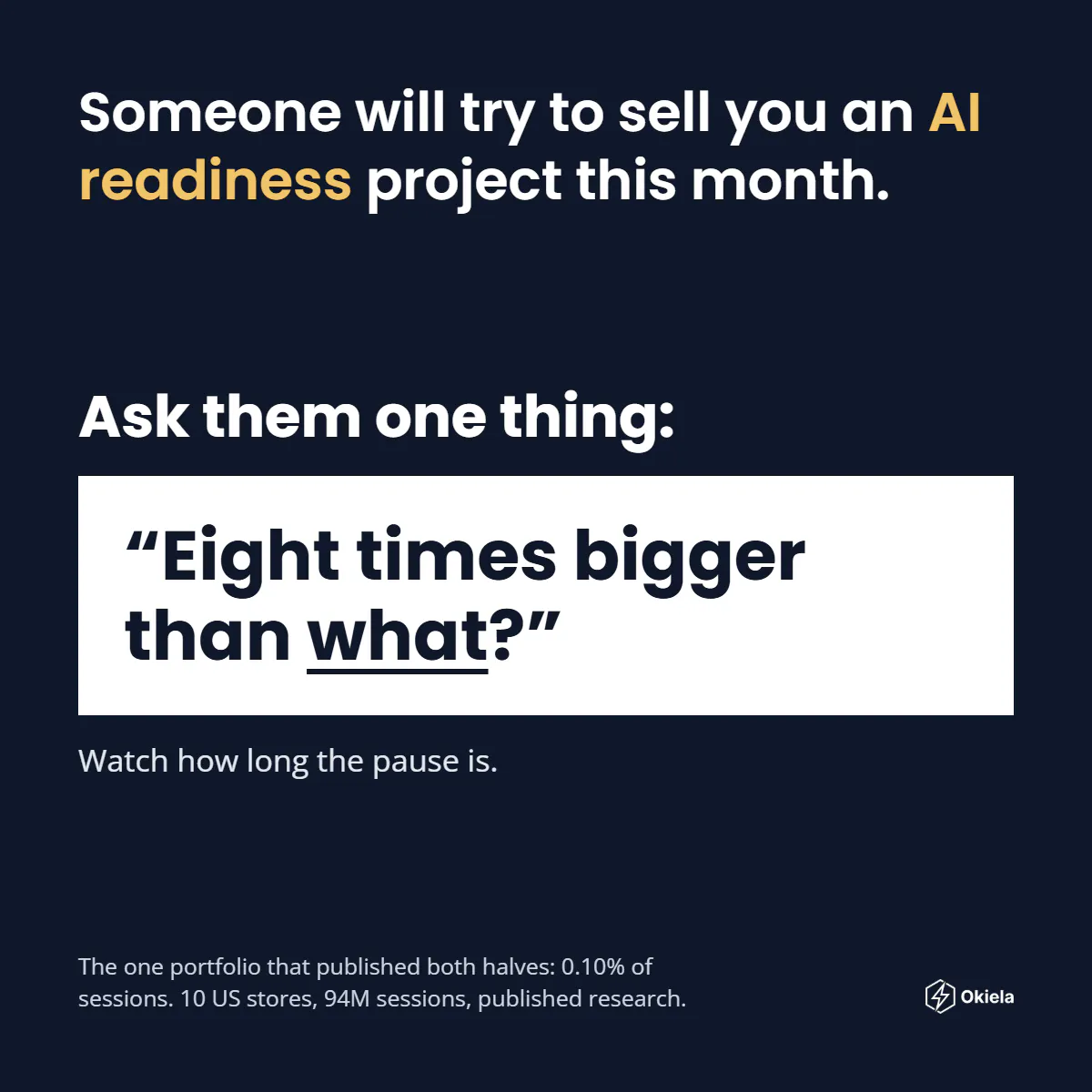
Eight times bigger. One tenth of one percent. Both are true, and you have only been shown one of them.
Shopify reported AI referral sessions growing more than 8x year over year. That number is on every deck about agentic commerce right now. What is almost never printed next to it is the share it multiplies.
One agency published both. Ten United States stores, 94 million sessions, 274 million dollars, two years of real analytics. ChatGPT, Perplexity, Gemini, Copilot and Claude, added together: 0.10 percent of sessions and 0.10 percent of revenue this year. Seventy-five thousand dollars out of seventy-six and a half million.
Now the part I respect them for. They also wrote down both ways their own number is wrong.
Too low, because a shopper who picks a product with a chatbot and buys three weeks later in a sale is recorded as direct or email. Their words: floors on AI's influence, not ceilings.
Too high, because all ten stores are their own retainer clients, already built for this. Their words again: a store that has invested nothing is likely seeing less.
Two arrows, opposite directions, on the same figure. So there is no honest point estimate, and anyone quoting you one is selling something.
Meanwhile, in the same dataset, the Shop app earned 35 times everything the chatbots referred. It is a switch in your admin and nobody is writing think pieces about it.
Four numbers from your own reports tells you where you actually sit. Then you can judge the pitch.
Follow Okiela for practical Shopify seller checks, tools, and ready-to-use templates.
#ai #shopify #Okiela
 •
•2mo ago
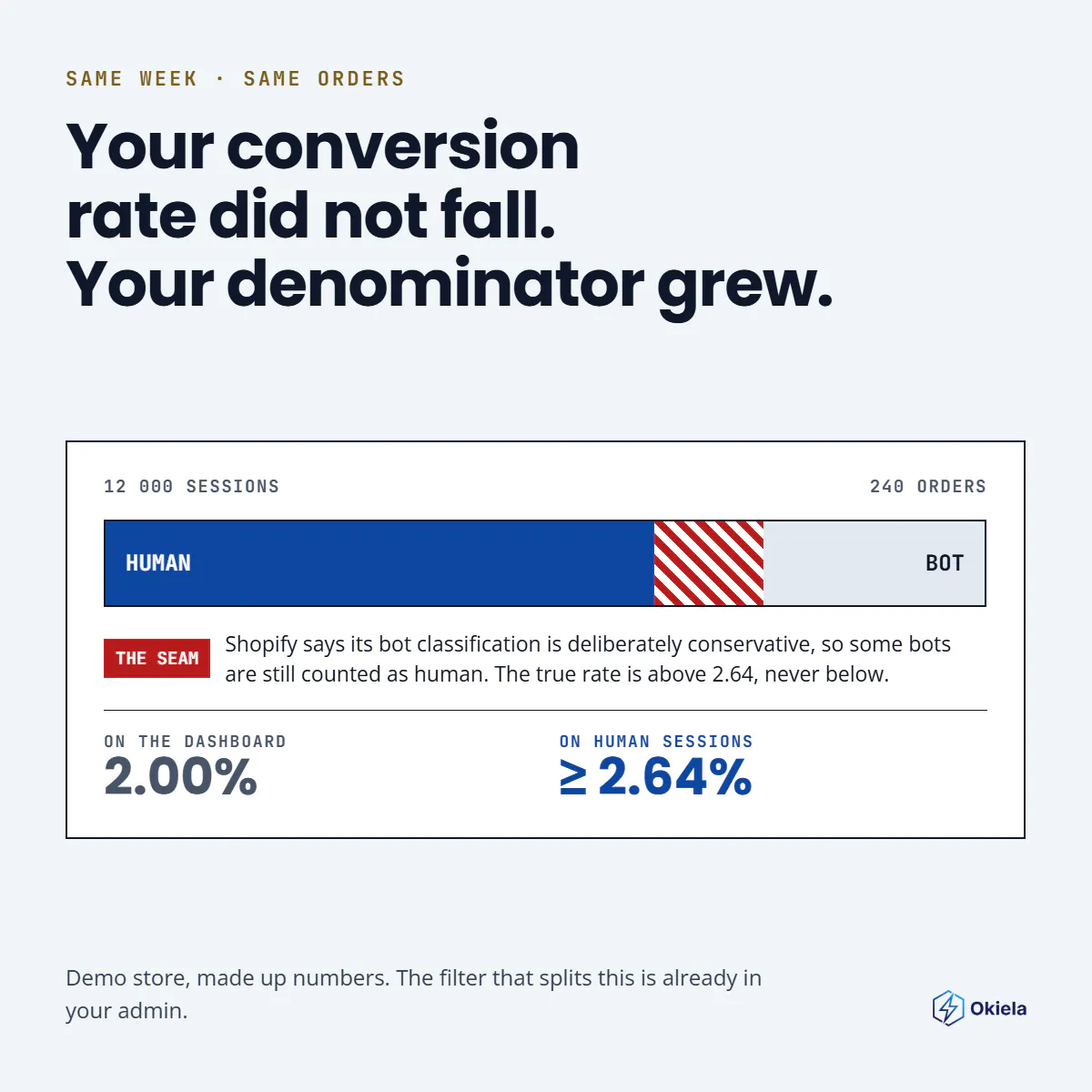
Your conversion rate did not fall. Your denominator grew.
Your conversion rate did not fall. Your denominator grew.
Conversion rate is orders divided by sessions. When it drops, almost everyone reaches for the top of that fraction. New photos, new copy, a discount, an agency call. The bottom of the fraction gets no attention at all, because it feels like weather.
It is not weather. Shopify labels every session on your store as human or bot, using all the events across the whole visit. That label is available to you as a dimension called Human or bot session, and as a filter that strips bot sessions out of a report entirely. It is standard analytics, not an app.
Take a demo store. Twelve thousand sessions, two hundred and forty orders, so the dashboard says two percent. Filter to human sessions and there are nine thousand one hundred. Same orders. The rate is 2.64.
Nothing about the store changed between those two numbers.
Now the part that matters more than the number. Shopify says the classification is deliberately conservative, because it is better to miss some bots than to label real customers as bots. So the human bucket still holds bots, which means 2.64 is a floor. Write it with a greater-than-or-equal sign, every time, or you have replaced one wrong number with another.
Ten minutes, and you find out whether you have been fixing a store that was never broken.
#Shopify #conversion #Okiela
 •
•2mo ago
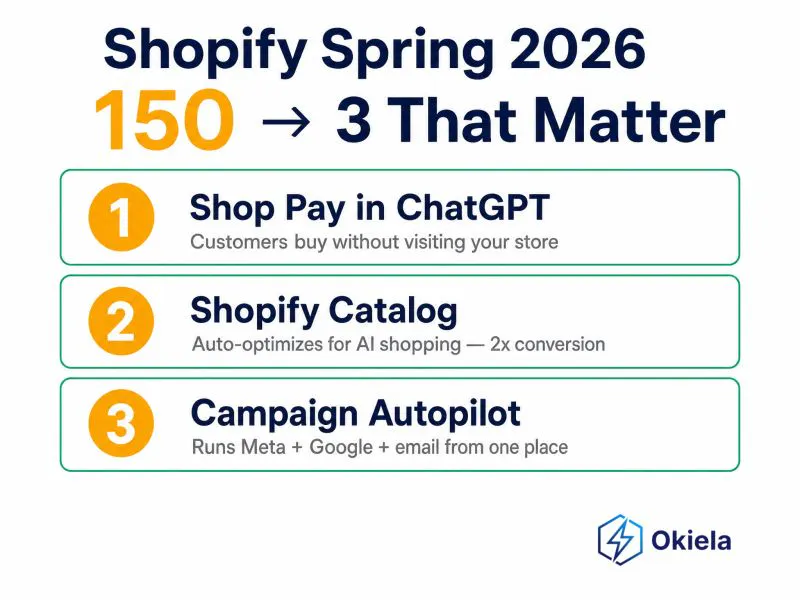
Shopify just shipped 150+ updates in their Spring 2026 Edition
Shopify just shipped 150+ updates in their Spring 2026 Edition.
I read through all of them so you don't have to.
Here are the 3 that actually matter if you're a solo Shopify founder:
1/ Shop Pay now works ANYWHERE... not just on Shopify.
Customers can now check out inside ChatGPT, Microsoft Copilot, and any AI assistant that supports the Universal Commerce Protocol. This means your products can be purchased without the customer ever visiting your store.
2/ Shopify Catalog auto-enriches your product data for AI.
Products syndicated through Catalog convert 2x better in AI chat recommendations than those that aren't. If you're not opted in, you're invisible to the next wave of AI-driven shopping.
3/ Campaign Autopilot runs cross-channel marketing using AI.
It learns over time... meaning your Meta, Google, and email campaigns can be managed from one place. For solo founders juggling 5 tools, this is consolidation.
The other 147 updates? Mostly B2B features, POS improvements, and developer tools. Useful if you're at scale. Noise if you're not.
The takeaway: Shopify is becoming an AI commerce protocol, not just a store builder. If you're still thinking "website + ads = Shopify business," you're one edition behind.
What update caught your attention? Drop it in the comments
#shopify #shopifyupdates #agenticcommerce #solofounder #ecommerce #dtc #Okiela
 •
•2mo ago
I read my own profit dashboard and found a product losing 41.77%
I built a profit dashboard for three weeks before I actually read one myself.
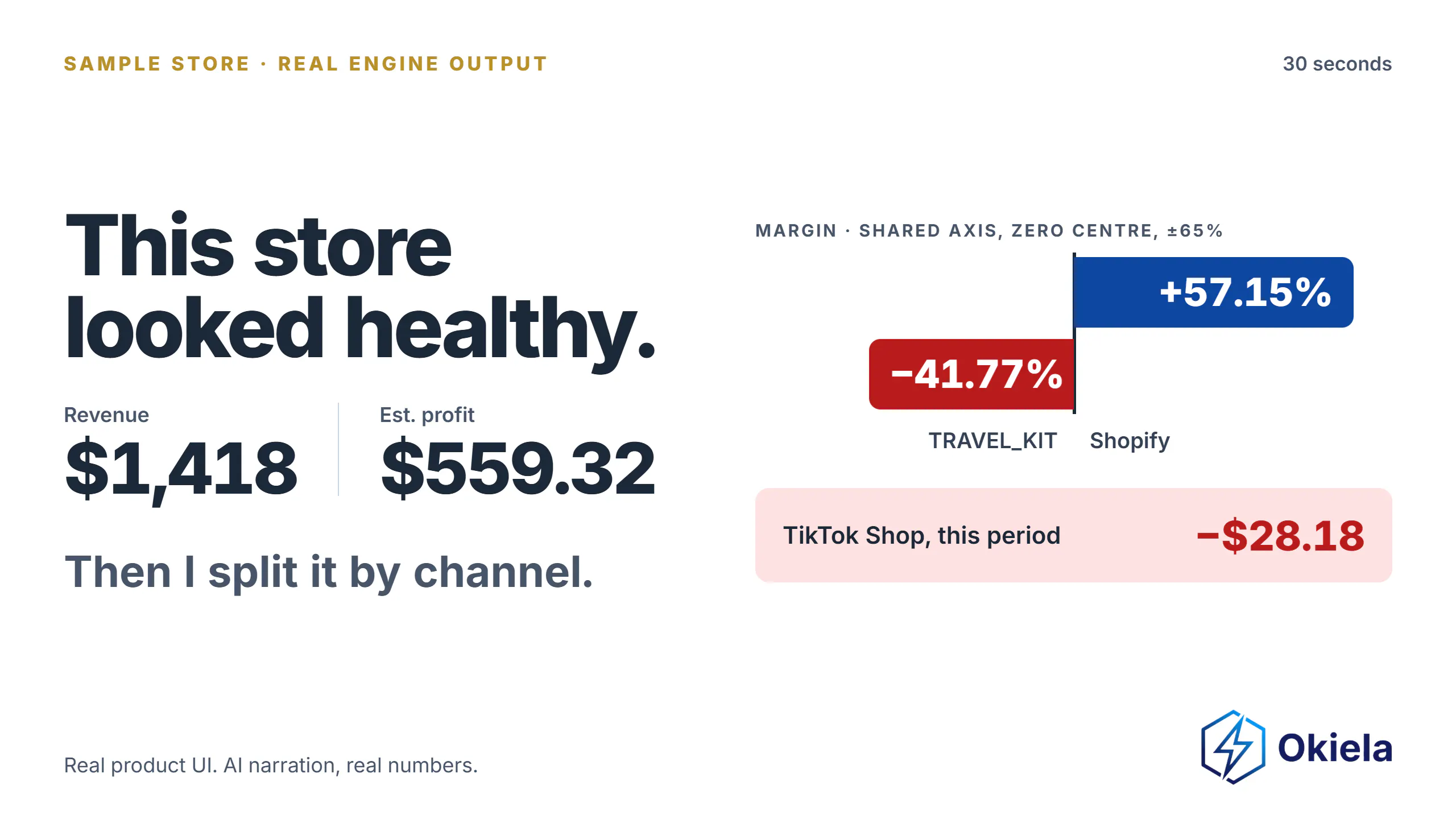
Sample store. Revenue $1,418. Estimated profit $559.32.
Looked fine.
Then the channel split. Shopify at +57.15%. TikTok Shop at minus $28.18 for the period. And one SKU, TRAVEL_KIT, sitting at minus 41.77% margin.
Revenue tells you the store is alive. It does not tell you which product is paying for the loss of another one, and that is where a lot of small stores lose a year without noticing.
30 seconds below. It is the real product UI, not a mockup. The narration is AI. The numbers are not, they come straight out of the engine.
Okiela is free right now because I have not earned the right to charge yet. No paying customers, no testimonial wall. I would rather write that than invent five faces.
Free Profit Leakage Audit: okiela.io/audit
#Okiela #Shopify #profit
I read my own profit dashboard and found a product losing 41.77%
 •
•2mo ago
Most sellers price a return as the refund...It isn't the refund. That's just the visible part.
Most sellers price a return as the refund.
It isn't the refund. That's just the visible part.
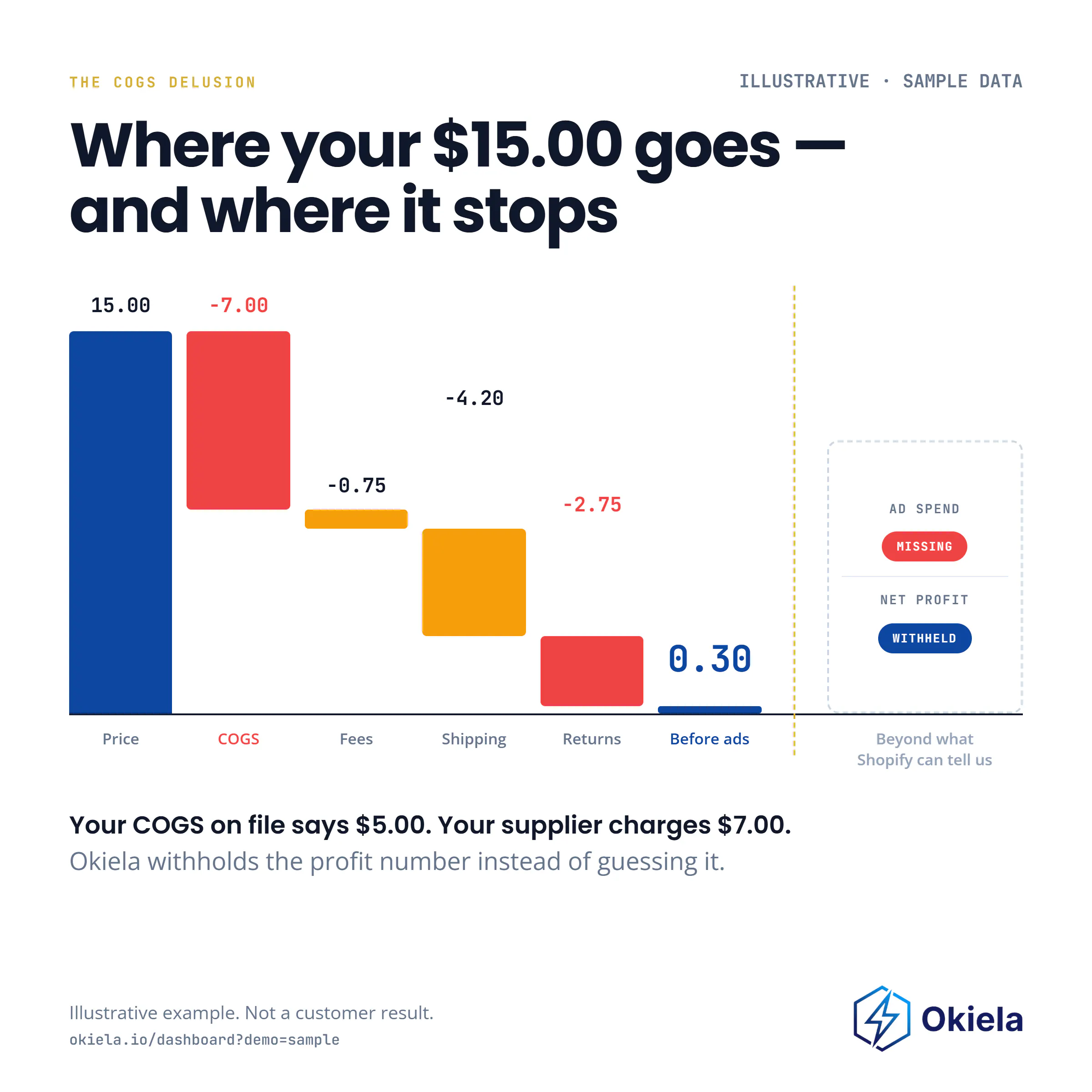
Run one through. You sold at a $6 profit and the customer sends it back. The profit reverses, obviously. But the shipping you paid to get it there is gone, and your processor generally keeps its fee whether the sale sticks or not. Call it $4.80 and $1.20 on this product.
Twelve dollars.
At $6 profit a sale, that's two more sales just to stand where you were standing before the first one. Not to grow. To break even on a single return.
Now the part I can't finish for you, and neither can Shopify. The return label isn't in there. Neither is the time someone spends opening the box, checking it, repacking it, putting it back on the shelf. Neither is the write-off if it comes back in a state you can't resell.
So two is a floor. I don't know your ceiling and I'd be making it up if I gave you one.
That's the whole design decision behind how Okiela reports this. Show the floor. Name what's still missing. Don't quietly average the unknowns into something that looks authoritative.
What to do with it: pull returns by product for one quarter, not store-wide. A store-level return rate is an average that hides whichever product is actually doing the damage. Then divide the known loss into that product's per-unit profit and see how many sales it's eating.
Figures above are illustrative.
okiela.io/audit
#Shopify #Ecommerce #ProfitMargin #Returns #DTC
 •
•2mo ago
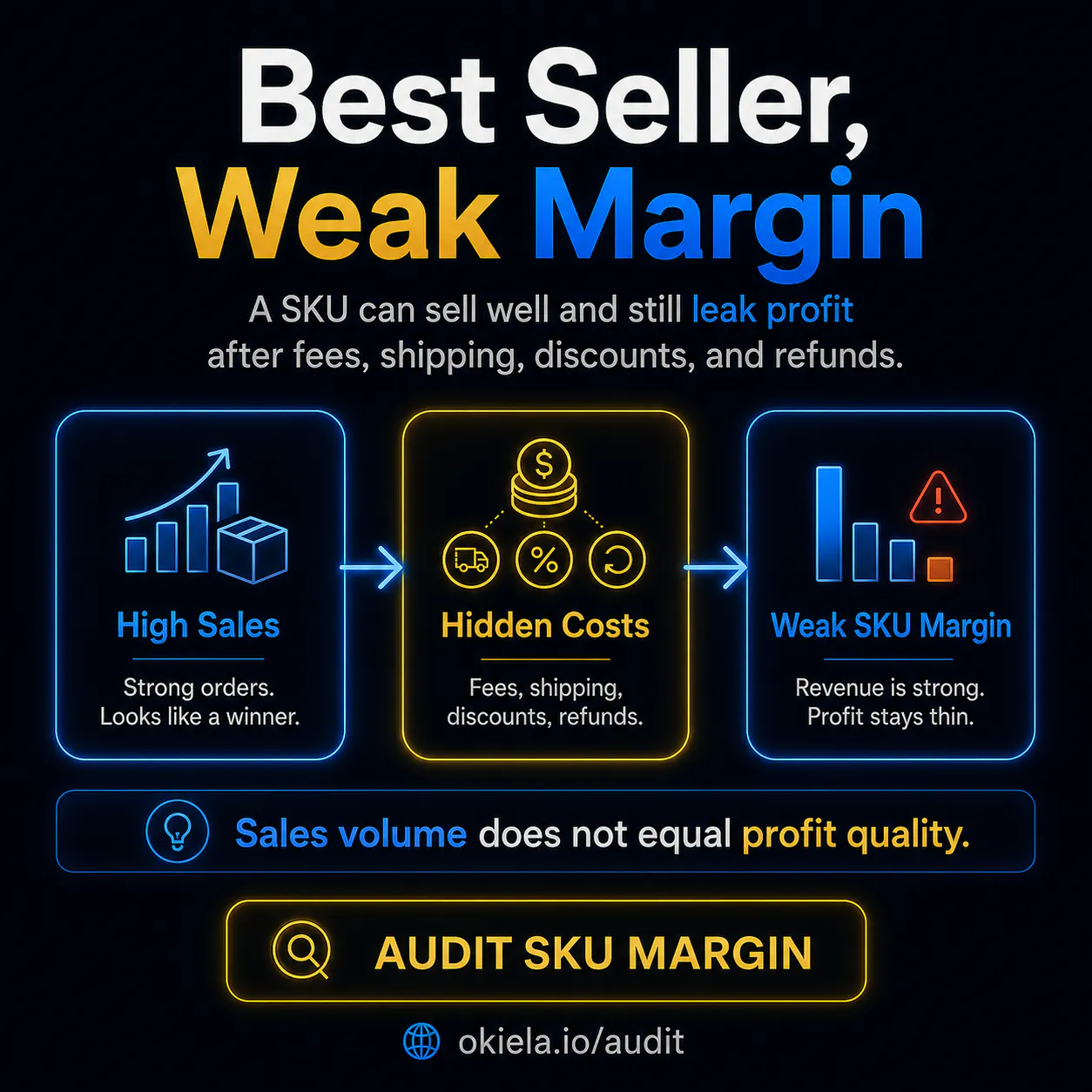
Your BEST-SELLING SKU is NOT always your BEST-PROFIT SKU
Your best-selling SKU is not always your best-profit SKU.
This is one of the easiest ecommerce traps to miss.
A product can sell well and still keep weak profit after:
* COGS
* platform fees
* payment fees
* shipping
* discounts
* refunds
* taxes
* ads
That means the winner on your sales report may not be the winner in your profit view.
The question is not only:
Which SKU sold the most?
The better question is:
Which SKU actually kept healthy profit after all cost layers?
This matters because many ecommerce decisions are made from SKU sales volume:
Scale ads.
Buy more inventory.
Push bigger discounts.
Feature the product more.
But if the SKU has weak true profit, scaling it may only scale the leak.
Okiela helps ecommerce sellers audit SKU-level margin and find hidden profit leaks.
Audit your SKU margin
#EcommerceProfit #ProfitLeakage #ShopifySeller
 •
•2mo ago
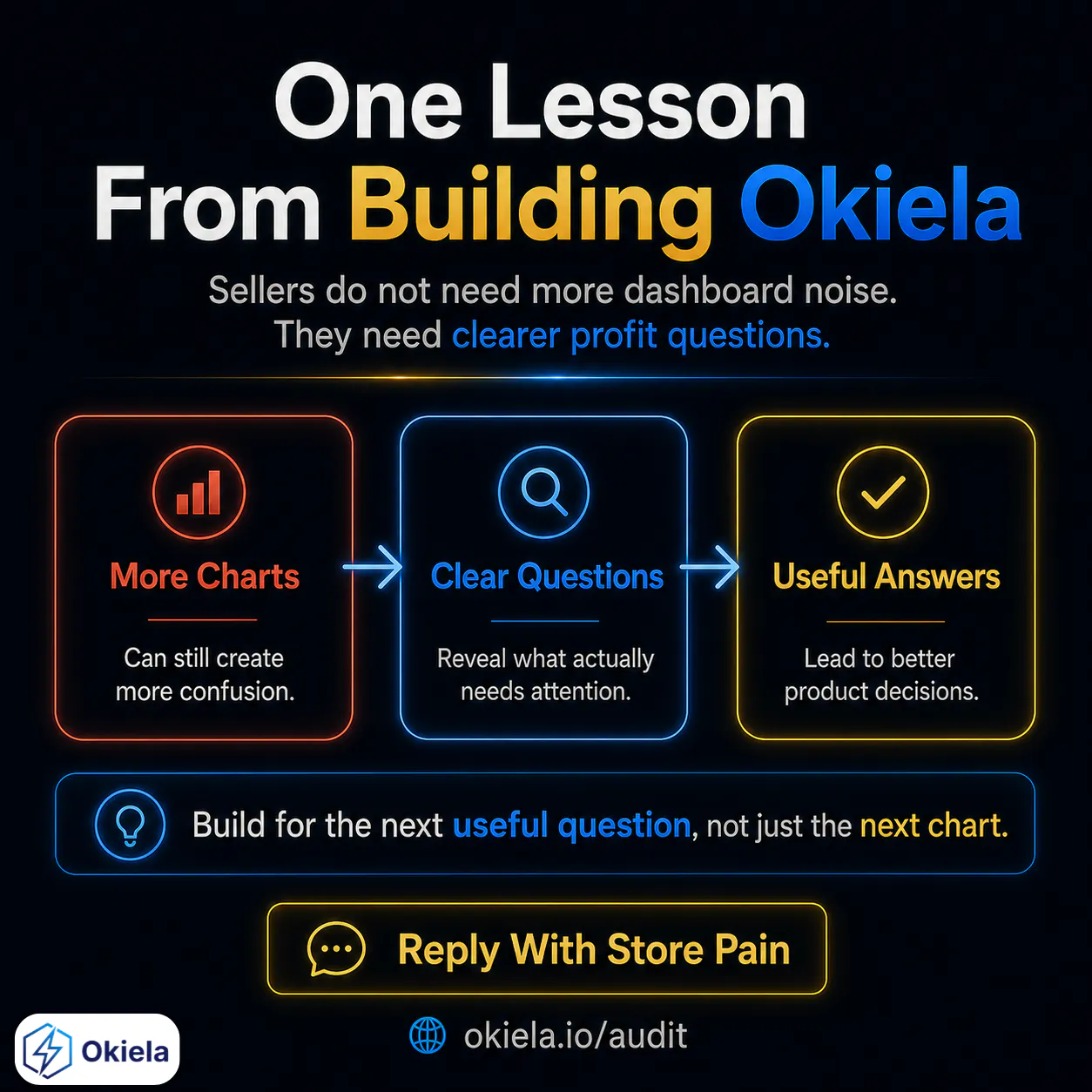
One product lesson from building Okiela
One product lesson from building Okiela:
Do not start with the dashboard.
Start with the decision.
It is easy to build charts that look useful.
Revenue by day.
Orders by channel.
Top-selling SKUs.
ROAS by campaign.
All helpful.
But for ecommerce founders, the real question is usually more uncomfortable:
Which product is quietly leaking profit?
Which channel brings revenue but keeps less margin?
Which cost layer is missing?
Can I trust this number enough to act on it?
That lesson changed how I think about Okiela.
The goal is not to build another analytics screen.
The goal is to help sellers make better profit decisions after COGS, fees, shipping, discounts, refunds, taxes, and ads.
Build the question first.
Then build the product around it.
If you run an ecommerce store, reply with the one profit question you wish your data answered more clearly.
#EcommerceProfit #ProfitLeakage #ShopifySeller #Okiela
 •
•2mo ago
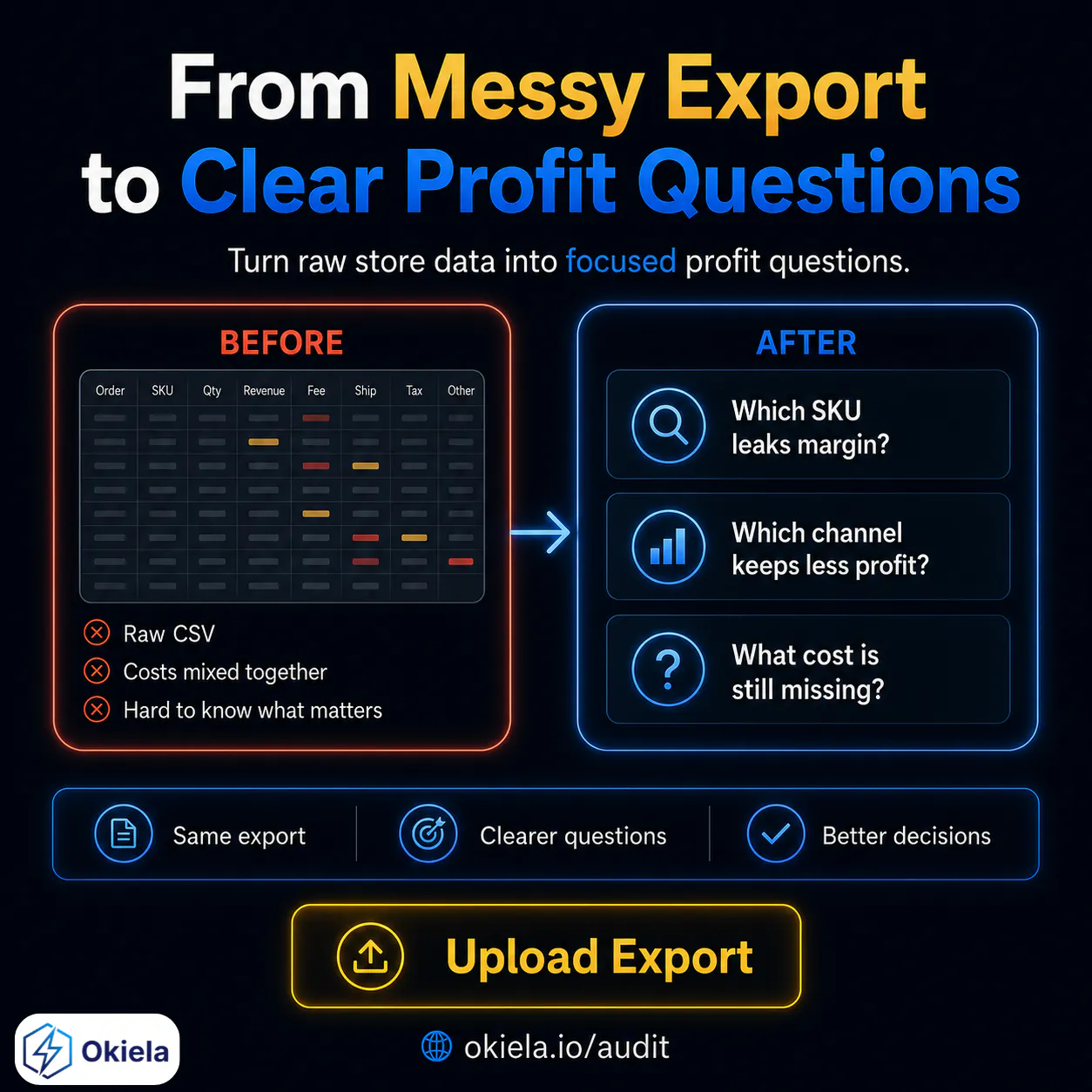
Before profit clarity, ecommerce data often looks like THIS...
Before profit clarity, ecommerce data often looks like this:
One order export.
Several fee lines.
Shipping columns that are hard to interpret.
Discounts mixed into revenue.
Refunds arriving later.
COGS sitting in another file.
Ad spend not connected clearly.
The result?
The founder keeps asking:
Are we actually profitable?
Which SKU is leaking margin?
Which channel keeps less profit?
Can I trust this number?
After a proper profit review, the goal is not to create fake precision.
The goal is to turn messy data into clearer profit questions:
* Which numbers are verified?
* Which numbers are estimated?
* Which cost layers are missing?
* Which SKU sells well but keeps weak margin?
* Which channel looks strong by revenue but weaker by profit?
* Which leak should we inspect first?
That is the workflow Okiela is built for.
Messy export mapped cost layers confidence labels clearer profit leaks.
Upload one export and start with your first profit question.
#EcommerceProfit #ProfitLeakage #ShopifySeller