

Most sellers price a return as the refund...It isn't the refund. That's just the visible part.
Most sellers price a return as the refund.
It isn't the refund. That's just the visible part.
Run one through. You sold at a $6 profit and the customer sends it back. The profit reverses, obviously. But the shipping you paid to get it there is gone, and your processor generally keeps its fee whether the sale sticks or not. Call it $4.80 and $1.20 on this product.
Twelve dollars.
At $6 profit a sale, that's two more sales just to stand where you were standing before the first one. Not to grow. To break even on a single return.
Now the part I can't finish for you, and neither can Shopify. The return label isn't in there. Neither is the time someone spends opening the box, checking it, repacking it, putting it back on the shelf. Neither is the write-off if it comes back in a state you can't resell.
So two is a floor. I don't know your ceiling and I'd be making it up if I gave you one.
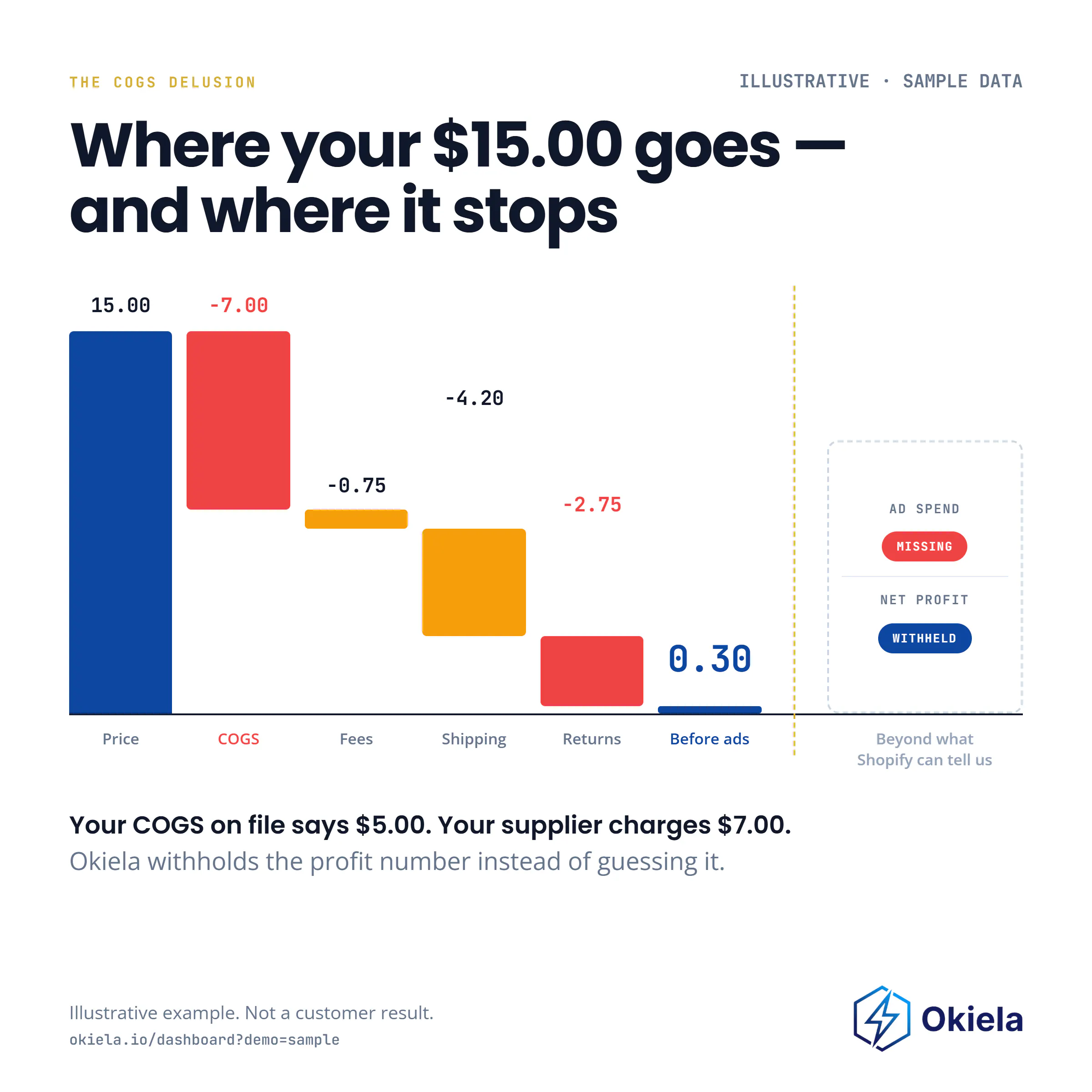
That's the whole design decision behind how Okiela reports this. Show the floor. Name what's still missing. Don't quietly average the unknowns into something that looks authoritative.
What to do with it: pull returns by product for one quarter, not store-wide. A store-level return rate is an average that hides whichever product is actually doing the damage. Then divide the known loss into that product's per-unit profit and see how many sales it's eating.
Figures above are illustrative.
okiela.io/audit
#Shopify #Ecommerce #ProfitMargin #Returns #DTC
Replies