Start a thread, join a discussion, stay in the loop.
p/general
by
Ghost Kitty
Our team was losing hours every week on repetitive tasks so automating the whole flow felt like an easy win.
The initial run was fast and clean, but edge cases quickly threw everything off.
We ended up spending just as much time auditing the automated results as we used to spend doing the work manually.
Shifting the bottleneck to quality checking wasn't the efficiency boost we planned for.
1
6
When I started I had a very clear picture of who I wanted to build for. I spent a lot of time thinking about that ideal user and what they would want. Then real customers started showing up and some of them were completely different from the people I had in mind. Their problems were different too and honestly they were the ones paying the bills. At what point do you stop trying to find the audience you imagined and start building for the one that actually showed up?
2
SHAMEEM AHMMED
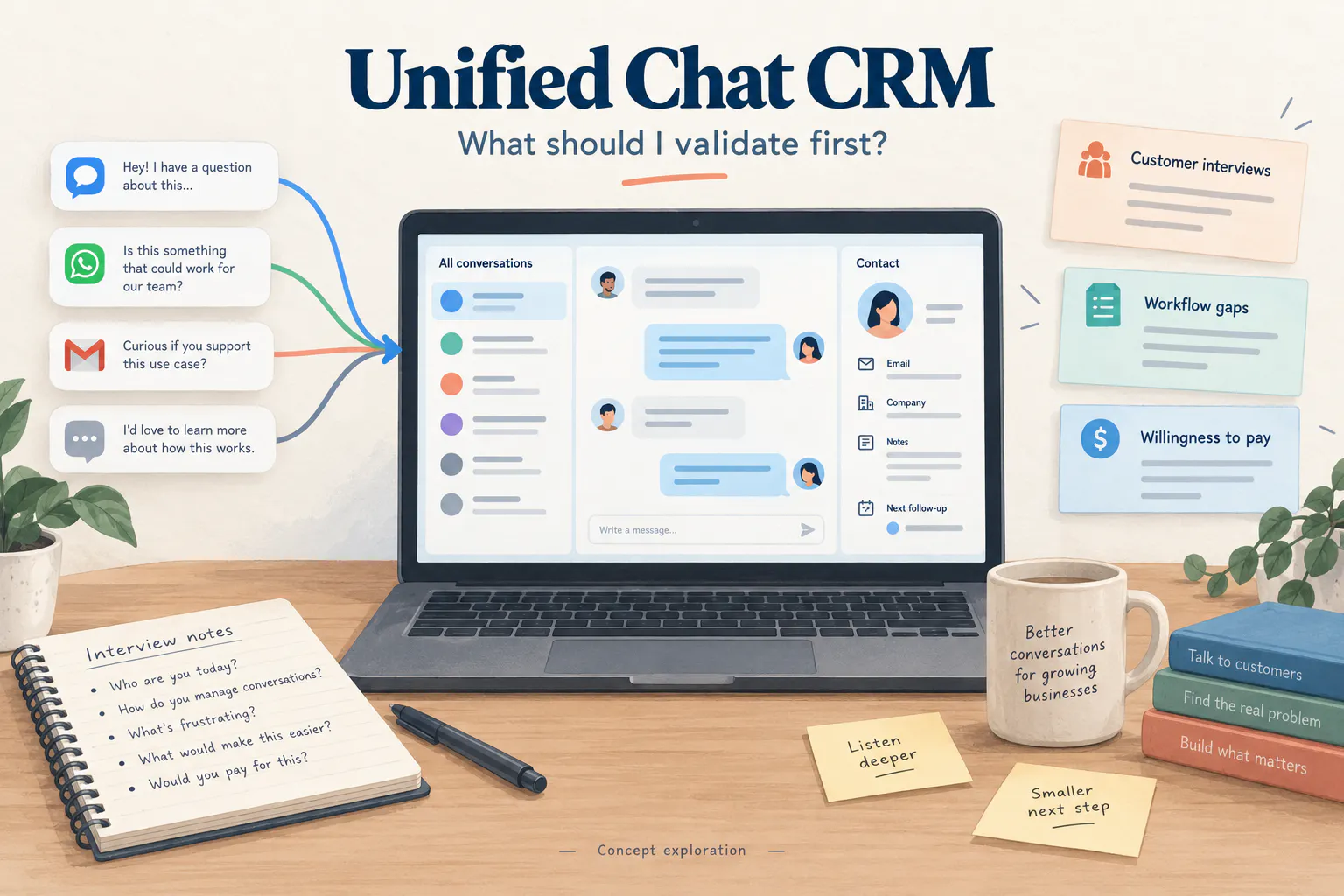
Concept illustration for the CRM idea I m researching.
I m a beginner SaaS builder currently working on a unified chat CRM. The idea is to bring customer conversations from different channels into one place and help businesses keep track of contacts and follow-ups.
Muhammad
Feature creep happens so fast when you're trying to make every early customer happy.
We made the exact same mistake and ended up with a cluttered product that confused new signups during onboarding.
When we finally decided to remove two unused features a tiny group of vocal users complained but our main activation rate shot up right after. Sending a polite heads up email with a simple alternative helped soften the blow.
Did you face any backlash when you started cleaning up your dashboard?
0
7
Anthony Wright
Been working as a solo dev for a while and the lack of feedback on code quality is definitely the hardest part.
You never really know if your architecture is solid or just holding together by luck.
Started writing down brief notes on why i pick certain tech choices just to double check my own thinking.
It helps a bit with clarity before pushing changes.
Hugo Le Follézou
Our dev cycle has turned into a endless loop of patching one bug only to watch another feature break right after.
It feels like we spend more time re-testing existing features than actually building new ones.
We re trying to set up a lighter workflow so every update doesn't trigger a full manual check of the entire app.
What basic QA routines or lightweight tools keep your builds stable without slowing down your weekly ship date?
5
Scrolling through today's launches, noticed a solo dev with under 500 followers sitting right next to a product backed by a known team with thousands of followers ready to vote within the first hour. Same leaderboard, very different starting lines.
Makes me wonder if Product Hunt's ranking genuinely rewards the product, or mostly rewards whoever can mobilize the most people fastest on launch day. A great solo product without a network behind it seems to need a lot more luck, timing, or a lucky external traffic source like YouTube or Reddit picking it up.
how others think about this. Should newer makers avoid launching against bigger funded teams if possible, or does timing not really matter since quality eventually finds its audience anyway?
Norma Wick
It's so easy to panic when a competitor launches a flashy update but half the time their own users don't even end up using it.
I usually ignore rival product moves unless our sales calls start repeatedly bringing up the exact same gap in our tool. Paying too much attention to others makes you build a reactive product instead of a distinct one.
Do you set up formal criteria for your team or is it more of a manual judgment call each time?
Claudia Lyons
Deciding what to build next gets confusing real fast when every user asks for something different.
Feedback is super helpful but if you listen to everyone your product turns into a messy kitchen sink.
I usually prioritize tasks that directly fix existing user drop offs rather than adding brand new features.
How do you balance fixing what's already broken versus building new ideas from your roadmap?
Ethan marshall
I spent almost a year preparing. Reading, planning, sketching, learning. I told myself I was building the foundation for what would come next.
The thing I was actually doing was avoiding the start. Every week of preparation was a week I did not have to fail at something real. And preparation looks exactly like work from the outside, so nobody questioned it, and I did not have to either.
Livia Bennett
Building something for days only to realize nobody wants it is the worst feeling.
I used to jump straight into coding every cool idea but now I try to test demand first with a quick landing page or simple mockup.
Talking to users directly helps but people often say they want a feature and then never actually use it.
Do you look for active complaints from current users or do you pre-sell ideas before starting development?
Alice Hayes
I cancelled something last week and I could not explain to the founder why. Not because the reason was complicated. Because it was embarrassing. The product worked fine. I just stopped opening it.
That is the most common kind of churn and almost none of it gets reported honestly. People say price or features or a competitor. The real answer is usually that a habit never formed. The product was fine and it was not quite the shape of my day.
Ian Powell
There is a feature in my product that exactly one customer uses. It costs me infrastructure, maintenance, and a little attention every month. The numbers say I should have killed it two years ago.
I keep it because I remember the conversation when they asked for it. They were at a company with a real problem, and I was small enough to actually solve it for them. It was one of the first times I felt like I was building something that mattered to a specific human being.
Cole Simmons
I have started asking one thing before I give anyone advice about their product. Do you want me to help you think, or do you want me to tell you what I would do?
They are completely different conversations and most of the time people want one and receive the other.
Ellie Russell
I set a rule for myself last month. No new features. No new projects. No starting anything.
Just finish what was already open. Close the loops I had been leaving open for months. Answer the emails I had been avoiding. Fix the small things that had become background noise.
Adrian Stone
Someone asked me for help with a problem last month. I gave them a solution. A good one. Thoughtful, detailed, exactly what they had described.
They did not use it. I could tell because the problem was still there weeks later.
Casper Voigt
A person bought my product a year and a half ago, paid once, never upgraded, never asked for anything.
Then they emailed me out of nowhere with a detailed explanation of a problem they had solved with it. Something I had never thought it could do. They had built a whole process around it and wanted to tell me.
Niamh Byrne
I built two things the same year. One got thousands of visitors in a week. The other got a slow trickle that never really stopped.
I spent all my time on the first one because that is where the attention was. Fed it, fixed it, promoted it. It peaked and faded and now it is a folder I do not open.
Ruby Longfelow
This partner model was actually tried by a few earlier startups but it ran into massive operational friction.
Beyond inventory mismatches speed is the biggest bottleneck a kirana owner has to manage walk in customers cash payments and chit-chat while dark store staff exist solely to pack orders in under 90 seconds. Plus, quick-commerce platforms make better margins when they buy bulk inventory directly from brands instead of splitting profits with a middleman shop.
Have you seen any local apps successfully blend both models in Delhi?
4
Nguyễn Thành Dân
I ve been a packaging designer in Vietnam for years, and the print-shop handoff is still the part I dread most.
My top 3:
Colors shift because the file wasn t really CMYK
Foil / UV layers get mixed into the color file
The box looks fine flat, but the artwork lands on the wrong panel once it s folded
What s yours? And how do you check before sending: physical sample, 3D mockup, or just hope?
3
p/vibecoding
Mazedur Rahaman
I fix WordPress and WooCommerce problems for a living, and AI has changed some of my routine. It's very good at reading an error log and explaining a stack trace in plain words. I still don't trust it to edit a live checkout or a plugin I don't know well.
The places it has sent me the wrong way are usually plugin-heavy sites, where it suggests a clean fix that ignores another plugin hooking into the same function.
Yusuf Umar
I love how fast AI helps us ship features but I ve noticed a risky habit creeping into daily workflows. Because it takes two seconds to generate a fix for any error there s almost zero reason to step back and analyze structural design choices.
It feels like we're spending all our energy making code work in the short term, rather than learning how to architect scalable long-term software.
blogs fussion
I run a small blog where I write wishes, messages and quotes for birthdays, anniversaries and festivals. Over the last few months I've learned that traffic doesn't come from writing more posts. It comes from writing the right ones.
Three things that worked for me:
Answering one exact search per post. "Birthday wishes for a sister" ranks much better than a general "birthday wishes" page.
Pinterest over other social platforms. For quote and wishes content, pins keep bringing visitors for months.
Updating old posts instead of always publishing new ones. Refreshing 10 older posts did more than writing 10 new ones.
I'm curious what's working for other makers and bloggers here. Is there a tool (SEO, writing, design or analytics) that made a real difference for you, especially a free one?
Adekemi A.
Feature creep happens so fast when you're trying to make every early customer happy. We made the exact same mistake and ended up with a cluttered product that confused new signups during onboarding.
When we finally decided to remove two unused features, a tiny group of vocal users complained, but our main activation rate shot up right after.
Sending a polite heads-up email with a simple alternative helped soften the blow.
Jacob Pegs