
 •
•1d ago
Title: I built an AI shopping assistant that can tell you not to buy
Every shopping tool on the internet is designed to end up in a purchase. Search it sells Comparison sites take you to checkout Reviews it
But, before any of that, most of us are asking a different question:
So do I buy this, really?
TickClip answers that question. It says price history, marketplace signals, seller context, timing, and how much uncertainty is left in the data -- and then issues a verdict, not a hedging bet:
Tick Buy now, data backs it Clip Wait or rethink, price/timing is wrong Skip Don t buy this
What gave the verdict its meaning was what we gave up. TickClip today earns no affiliate commission, and no seller can purchase a better score or a friendlier verdict. If the evidence does not support buying, then the answer is just "don't."
We re now live on Amazon products and building toward an independent decision layer across e-commerce and soon inside AI assistants via MCP.
Three things I would really like from this community:
Would you use a tool whose best answer is sometimes no ?
What would make you trust a verdict -- price history, sourced reasoning, a confidence score, other?
Which platform do you want us to cover next? eBay, Walmart, AliExpress, Shopify stores? https://www.tickclip.ai
I m the founder and I ll be in the comments all day. Happy to get into methodology, data sources or the obvious one - how a no commission model is supposed to pay for itself.
 •
•1yr ago
Build an audience first, or launch and grow later?
 •
•5mo ago
We Built a Bot Detection Engine Because Our Own Marketing Data Was Bad
So here's what happened. We were running campaigns, watching our click metrics climb, feeling pretty good about performance. Then we started digging into where those clicks actually came from.
Half of them were bots.
Not simple ones either. Headless browsers mimicking human behavior perfectly. Selenium scripts automating clicks at scale. Click farms using mobile devices. Advanced stuff rotating IPs, spoofing geolocation, faking mouse movements, generating realistic referrer patterns. Fingerprinting evasion. Timing tricks. Some were so good they looked completely human.
We realized most link tools just count clicks. They don't ask if those clicks are real.
 •
•16h ago
Miniclay – describe a text model in plain English, get a deployed one
You give it a sentence describing a text task sort these support tickets, tag this feedback, work out what the customer is asking for and it finds or builds the training data, fine-tunes, and hosts the endpoint. pay per job, no subscription.
The data step is the only part I'd claim is interesting, mostly because it's where everything went wrong. Nearly every fine-tuning tool assumes you show up with a dataset. The people who most want a custom model don't have one and have no realistic route to getting one, so that assumption quietly excludes them. So it searches dataset repos and open-data sources against an inferred task spec, ranks on label fit rather than keyword match, checks licenses before anything enters the pipeline, and generates labelled data when nothing suitable turns up. That last one is gated hard, because ungated synthetic data is worse than no data and it took a while to accept that.
An early user broke it comprehensively and the fix is most of what this version is. Nothing reaches training without passing a blocking check. If a failure was detectable before we charged you, it isn't allowed to happen after. Every error comes back with a cause and something you can click. Sounds trivial written down. Was most of the work.
What it doesn't do: anything other than text, pick between architectures for you, or improve the model after deployment. All on the list. I'd rather say it than let the landing page imply otherwise.
 •
•16h ago
We built CoverScale to turn hours of music release work into minutes 🎵
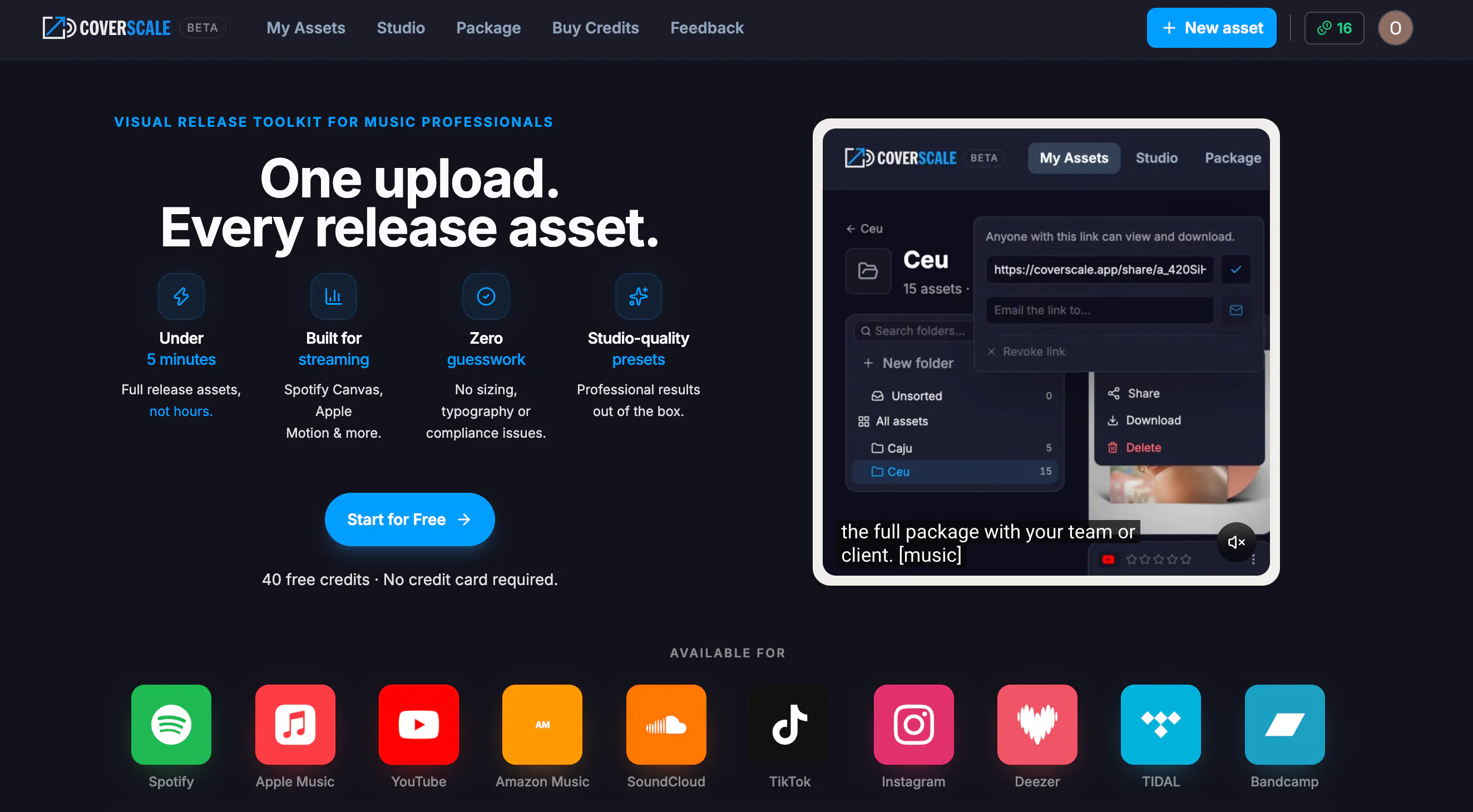
Every music release needs more and more visual assets: Spotify Canvas, Apple Motion, YouTube visualizers, Reels, banners, profiles, mockups...
We got tired of creating the same formats over and over, so we built CoverScale.
 •
•2mo ago
My Website-Writing Agent
Hello! I m building an AI writing platform designed specifically for giving writing feedback, unlike a general AI chatbot. It provides detailed feedback, tracks your progress overtime, remembers past assignments, and explains why changes should be made so you can become a better writer.
If you're willing to spend a few minutes trying it out, I'd really appreciate it. If you find it useful, feel free to create an account and let me know what you liked, what confused you, and what features you'd want to see next.
Here's the link: https://writing-agent.app
Would you use this website? Do you prefer this over Chatgpt or Claude? Let me know!
 •
•7mo ago
Feedback wanted: AI that handles the "what's for dinner?" mental load
Hey Product Hunt community!
I'm building something to solve a problem my family faces every single day, and I'd love your feedback.
The problem:
Every household has someone carrying the invisible mental load of meals. It's not the cooking that's exhausting it's the deciding. 21 meals a week. Remembering who eats what. Knowing what's in the fridge. Figuring out quick meals for busy nights.
 •
•2mo ago
Embracing the Power of Product Hunt: Make ReachRobin Greater!
We built a sales assistant tool called ReachRobin, and here is our latest update: You can run it directly from Claude. We think it's pretty good but we've been staring at it too long.
So we're doing something bold: we're handing over full access and asking you to roast it. UI/UX, pricing, positioning, features, whatever: the harsher (and more useful) your feedback is, the better. But not the name, we're stuck with it for now lol.
 •
•3d ago
Built a lightweight JSON-LD Schema Generator micro-tool using AI & JS—would love your feedback!
Hey Product Hunt community!
As someone who works extensively with technical SEO and web development, implementing correct structured data is one of the most effective ways to help search engines understand entity relationships and grant rich snippets.
 •
•19h ago
I’m building an app to help men understand their partner’s hormonal phases
Hi everyone !
After years with my partner I was still sometimes confused by what I used to label as her "mood swings" until I realised it wasn't mood swings at all. It was hormonal phases genuinely affecting her energy, emotions and needs. Once I started studying this, everything changed. I learned to approach her with the right energy at the right moment when she needed space, when she needed support, when she was at her most communicative or her most withdrawn.
So I started building Cycle Sense.