
 •
•1mo ago
Launching Monday (July 27) — would love tagline feedback
Launching Monday 7/27 NTS, a workspace for solo operators (tasks, clients, invoices) with one unusual mechanic: finished work builds visible momentum. Current tagline: "The solo-operator workspace that turns work into momentum." Two alternates I keep circling: "Tasks, clients & invoices that build momentum as you work" / "Turn your real work into momentum." Does the first one earn its 57 characters, or is there a sharper cut? Happy to return the favor on yours.
It's live if you want to poke around
 •
•2d ago
Hi Product Hunt!
Today I'm launching JAMP! An agentic analytics tool, that is extremely lightweight, cookie-free, and has a generous free tier!
We do Analytics, Error Tracking, Uptime, Performance, and more. Basically an all-in-one monitoring suite for your website, so you can tell exactly what users are doing on your website, where they've come from, and where they are dropping off.
Our biggest differentiator? JAMP is built for Agentic web development. You can connect to our MCP server and pipe all your site's data directly to your AI agent.
Here s how it works: An API fails to one of your users. JAMP collects the error in real-time and alerts you via Email/Discord/Slack. You then ask your AI agent to retrieve the stack trace and the exact sequence of user actions leading up to the crash, allowing the agent to deliver a precise, immediate fix.
Giving you faster debugging, faster development times, and insights for you to make business decisions
We're giving out free Pro for life if you can give us feedback!
If you have any questions, feel free to comment below
Cheers
 •
•9h ago
How Tukey beats Marques Brownlee's content team
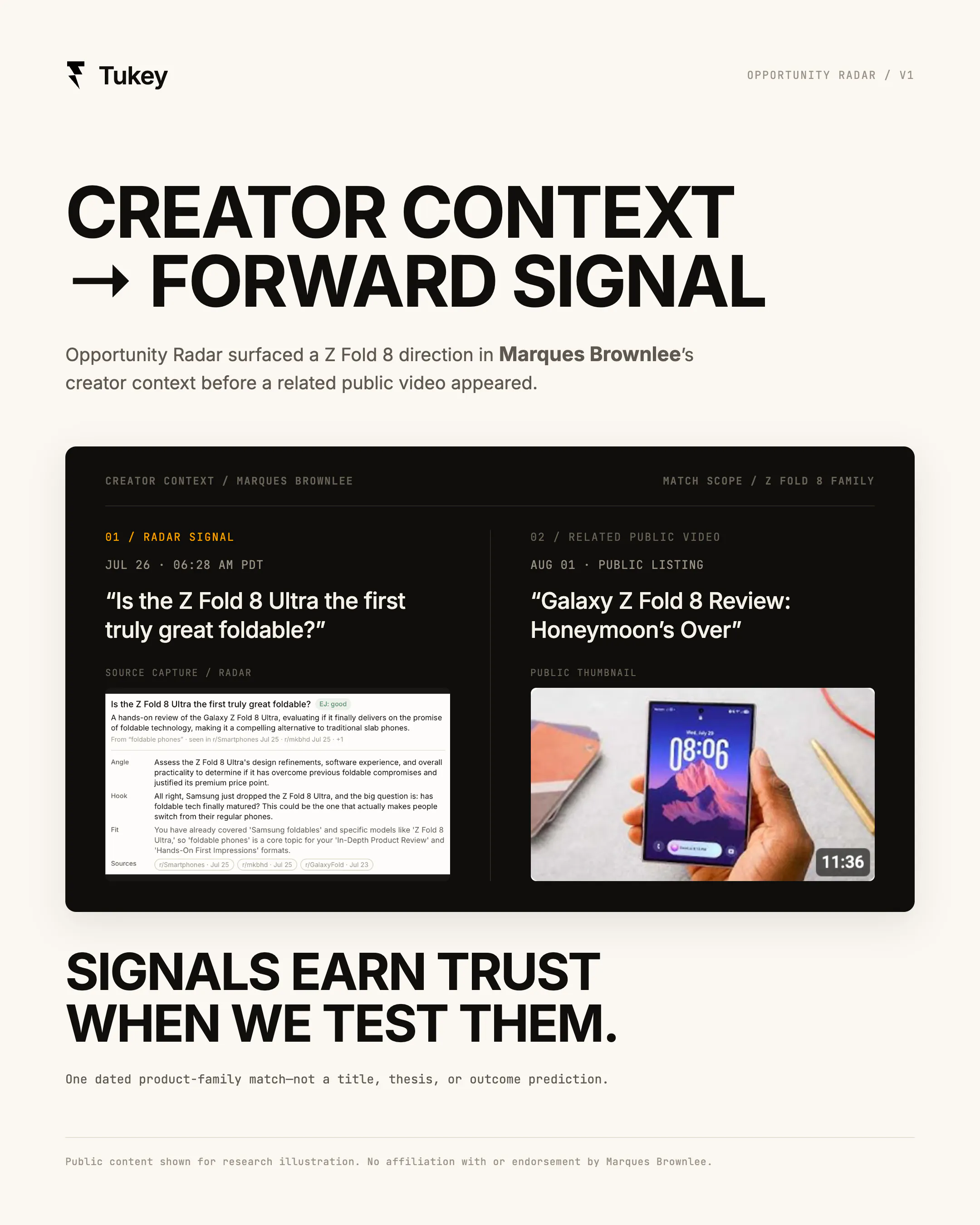
At one very specific task: identifying a creator-fit opportunity before the resulting content becomes public.
A few days ago, Tukey s Opportunity Radar surfaced this opportunity for Marques Brownlee:
 •
•12d ago
What made you build your product? Drop the real story below.
I'll go first.
Six months ago I was running growth for a small team. Seven tools open at once. I'd draft something in Notion, paste it into the CRM, copy the numbers from Analytics into a Sheets report nobody read, then schedule the post in a different tab. Every week the same loop. Nothing talked to each other, so I was the integration layer.
 •
•10h ago
LaunchPilot – Your AI marketing co-founder that works while you sleep
Honestly built this out of frustration.
I kept telling myself I'd do outreach "after this sprint." Three months post-launch, I had a solid product and roughly zero users. The marketing stuff wasn't hard I just kept skipping it because shipping felt more real.
LaunchPilot runs overnight. It finds relevant leads, drafts outreach emails, writes content, and drops posts into communities while I'm asleep. Morning comes and there's a queue waiting I approve what looks good, skip what doesn't, and the rest goes out.
 •
•1mo ago
The Cash Flow Risk Simulator (CFRS)
I've made this tool called the Cash Flow risk simulator, from the very obvious name you can tell what it does, it basically takes simple financial records whether tangible or intangible, and quantifies the probability of failure. As a business owner the thought of your business failing is always something that looms overhead of founders alike. With my tool you can better understand the risk of failure, how much runway you have, and how to optimize for the lowest chance of failure. The product is still in beta and feedback on my software would be much appreciated. The link for the product will be in my profile if anybody would like to test the early stages of a much bigger vision.
 •
•13h ago
Orthodox Theology ChatGPT Plugin
Rigorous Orthodox theology, Scripture, and source verification in ChatGPT
Short description:
A specialized ChatGPT plugin for Orthodox theology, Scripture, patristics, Councils, Liturgy, Church history, and primary-source research built to distinguish evidence, authority, reception, interpretation, and verified quotation.
 •
•13h ago
I built PanchangTime — A modern web app for one of the world's oldest timekeeping systems
Hey PH!
Quick question: what's the oldest "daily-updating information system" still in continuous use?
My answer: the Panchang the Hindu calendar system that hundreds of millions of people still check every morning, and have for thousands of years. It's a genuinely impressive piece of ancient astronomy: it tracks the lunar day, the moon's position against star constellations, sun-moon angular relationships, and more all computed fresh for each location, because the same calendar day can literally differ between Mumbai and New Jersey depending on local sunrise.
The problem: most panchang websites feel stuck in 2005. Slow, cluttered, ad-heavy, and impenetrable if you didn't grow up reading one.
 •
•4d ago
Built SEO agents for Claude and Cursor to fix my own mess. What am I missing?
Hey Product Hunt
Maker of SEO Skills AI here. Quick backstory: I didn't plan this as a product. I built it because my own SEO workflow was a disaster.
I run a few niche sites, and my setup was painful. Expensive keyword tools, a separate audit tool, spreadsheets everywhere, hours of copy-pasting between tabs. Meanwhile Claude Code and Cursor were open on my screen all day anyway. One night it clicked: why am I paying for five tools when the AI in my terminal could do most of this?
So I wrote my first SEO skill for Claude Code. It found low-competition keywords in under a minute. Then I made one for content optimization. Then audits. Then meta tags. A few weeks later my whole SEO workflow ran inside my coding assistant, and I cancelled the subscriptions.
 •
•14h ago
Unpopular opinion: your first 10 users matter more than your first 100
Everyone chases signup numbers early on. i think that's backwards.
10 people who actually use your product and complain about it teach you more than 100 who signed up and forgot you exist.
I've got 8 paying users right now for Banalo.Business. haven't even scaled outreach yet, just been obsessing over what those 8 actually do inside the product.
Curious what others think, early on do you optimize for more users, or deeper usage from fewer?