

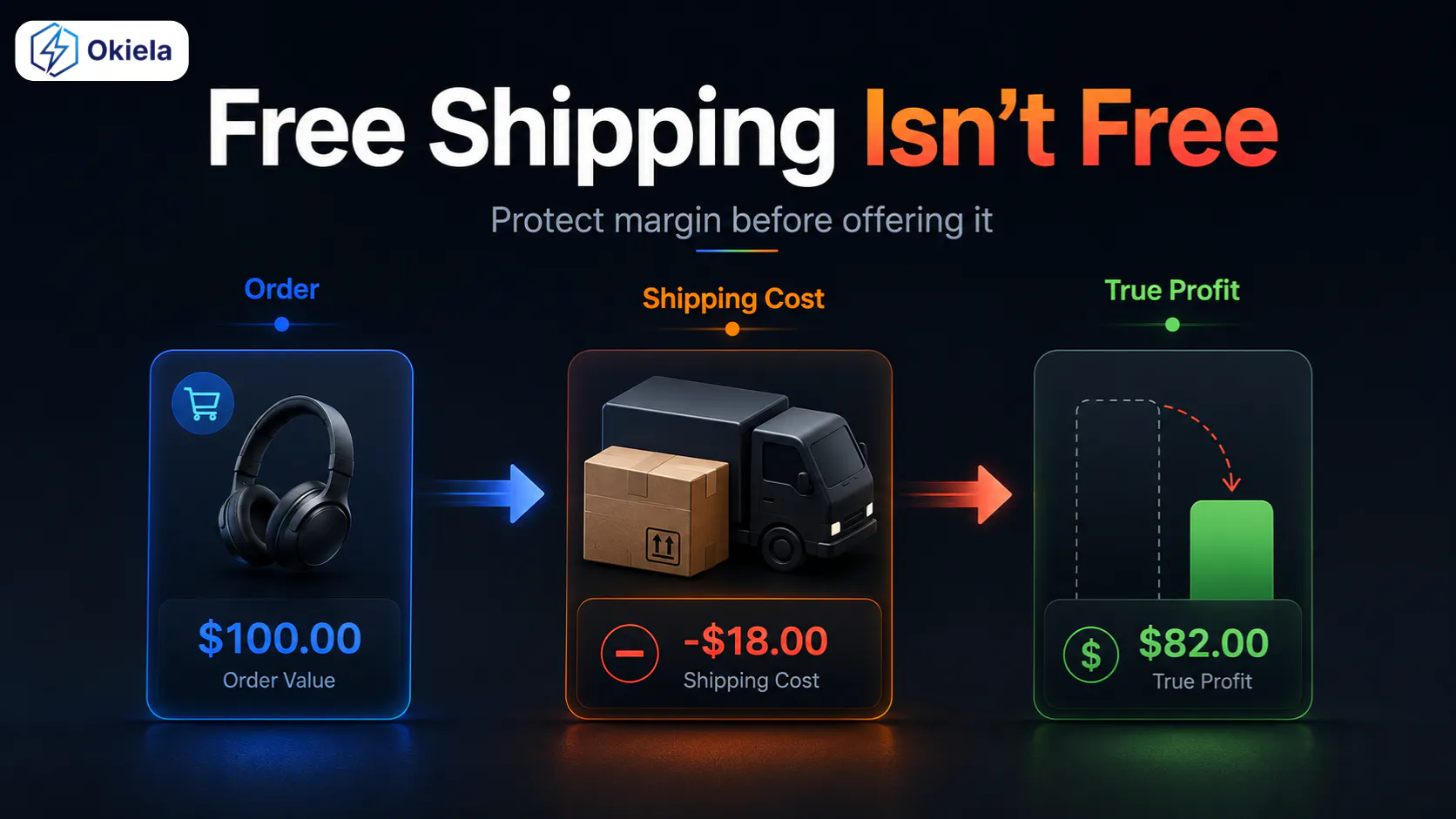
Shipping cost is one of the easiest places for ecommerce profit to disappear quietly...
Shipping cost is one of the easiest places for ecommerce profit to disappear quietly.
Not because founders ignore it.
Most founders know shipping is expensive.
The problem is that shipping often gets treated like an operations detail, not a profit decision.
But it affects almost everything:
conversion,
AOV,
gross margin,
cashflow,
returns,
customer expectations,
and whether free shipping actually makes sense.
A free shipping offer can increase conversion.
But it can also quietly turn a good order into a weak one.
A flat shipping rate can feel simple.
But it may hide losses on heavier or lower-margin products.
A free shipping threshold can lift AOV.
But only if the extra items actually cover the shipping cost.
That is why I think shipping should not be optimized in isolation.
It should be connected to SKU margin, order value, product weight, return risk, and customer behavior.
Before changing shipping strategy, I’d ask:
Which products are shipping-heavy?
Which SKUs lose margin after shipping?
Does free shipping improve profit or only revenue?
Is the free shipping threshold set above the real break-even point?
Are we subsidizing unprofitable orders?
Can packaging reduce dimensional weight?
Can we separate shipping rules by product, region, or order value?
The goal is not always the cheapest shipping.
The goal is shipping that protects conversion without quietly destroying profit.
That is the layer I want Okiela to make clearer:
not just “shipping cost is high,”
but:
which orders are affected,
which SKUs are leaking margin,
what threshold makes sense,
and what action should be checked first.
Because shipping is not just a logistics problem.
It is a margin problem.
#ecommerce #shopify #profitability #shipping #dtc #unitEconomics #Okiela
Replies
@amol_khose Exactly.
I’d look at both:
SKU level: which products lose margin after shipping?
AOV level: what order value makes free shipping still profitable?
A free shipping threshold only works if the extra cart value actually covers the shipping cost. Otherwise it increases revenue but weakens contribution.