Why am I talking about it? Because Twitter is our Top-2 traffic source for www.makerbox.club, requiring a $0 budget. Consistency and personal brand pay off. Here're the learnings: 1. Niche down
2. Treat your Twitter profile like a product
3. Create a content matrix
4. Mix professional and personal
5. Don't spam with your product
6. Focus on your experience, not on the theory
7. Don't be a copycat
8. Connect with people
9. Be kind
10. Experiment a lot What would you add?
Whenever I browse product launches, I somehow subconsciously judge not only the product itself and its quality, but also the quality that is reflected in the effort the makers put into preparing it.
It may sound insignificant, but in my case, these things also make a significant difference:
Icon GIF at the launch it enlivens the overall impression and is dynamic
Quality graphics and video
First, a properly filled-out comment
Photos in the makers' profiles (it's less trustworthy for me when there's only the letter "J" or something similar)
Whether any of my contacts or acquaintances on the platform reacted to the launch
People always say they want simple products. Bloat is a big reason people dislike products and migrate away from existing tools. But I don't think that bloat comes from having too many features. Instead, it's mostly a UI/IA problem.
This is something we think about a lot at @Basedash. Analytics and BI can get complicated quickly: permissions, SQL, charts, dashboards, filters, joins, data sources, teams, sharing, alerts, and so on. We can t remove all of that complexity, because real teams eventually need it. Instead, we're trying to figure out how/when to reveal that complexity. Filters only appear if you ask the AI. Access controls can get super fine-grained, but only if you start inviting more teammates.
Video has always been one of our biggest customer acquisition channels at my company. But for 2 years, our video making process was a mess. Not the recording - the everything else. Finding editors who understood our specific AI context was hard, so we ended up doing it ourselves. It was draining. It was inconsistent. It was a bottleneck.
Over the last 10 days, I built an autonomous AI video agent (powered by Hermes - or OpenClaw - both work) to kill the drudgery for good.
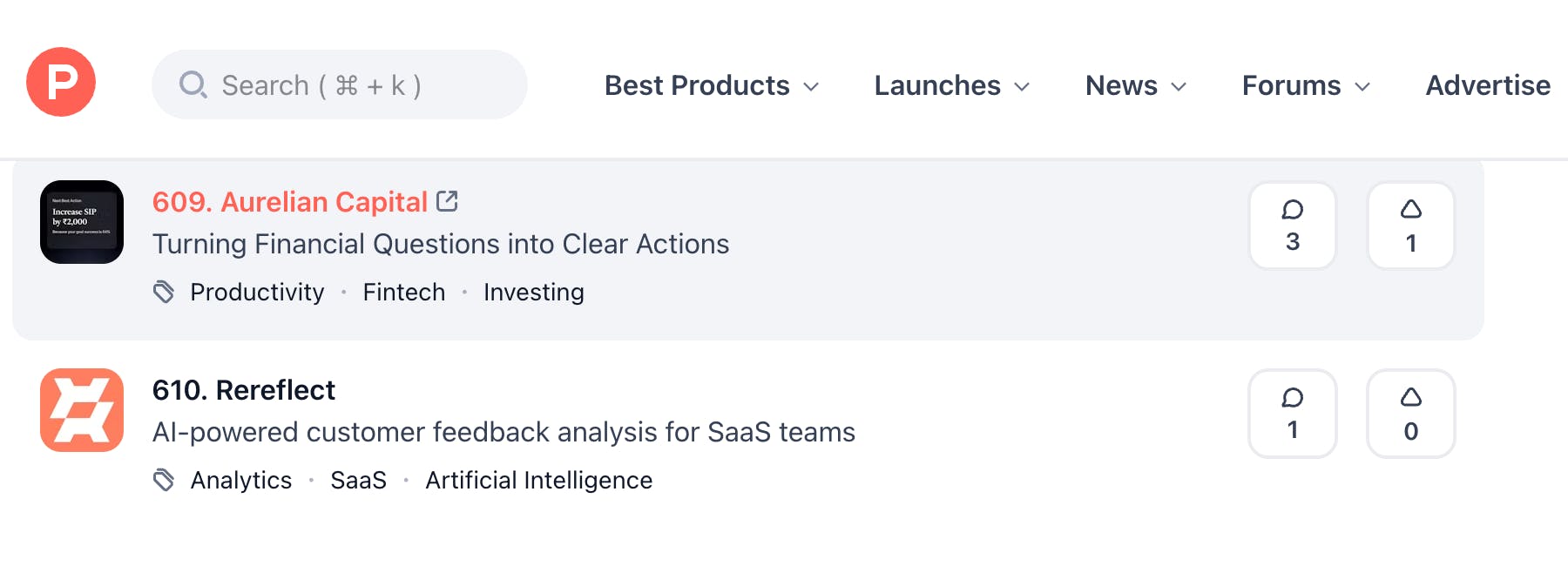
As a measure of the impact of vibe coding and the need to focus on positioning, narrative, and marketing and distribution, I noticed that that 610 products were submitted to the Product Hunt leaderboard today, but only 16 were featured which is less than 3%.
The previous high was just over 500 products in December.
Hi, makers! I'd love to hear about your experience with the audience-led approach and what are the best practices that you've discovered? Did you build an audience before launching your product/s? Which platform/s have you focused on to build an audience? And what kind of content have you created? Thanks!
Teachable is an online platform that enables creators to earn a living from their knowledge. We helped 50,000+ creators teach over 50 million students and earn over $1B+ in the process. After Teachable was acquired in 2020 by Hotmart Technology, I started Vibe Capital -- a venture fund to invest in early-stage technology companies worldwide. Here to answer any questions regarding starting a company, fundraising, starting a fund, and/or everything about founder mindset! AMA