

LabEx Challenges: LeetCode for Linux
We recently launched a new Challenges page for LabEx:
The goal is to make Linux practice more structured, measurable, and closer to real-world problem solving.
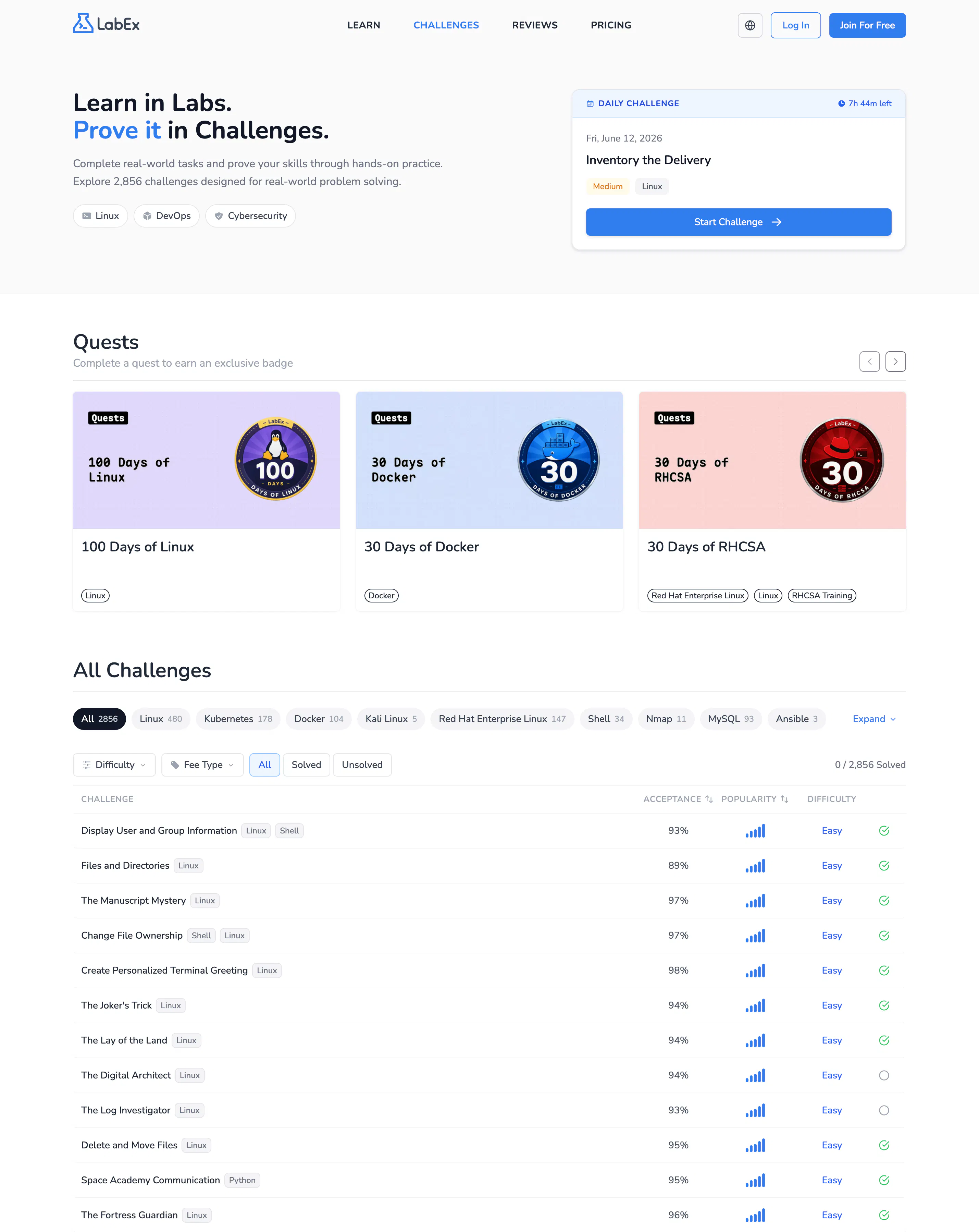
For many learners, Linux education usually starts with tutorials, documentation, or guided labs. These are useful for building familiarity, but they do not always answer a more practical question: can the learner solve a problem independently in a real terminal?
That is the gap LabEx Challenges is designed to address.
Each challenge runs in a real hands-on environment. Users are given a task, a system state, and a set of checks. They need to inspect files, run commands, debug issues, configure services, or fix broken systems. Instead of choosing an answer, they have to make the environment pass verification.
In that sense, the experience is closer to coding challenge platforms, but focused on Linux and infrastructure skills. Think of it as LeetCode for Linux.
The new Challenges page brings these exercises together in one place, including collections for Linux, Docker, Kubernetes, DevOps, Cybersecurity, and more. Some challenges focus on basic command-line usage, while others simulate operational tasks that are closer to what users may face in production environments.
Our broader idea is simple: guided labs are good for learning new concepts, while challenges are better for testing whether those concepts can be applied without step-by-step instructions.
Learn in Labs. Prove it in Challenges.
Replies
I like this framing: tutorials help you recognize the concepts, but challenges show whether you can actually use them when the steps are no longer written out.
The “real terminal + verification” part feels especially important. A lot of Linux learning breaks down when the learner has to inspect the current state, decide what matters, and debug from imperfect information. That’s much closer to real work than multiple-choice quizzes.
I’m curious how you balance difficulty across challenges. Do you guide users with hints when they get stuck, or is the goal to keep it closer to a production-style problem where they need to investigate independently?
The concept sounds good, but I wonder how realistic the challenges actually are. Many platforms claim to simulate production environments, yet the problems often feel artificial. What makes these exercises different from ordinary guided labs with the instructions removed?