Start a thread, join a discussion, stay in the loop.
p/mcp-builder-ai
by
Dominik Rampelt
We did our first launch of MCP-Builder.ai (a platform to build hosted MCP-Servers) a few months ago and since then learned so much from talking to users, getting our first paying customers and also listening to the ones we didn t close.
One thing became very clear from all those learnings:
Coding an MCP-Server is not the hardest part anymore. It s what comes afterwards.
Hosting it, keeping it versioned, making sure it stays online, debugging, monitoring what actually happens and adding proper security. Especially in bigger companies and enterprise setups, a basic MCP-Server is often not enough. Security, authentication, observability and securely connecting internal systems quickly become just as important as the MCP-Server itself.
4
28
p/htmldrag
Bowen Tu
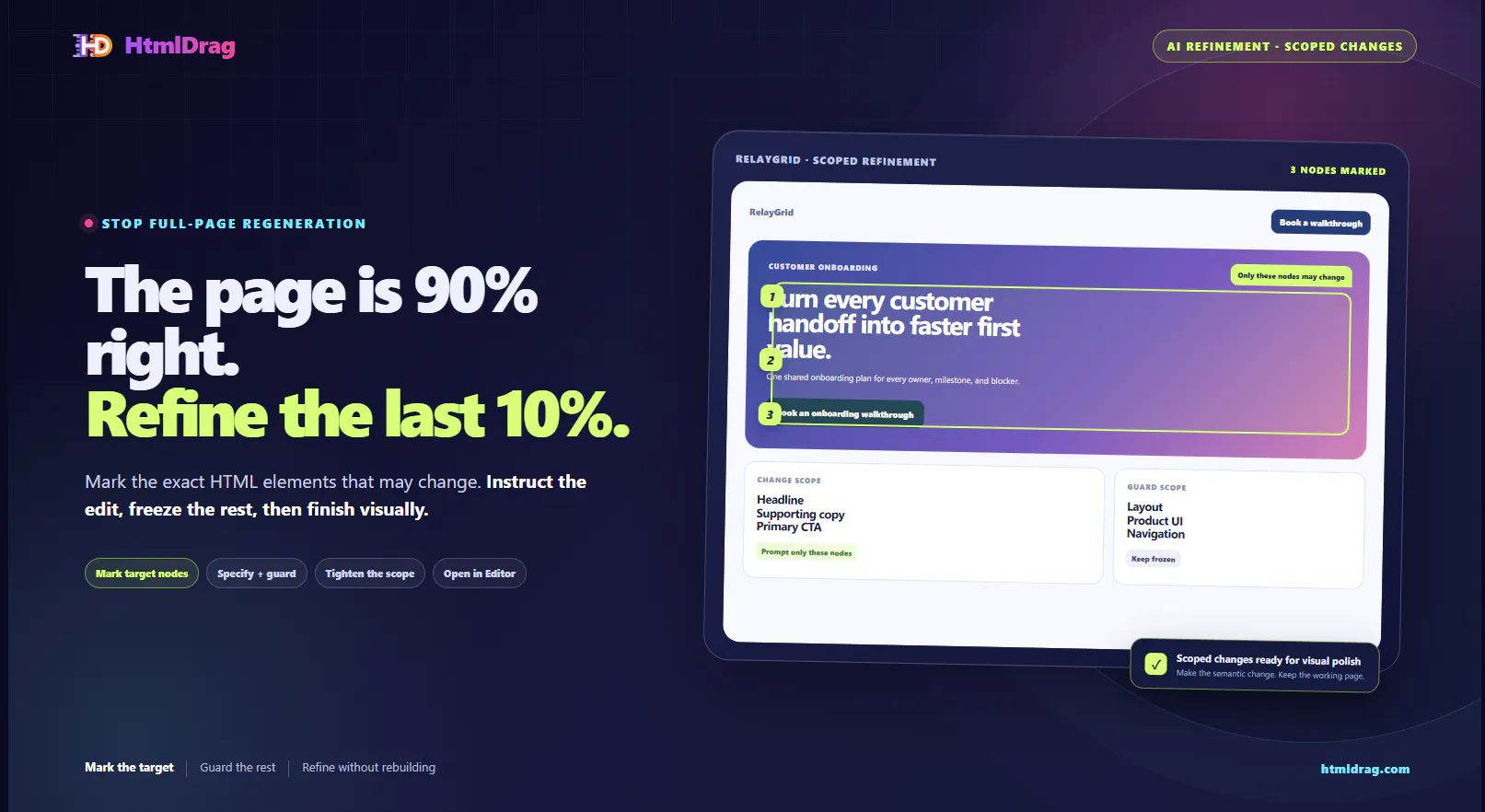
AI can produce a strong first landing-page draft. The final step should not be a risky full-page regeneration just because one headline or CTA needs work.
HtmlDrag lets you load the existing HTML, mark the exact DOM nodes that may change, keep the rest of the page protected, and work in smaller refinement passes. Then move to the visual editor for tables, links, locking, cleanup, versioning, and clean HTML export.
1
5
p/prodshort
Amrani Yasser
Getting a let s keep in touch from investors can keep you waiting for months. Accelerators are different. You apply, and eventually you get a clear Yes or No.
So here s a simple way to start applying without spending hours rewriting the same answers:1. Go to ApplySeed2. Find programs you qualify for !!
Would love your support and feedback !!
25
p/applyseed
Anas Chhilif
7 months ago I was at the airport in Nice waiting for a friend, in the very first months of building Entervio.
Still figuring things out, I posted on Reddit asking about French incubators, investment options and residency permits.
Amine Benjelloun left a comment that stuck with me. At that stage, don't waste time chasing investors, apply to accelerator programs like YC or EF instead. Programs that actually give you a clear YES or NO.
22
p/whaleread
New User
WhaleRead 1.18.1 Preview for Apple silicon Macs is now available to download and try.
Download: https://github.com/catlovemiaomi...
Product page and demo: https://whaleread-astra.kunyu575...
What s included:
6
p/naseem-2
Ayman Hamed
Yesterday, Naseem finished its first day on Product Hunt:
#21 Product of the Day 76 upvotes 57 followers
And today, Naseem got its first paying customer at the $29 launch price.
What surprised me: the first customer was a company, not an indie developer. I wasn t expecting that this early.
18
3
p/general
Nika
The more projects and responsibilities you have, the more you try to organise your time better and accomplish as much as possible in the shortest amount of time.
Not to mention when you have a family and want to make time for your personal life too.
48
23
p/brev-io
Chris Pitchford
Ten years to get home. Lost his entire crew. Would love to see that quarterly business review.
We re making a short film for everyone who s ever been responsible for keeping a company on track. The people chasing updates, untangling priorities, and trying to answer a deceptively simple question: Are we actually going to hit our goals?
Apparently, we decided Greek mythology was the best way to explain this.
The film drops September 22 alongside our new Brev launch. It ll be slightly absurd, hopefully funny, and possibly the most elaborate way anyone has ever explained business operations.
2
Shikhar Bower
I run multi-client creative work (video, ad scripts, photography) and feedback always ends up scattered across WhatsApp, email, and Figma comments. Half the time nobody's sure which version actually got approved.Curious how others handle this, especially freelancers and small agencies juggling several clients at once.Is your bottleneck getting clear feedback, keeping versions straight, or something else entirely?
65
p/netfox
Giovambattista Fazioli
Hey everyone
New module shipped, and it answers one question without a terminal, a router admin page or a speed test: is my connection the problem, or is it something past my door?
16
26
RunAI Coder
In August one coding-agent CLI's release note took its task-tracking tools away from its newest models and kept them for the older ones, with an environment variable to reverse it. The note gives no reason. A component study posted in mid-September is the nearest thing to the arithmetic behind a call like that: a harness part is built to cover for something the model does badly, and the same part does a different job once the model stops doing that thing badly.
The study held an agent loop fixed and swapped parts across four models of different size. Its planning scaffold, a plan re-injected every turn, added 11.6 points on the repository benchmark for the smallest model, whose median run otherwise ended after five turns, two runs in three without an edit. For the largest it trimmed cost by about 30% with a two-point drop in success, because what it cut was verification the model would otherwise keep doing. A predefined tool set showed the same crossover: worth 15 points to the small model on the repository benchmark, while the large one did better there and 53% cheaper with bash alone, bundling several edits into one script.
Our reading: whether a part helps is a question about the model, the task and the budget; what the part costs, in tokens on every turn, is charged whatever the answer. A part that was right when it shipped can be wrong a model generation later without anyone touching it.
We tried the smallest version on our own setup: one small task, one model, fifteen runs, five under each of three tool lists. Every run passed the same four checks. With the task-tracking tools switched back on, the model was offered them in every run and called them zero. With bash alone it finished in a median of 10 turns instead of 17, and the first request carried a quarter of the context. We kept the typed file tools on anyway, because path permission rules attach to them and cannot see inside a shell script.
0
7
Netfox has always found devices by listening. This release lets it ask.
Your network has things on it that never say a word. A printer asleep. A camera that only ever talks to its own cloud. A Pi you set up in March and forgot. They are powered on and perfectly reachable, and until now Netfox could not show them to you not because it was hard, but because everything it knew came from whatever announces itself, or whatever has already spoken to your Mac.
I m getting closer to launching my tool on Product Hunt, hopefully sometime in the second half of this year.
I currently have a 3-phase launch strategy in mind.
21
12
p/problemhunt
Boris Glen
1. Wrote to 105 immigrants.
2. Got about 20 replies.
3. 10 people gave interviews.
8
p/producthunt
fmerian
Building a team or want to join a startup?
Founders, teams, and startups drop a comment if you're hiring.
33
40
p/aisa-ai-skills-test-ai-leaderboard
Ozan
Would love to hear thoughts. Here's my perspective.I'm against AI slop, but I'm not against AI. I believe AI is a great tool but it also needs greats pilots to use it well. This is what I'm working on. AI Fluency.
Biggest marker of AI fluency is AI judgement. Where and when to use AI and where and when not to.
BAD AI JUDGEMENT
83
p/tiun-2
Nikolaos Christoforakos
Yesterday, tiun launched on Product Hunt and finished with 527 upvotes and 106 comments, making us #1 Product of the Day.
For our first launch, this feels incredible, Thank you!
19
p/ctruh-studio
Somesh Putatunda
Not your biggest achievement.
Your biggest bottleneck.
Is it... Finding users? Retention? Distribution? Pricing? Building fast enough?
Curious to see what most founders/Builders are struggling with today.
32
p/dina
Zaid
Just shipped 3D in Dina.
You can now turn a normal screen recording into a much more cinematic scene with 3D moves, perspective changes, unfolds, sweeps, pull-backs, and more, without touching any 3D software.
The goal was simple: make product demos and screen recordings feel less flat, while keeping the workflow ridiculously easy.
Would love to know what you think of it
p/mossy-2
Mossy
A few of you installed him on launch day and never touched him since. That's the point, but he's changed since then. Right click the plant, "Update", done.
What's new:
He updates himself now.
You can offer him to someone, with a note inside. Right click, "Offer a cutting". They get a link, the note opens when their plant sprouts.
Fixed: when the plant ends up off screen, he comes back to the middle.
Fixed: you can now park the plant against the edge, or slightly off screen, so he takes less room. The bubble follows him.
If yours already says 0.2.15, you're good. Go pick who gets the first cutting.
120
p/captain-kill-switch
Simon Crean
Which of these is you?
Pre screen-share / demo panic: thirty windows, notifications armed, everyone waiting
End of the day: shut everything so tomorrow starts clean
Before gaming or a recording: free the machine
Focus reset: close the tabs I've been "coming back to" for a week
None. I upvoted because it looked neat and I won't use it
And the one I really want: if you looked and did NOT install, what stopped you? Closed source, telemetry, "I can just Cmd-Q", two clicks instead of one, no Spotify exception, SmartScreen warning, something else. Say it plainly. I would rather build the version you'd actually keep than defend this one.
p/murror
Mona Truong
Search Central states plainly that AI Overviews need no special markup, no AI text files, no schema. The one independent study of what users actually do is 18 months old and says a citation is worth a 1% click. Everything fresher is measured by the people selling the service.
It's Q4 planning season, which means a lot of small teams are about to write GEO on a budget line. Before you do, I'd spend twenty minutes on two documents, because they disagree with the pitch in a specific way.
The first is Google's own page on AI features and your website, in Search Central. It says there are no additional requirements to appear in AI Overviews or AI Mode, and no special optimisations necessary. Further down it's blunter: you don't need to create new machine-readable files, AI text files, or markup, and there's no special schema.org structured data to add. The whole page is a restatement of ordinary SEO fundamentals - be crawlable, be indexable, be useful, have your important content in text.
That's the platform saying, in its own documentation, that the product being sold to you does not exist as a distinct technical practice. You can decide Google is being coy. I'd just note that this is the one party in the conversation with nothing to sell you, and that it's the version I'd have to defend if I were wrong.
10
p/parasocial
Paul Geller
Thanks to everyone who supported us. We met a crucial milestone and decided to make the app completely free. You can choose to support us with our new supporter tier, but every feature remains behind the gate, and it's going to stay that way. If you haven't tried the best podcast player around, now is your chance. https://apps.apple.com/us/app/pa...
The legacy "Block AI bots" switch is deprecated on 15 September, and mixed-purpose crawlers get folded into it. Googlebot, Applebot and BingBot are in scope. Opting out is one click and the window is 25 days.
Sometime in the last two years a lot of us flipped a switch in Cloudflare called "Block AI bots." It was one click, it was free, it was framed as protecting your content, and there was no reason not to. I did it. I never thought about it again.
We re fighting for top1 launch today!
Everyone, thank you so much for the support today! We re currently at number 1, with Voiskey and KiloCode right behind us. We honestly didn t expect such a strong start!