
Launched this week

Siteline
Growth analytics for the agentic web
645 followers
Growth analytics for the agentic web
645 followers
Track how AI agents and bots interact with your website. Analyze traffic trends by platform, page, and topic. See how this traffic turns into human visits. Get your first insights in minutes - and go deeper once you have your aha moment about how it impacts your product growth.




Siteline
Hello fellow makers 👋
David here, founder of Siteline - Growth analytics for the agentic web. Think Google Analytics, but for AI agents and bots.
Why we built Siteline
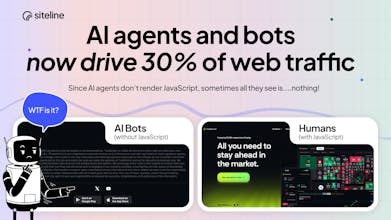
The web as we know it is changing. Humans are no longer the only customers visiting websites to research products and brands. Agents, bots and crawlers already make up 30% of web traffic and are hired by humans through apps like ChatGPT to visit hundreds of websites on their behalf, report back their findings and even make purchases.
The problem
The way people discover potential products is moving from direct web visits to indirect access through chatbots and agents, yet the web is still built only for human visitors. While new “AEO” / “GEO” tools provide some visibility, they don’t show what’s actually happening on your website. Additionally, they rely on running simulated prompts to determine if your brand appears in AI answers. But without reliable data about what people are actually asking ChatGPT and other AI chatbots, this approach has proven to be misleading and expensive.
Our approach
I’m a data nerd with 10+ years of experience at companies like Twitter & Glovo and thought there had to be a more evidence-based way. So instead of guessing prompts and simulating outcomes, my co-founder @vzotov and I developed a different approach which measures the full AI purchase funnel: from bot / agent visits, to citations & answer visibility, all the way to real customer traffic coming from AI apps.
What Siteline helps you answer:
Is my site a go-to source for AI?
See which AI agents visit your site, how often, and where they get blocked - with clear recommendations for what needs to be fixed or improved.
Is my most important content actually referenced by AI?
Understand which pages and topics AI fetches or ignores, and build a truly data-driven content strategy. Especially useful for info-heavy products that target AI power users (developers, product folks, marketers).
How does agent & bot activity translate into human traffic and new customers?
Cross-reference actual AI bot visits with prompt visibility to understand how AI exposure translates into traffic and authority.
Thanks so much for checking out Siteline - we’d love your support and feedback 🙏
Our basic agent analytics and AI visibility product is forever free. To unlock more features and higher limits at 30% off for 2 months use the promo code PH30.
Congratulations on the launch!
As someone who works on marketing side, actively iterating with SEO/AEO/GEO, I think this piqued my interest today really. Going to check it out!
Siteline
@krupali_trivedi thank you! Hopefully it provides a bit of a new perspective on how to approach AEO / GEO than the other tools out there you've tried. Would love to hear your thoughts once you have a chance to check it out. There's a free plan so you can set up both Agent Analytics and the more "traditional" prompt visibility tracking functionality as well.
@vzotov @davidkaufmann Definitely gonna give it a try! 👀🔥
I’m curious about attribution – how reliably can you connect agent visits to downstream human traffic or conversions? Especially when users jump across devices and channels.
Feels like this could become a core analytics layer if the signal quality is strong. 🙂
Siteline
@vzotov @tereza_hurtova really good point, attribution from AI apps like ChatGPT is tough as folks will often research extensively then still search and have a navigational last touch with Google... Of course you can look at UTMs / referral header (we do in the product), but we're exploring ways to do probabilistic attribution: if you see a big spike in AI visits / citations and then later see human traffic or purchases in those same areas of your site.
Hard problem though! Would love your thoughts on how you've been trying to approach it :)
@vzotov @davidkaufmann I'm seeing similar patterns where AI clearly influences research, but Google still "gets the credit." What we’ve been thinking about internally is looking less at perfect attribution and more at directional correlation: spikes in AI citations + branded search lift + direct traffic growth in the same content clusters. It’s obviously not clean attribution, but if the patterns repeat consistently, it becomes strategically useful. :)
Product Hunt
Siteline
@curiouskitty great question. After integrating and start to see traffic flow in I would immediately check if your key pages are being covered by agents from the top platforms (OpenAI, Anthropic, Google, etc) and if there any errors / timeouts or permissions issues.
Then by day 2 you should already be able to see trends emerge that are help inform content optimization: which pages and topics (we cluster pages automatically for you) receive the most traffic from "user-initiated" agents and how does that convert to referred "human" traffic from the AI apps. From there you're off to the races :)
The "stop guessing prompts, measure actual bot traffic" approach is way smarter than most AEO tools. I've seen products spend $500/month on prompt simulation tools that don't reflect what users actually ask ChatGPT. Does Siteline differentiate between OpenAI's crawler vs actual ChatGPT browsing on behalf of users?
Siteline
@dronidev we do! For OpenAI we differentiate between crawling for LLM training and search indexing vs. agent visits that are "user-initiated" i.e. are trigger live when a user is asking something on ChatGPT.
Would be curious to hear your experience with Siteline compared to other AEO / GEO tools when you get a chance. Thanks for the support!
@davidkaufmann Makes sense! I'm building two products right now and honestly had no idea bot traffic could be that granular. Will definitely test Siteline once I start seeing meaningful traffic — curious to see which pages AI agents hit vs ignore. Thanks for clarifying the differentiation!
Siteline
@dronidev of course! let's be in touch
Siteline
@vouchy definitely! The biggest wake up call is just seeing how much your visibility is biased by which prompts you select. We saw some cases where if the prompts we're focused only on the brand / products strong-suits the visibility was 80%, but when more balanced and representative of what people are likely asking, the visibility dropped in half 👀.
We still believe visibility tracking is valuable (and still offer it in the product), but feel the selection should be done in a smart way. So far the best technique I've seen is by using a mix of Google search volume for similar keywords (from Semrush for example) + which pages / topics on your site are visited by user-initiated AI agents like 'ChatGPT-user'. It's not perfect, but it's much more likely to be aligned with what people are actually asking :)
Product Hunt
@vouchy @davidkaufmann If you're feeding pages / topics that AI agents are actually visits into your visibility tracking, aren't you biasing your visibility metrics towards prompts where your visibility is already good?
To me, what's important is to figure out what gaps there are in your AI visibility. How does live AI agent visits help inform that? Or, is it only intended to measure how many eyes are reading your content through an AI chatbot?
Seems like a compelling product, congrats on the launch! Do the scraping agents from the big labs all set a proper user agent? Or in other words, could they hide this data from you?
Siteline
@wilco_kruijer1 great question. From what we've seen the biggest labs (OpenAI, Anthropic, etc) value transparency and publish their user-agent strings and IP ranges for verification. In theory it's in their interest to make sure websites are accessible for consumption / scraping for their LLMs and live agents.
However we do see impersonation from less reputable platforms trying to mimic ChatGPT agents for example, but we catch and filter that out with IP and other verification methods. Have you experimented with the agent / bot analytics data at all?
Have been using the product since their private beta. It helped us get insights into our ai seo visibility and take steps towards improving it as efficiently as possible. The team is also great - extremely responsive, helpful and knowledgable. Congrats on the launch, Siteline!
Siteline
much appreciated @anna_paykina_cerbos ! You're a top customer :)
Congrats on the launch!
Quick questions for the team :
How do you handle differentiation from traditional analytics (GA4, Plausible, etc.) when agents mimic human behavior more and more?
What's one quick win you've seen that boosts how often agents cite/reference your site/pages in their responses (without gaming the system)?
Siteline
@cathcorm great points! On the GA4 side, at the moment it's all Javascript tag based, so they miss most AI agent traffic which just renders everything from the server. That's not to say they couldn't start to measure it of course, but I think the real value comes with connecting the AI / bot traffic to your citations and visibility data. Then once you add referrals that come to your site from AI apps you have a full picture of the funnel: ingested, cited, visible in answers, acquired human traffic.
And regarding quick wins, what we've seen work best is using the agent visit data to figure out which topics / content users on ChatGPT are actually asking about and then filling that gap with high quality content that answers users' questions. Maybe a bit more substantial than a "quick win" but as you mention, a lot of people try to game the system with hacks that end up backfiring... Anything you've seen working so far?
@davidkaufmann Hey there!! Thanks for the thoughtful reply, super spot on about the GA4 limitations with JS-based tracking. Love how you're connecting the dots across the full agentic funnel; that's exactly the kind of visibility shift we're seeing explode in 2025-2026.
On the quick wins side, I've seen the "hacky" stuff backfire fast, either with lower quality scores or just getting ignored by the models... real wins seem to come from exactly what you mentioned : using agent visit data to spot content gaps where people are asking ChatGPT/Perplexity/Gemini things your site should own but doesn't yet.