
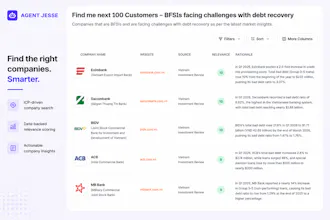
Sales teams have been stuck with stale databases for 15 years. Jesse changes everything.. the first internet-wide search engine built for sales & marketing. Ask in plain English: "Find newly opened soccer facilities in the Midwest needing turf solutions." Jesse scans the live web and finds the right buyers in the market today. We are an anti database company, we don’t scrape and store stale databases and sell them at premium. Every lead is found fresh from the live internet and delivered.



Free Options
Launch Team / Built With


Render: Get up to $100K in startup creditsCloud infrastructure for founders who want to move fast and NOT break things
Promoted


How do you verify the leads are actually newly opened and not just old pages getting reindexed?
@thamibenjelloun
Thanks.
Sharp question.
We anchor recency on the dated signals in the source itself, a funding date, a role start date, an article's publish date, not on when a page was crawled.
A reindexed old page keeps its original dates, so a recrawl does not make it look fresh.
The honest limit is undated or evergreen pages, where age cannot be read from the content. We do not stamp those new, they land with a low relevance score and the source attached, so they rank near the bottom and you can see the signal is weak rather than us passing it off as a confident fresh lead.
A structured recency check, filtering to genuinely changed in the last N days, is what we are building next.
Interesting positioning. How do you balance 'live internet search' with getting consistent, structured lead data at scale?
@workout097_collab Thanks for the support. We are doing it by first running every query via our live internet search data. Then we cross-reference the same through the structured databases that we have connected on the backend. This gives us two distinct advantages:
1. We are able to first get the live and correct data from the internet so that we always get the most recent output.
2. We are able to cross-reference the same with structured databases and provide you an output in a structured manner.
This is the most unique feature of Jesse that no one else in the market right now is utilizing.
I did a people search but there is no contact information or LinkedIn profiles. Am I missing something? I’m on the free plan.
@jill_camhi_osinoff Yes, we provide contact information and LinkedIn profiles when you enrich. That feature is right now available starting from the base plan, which starts at $5.
In our next launch, we are also adding a preview feature where a few of the contact information and details will get available even in the free plan. This way, the product becomes more transparent, and our customers have more confidence in the product to move to the higher tiers.
Thank you for the suggestion. Will implement it right away.
I've been running into this exact problem with Apollo so Jesse looks like a fresh gust of air.
Is there an additional verification layer?
Because many small businesses will not have their information updated on all channels, I wonder how any conflict is handled and whether there is a way to check the validity of that information that turns up through searches.
@kyleysryu Good question, and yes- there is an accuracy/verification layer built in.
It refreshes on every new list, the agent goes out to the live web in that moment, so you get whatever is currently accurate on the sources. We weight trusted, verified portals like LinkedIn by how reliable each one is, to keep results as accurate as possible.
Secondly for enriched data like emails, we run additional verification loops from Industry leading tools to always give accurate data.
An honest caveat on conflicts:
Freshness is bounded by what has actually gone public. When different sources show different values, Jesse ranks by source reliability and surface recency, then attaches the actual signal and source link so you can verify.
On validity checks:
Today, you can trace every lead back to its source (LinkedIn post, funding announcement, company site), which lets you manually validate the signal.
For small businesses that are sparse online, the main limit is coverage: if the signal hasn't published yet, we won't invent it. But once it's public- news, company page, LinkedIn, forums, Google maps- it's catchable as soon as it surfaces.
@sarthak_shrivastava2 Just wanted to let you know you convinced me and I already signed up lol
it's looking good!
The plain-English query example for hyper-targeted niches is brilliant. Since it's scraping and analyzing live web data on the fly, are there any constraints on the number of leads or companies Jesse can pull per query, or does it scale seamlessly for larger market mapping?
@andika_fadhilah
Thanks.
Straight answer: There is a per-query ceiling.
A single search tops out around 500 leads or companies today, so it is not unbounded per query, and bigger pulls take longer (it runs in batches, so 25 is a few minutes and 500 can run closer to an hour) and cost more, since billing is per result.
For larger market mapping the pattern is not one giant query, it is several tighter ones. Segmenting the market into focused ICPs actually returns better matches than one broad prompt, and you stitch the segments together. So it scales through many targeted searches rather than a single unbounded pull.
At real scale, that is exactly what the API and our n8n integration are for, fan out a set of queries and collect the results programmatically.
Hi I am Sukanya.. Marketing lead at Omnify.
One challenge I constantly face is finding new prospects that are similar to the customers who already get the most value from our product. Can Jesse take a list of my target customers and identify lookalike companies that would be a strong fit for outreach?
@sukanya_kakoty1
Hi Sukanya.
Great use case, and yes, Jesse does this directly.
You seed it with the accounts that get the most value from Omnify, and it distills the signals those accounts share, the business attributes plus the softer traits it can read off the live web, into a working profile, then searches the live web for companies that match it.
You get back a ranked list scored by relevance, each with a one-line rationale and a source, so you can see and trust why a company landed there.
Happy to take a sample of your top accounts and run it live so you can judge the matches yourself.
I have seen my fair share of stale leads and contacts so great job for focusing on an unsolved problem. What markets do you focus on? Are there ones that are stronger or weaker? Interested in learning more. Congrats on the launch.
@yumi_joh
We are not locked to one vertical. Because Jesse reads the live web per search, the real dividing line is web footprint, not industry or geography.
It is strongest wherever your targets leave a public trail, B2B tech and SaaS, funded startups, anything with news, funding, hiring, or active profiles, all easy to find and rank with a solid rationale. The tougher cases are low web-footprint targets such as very tiny local businesses, stealth-mode companies, low-digital-presence industries or regions, where signal is sparse so results come back fewer and lower confidence.
Widening that thinner end is what we are working on now.
Happy to go deeper. What market are you selling into?
I will tell you honestly how strong a fit it is.
@ritesh2503 thanks for the complete response and great to know that there is no boundaries on geography. My ICP will leave a trail of information so with this information, I'm excited to give Jesse a spin.
@yumi_joh Thanks for the support. Yes we do work better for markets that is unexplored / not easy to find on traditional databases like Apollo and Zoominfo. These will be the non-digital markets from traditional industries like:
1. Manufacturing
2. CPG, D2C, ecommerce
3. Finance
etc
We also work better for geographies where the coverage is poor such as APAC, Middle east etc.
Since these are hardest to curate in traditional databases and were only accessible by having a person comb through google searches and build the list, we made them a staple usecase for Jesse.
That being said, it gives equally good results for other markets that you might be exploring.
@sarthak_shrivastava2 Gotchu. Will give it a go and see how prospecting looks from Europe. Thanks
@yumi_joh Loving it, let me know how your results have been for EU. We are aiming for a Global solution. EU would be a big market for us for sure!