
 •
•2mo ago
The cheapest model on your router is usually the most expensive one you run
Everyone read today's pricing news as costs going down. On agent workloads it doesn't work like that.
A cheap model that gets something wrong rarely fails loudly. It returns something plausible, the next step eats it, and you find out four steps later. By then you've paid for the cheap call, the three calls after it, and the rerun on the expensive model. A call that errors out is nearly free by comparison, because you just retry it.
 •
•10mo ago
Building a SaaS is 50% coding, 50% fixing the stuff you broke yesterday 😭
The real founder coding vibe:
You ship a small fix break 3 things
You deploy confidently production crashes
Local works perfectly Vercel says nah
You spend 1 hour coding 4 hours debugging
Slack notifications hit instant anxiety
Founders know the pain:
You re coding, marketing, fixing bugs, writing docs, and answering customer emails all at the same time.
What s your funniest or most painful founder-coding moment recently?
Let s vibe in the chaos
 •
•1yr ago
Prompt recipes: from boilerplate to production
AI coding is pretty mindblowing but sometimes it's a headache built on a mountain of bugs. Usually that comes down to issues with how you prompt. So, with that in mind, I'm starting a crowdsourcing discussion so we can all improve our prompts and in turn our apps.
Share the exact prompts that turn blank AI requests into real world code. Show us how you go from generate a REST API to a deployable service in just a few steps.
What to post:
•6d ago
Your model provider can change your product overnight and you find out from a user
We run 30+ models across six studios in Arteza and every one of them belongs to someone else. If a provider retires a version or quietly reweights it, the thing a paying user made last month stops being reproducible this month, and I have no changelog to hand them.
Pinning a version only delays it. The pin gets deprecated too, usually with a few weeks of notice, and the replacement is better on the benchmark and different on the exact prompts people have built habits around. Better is not the same as the same.
The part I don't have is detection. You'd need a fixed set of prompts running on a schedule with a person looking at the outputs, which is an eval suite for taste, and I've never seen one that works. So in practice we find out when someone writes in to say it used to look right.
If you're building on models you don't own, do you check for drift at all, or does a user tell you first?
 •
•3mo ago
Why is “vibe coding” suddenly treated like a bad thing?
Feels like people are using it as a shortcut to dismiss products they don t like.
At the end of the day, devs have always relied on tools to go faster, frameworks, libraries, Stack Overflow, templates, all of it. AI is just the next step in that chain. Typing code was never the hard part anyway. Understanding what to build, making the right product calls, and handling messy edge cases is where the real work is.
AI doesn t change good vs bad builders, it just changes speed.
 •
•15d ago
Is every AI Software Factory just a local script wrapped in 40 prompt files?
Or am I missing something?
Guys, let's talk honest about AI SDLC orchestration.
Has anyone here actually successfully moved AI-driven software development from "cool local demo on a senior engineer s MacBook" into governed enterprise-grade SDLC system?
 •
•29d ago
My AI agent doesn't forget code. It forgets why we made the decision
I've noticed a different kind of context problem while working with AI coding agents.
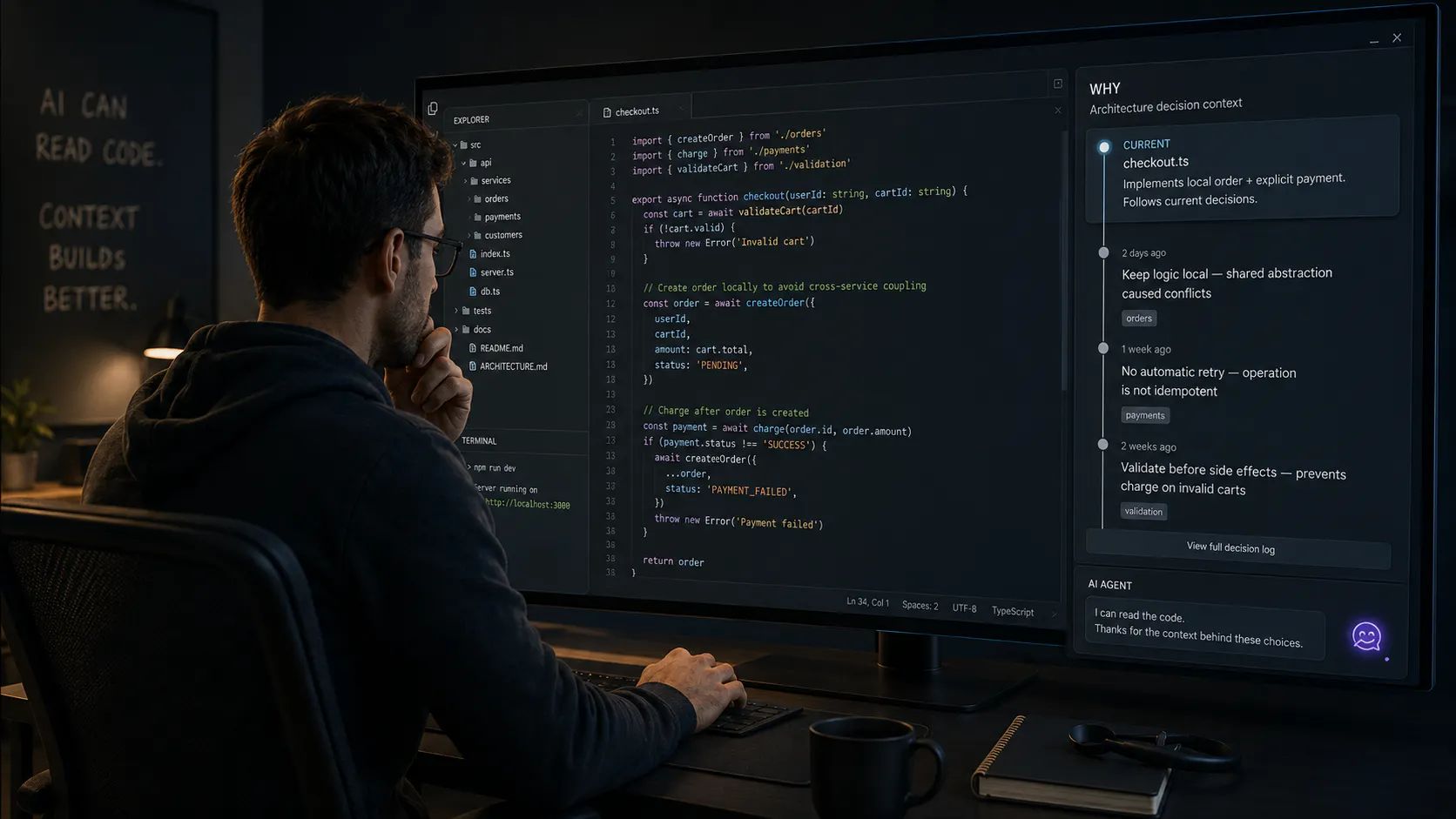
The agent can read the code.
It can inspect the git history.
It can find the files it needs.
 •
•2mo ago
Anyone actually checked their vibe-coded app for security holes, or just hoping for the best?
Been thinking about this after seeing a few posts here about vibe-coded apps breaking in production. Auth bugs, webhook failures, that kind of thing.
What worries me more is the stuff that doesn't break loudly. No error, no crash, it just quietly leaks data or accepts requests it shouldn't. Things like exposed API keys sitting in the frontend bundle, missing rate limits, or database rules that let any logged in user read rows that aren't theirs. None of that throws an error. It just sits there until someone finds it.
For the non-engineers building real products with this stuff, what does your actual security check look like before you launch. Are you running anything to scan for this, paying someone to review it once, asking the AI itself to audit its own code, or just shipping and hoping nothing bad happens.
Curious if there is an actual workflow people are settled on, or if this is still the part everyone quietly skips.
 •
•2mo ago
A vibecoded pricing bug let people subscribe for $0 for six days before anyone noticed
Had Claude Code refactor our checkout flow to add an annual billing option alongside monthly. It worked in every test I ran, annual customers got charged correctly, monthly customers got charged correctly, everything looked clean.
What I didn't catch was a specific combination, someone applying a discount code and then switching plans before completing checkout, that caused the final price to recalculate against the wrong base amount. Instead of erroring out or defaulting to full price, it just quietly landed on zero.
Nobody typed in a hack, nobody exploited anything on purpose, the flow itself just handed out free subscriptions to whoever happened to click things in that particular order.
Took six days to notice, and only because I was manually checking Stripe for an unrelated reason and saw a cluster of $0.00 charges I couldn't explain. Roughly 40 people had gotten a free year of the product by the time I found it.
Fixing the bug was fast. Deciding what to do about the 40 people who were already in, upgrade them to properly paying, quietly let them keep it, reach out and explain, was the actually hard part.
Ended up honoring it for existing users and just fixing it going forward, felt like the least damaging option even though it cost real money.
 •
•14d ago
280 markdown files, 123 React components. I counted my repo the wrong way round.
I counted the tracked files in my main repo this morning, expecting the code to dominate.
280 markdown files. 123 React components. The markdown runs 427,099 words. The components run 23,394 lines.