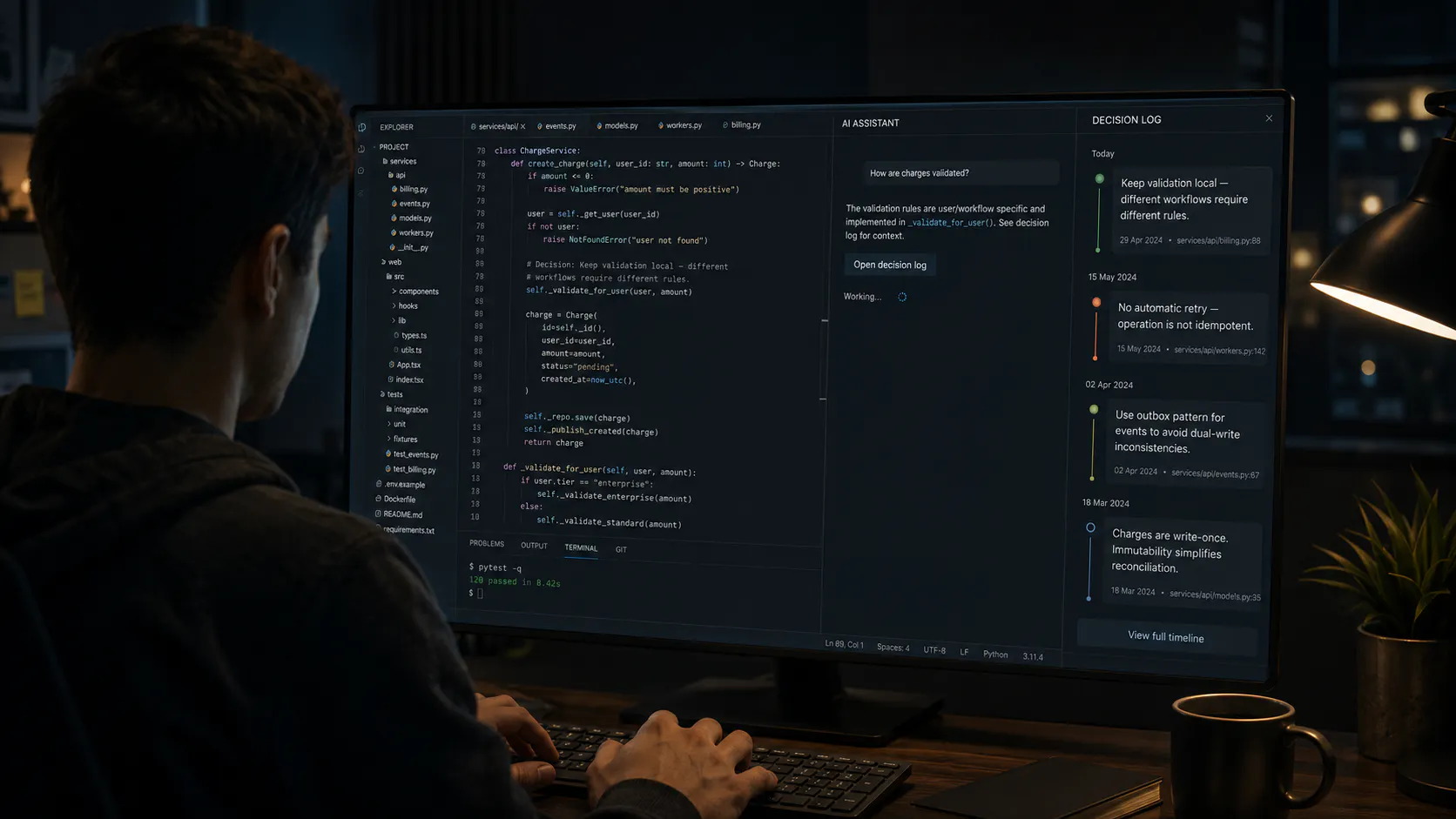
Hello everyone! I have used codex with gpt5.6 sol, Claude code with opus 5 and fable and tested kimi k3 ( I think their coding agent doesn t have specific name ) and most of development task is done pretty well . But it still sucks with design ( all vibe coded apps looks similar to me ) and agentic stuff - agent loop , tools and all infra around. And if unique cool design system it s smth we can postpone ( someone may not agree ) the agent implementation usually is the main product feature. Do you have the same experience guys ?
Hey everyone! I had a massive reality check this month and wanted to see if other founders have experienced this.
We use Stripe for billing and HubSpot as our CRM. Our dashboard looked incredibly healthy, MRR was growing, and deals were marked as "Active." But out of curiosity, we cross-referenced our active paying users with our actual product analytics (Mixpanel/PostHog).
Turns out, almost 12% of our paying customers hadn't logged into the app in over 20 days. They were "ghosts." Because their Stripe subscription hadn't failed yet, our CRM was completely blind to the drop-off, and our CS team was doing nothing to save them.
We ended up having to build a native bridge to pipe usage data directly into HubSpot to fix this.
As an SAP ABAP Developer, I had app ideas sitting in my head for years. Before AI, the learning curve for mobile development felt impossibly steep. Now? I shipped my iOS app in weeks.
But here's my honest question:
How many of us vibe coders are actually building sustainable products?
As a product architect working on data-heavy dashboards (like an on-site event management OS and an automated trading bot), I've been heavily exploring vibe coding lately.
The biggest friction point I've hit: AI coding agents almost always default to "modern," heavily padded UI layouts. I strongly prefer a professional "terminal" feel where I can see all critical data points at a single glance. I constantly find myself having to correct the AI because it sacrifices information density for unnecessary empty space.
Has anyone found a vibe coding tool, or a specific prompt framework, that natively understands how to generate dense, data-rich interfaces (especially integrating Dark Mode or Glassmorphism aesthetics) without needing constant manual overrides?
Has anyone here rebuilt something they use daily because the official product has a quirk / bug that annoys you? For example - I use Termius to connect to servers over SSH but on my Ubuntu 26 Desktop, Termius is buggy to the point of being unusable. So - I recreated it using Claude, with one or two improvements. Now I run my version in Docker whenever I need to use it.
Everyone talks about which tool they're using right now. Fewer people talk about the tool they left and why.
I switched from Bolt to Cursor halfway through a project a few months ago, not because of a big feature gap, but because of something small: Bolt kept losing context after a few file edits and I'd have to re-explain the whole architecture every session. It wasn't a benchmark loss, it was a patience loss.
That's the kind of thing that never shows up in comparison posts. Nobody writes "Tool A has 12% worse long-context memory," they just quietly open a new tab and start using Tool B.
So, curious about real switches, not hypotheticals:
On social media, we're constantly hearing about individuals who never knew how to code and were able to vibecode a product within a short period of time.
Whenever I come across these posts, I always wonder if their product is truly marketable and profitable. Or, they are just selling the dream.
Elon Musk openly admitted that Claude Opus 4.5 is outstanding, then added that Tesla engineers still prefer Grok. The most predictable plot twist ever: Guy who owns Grok says his own AI is better.