
 •
2mo ago
Why people rage quit my app 😡
Road to 1,000,000 Votap users - Day 81 | Current: 1469
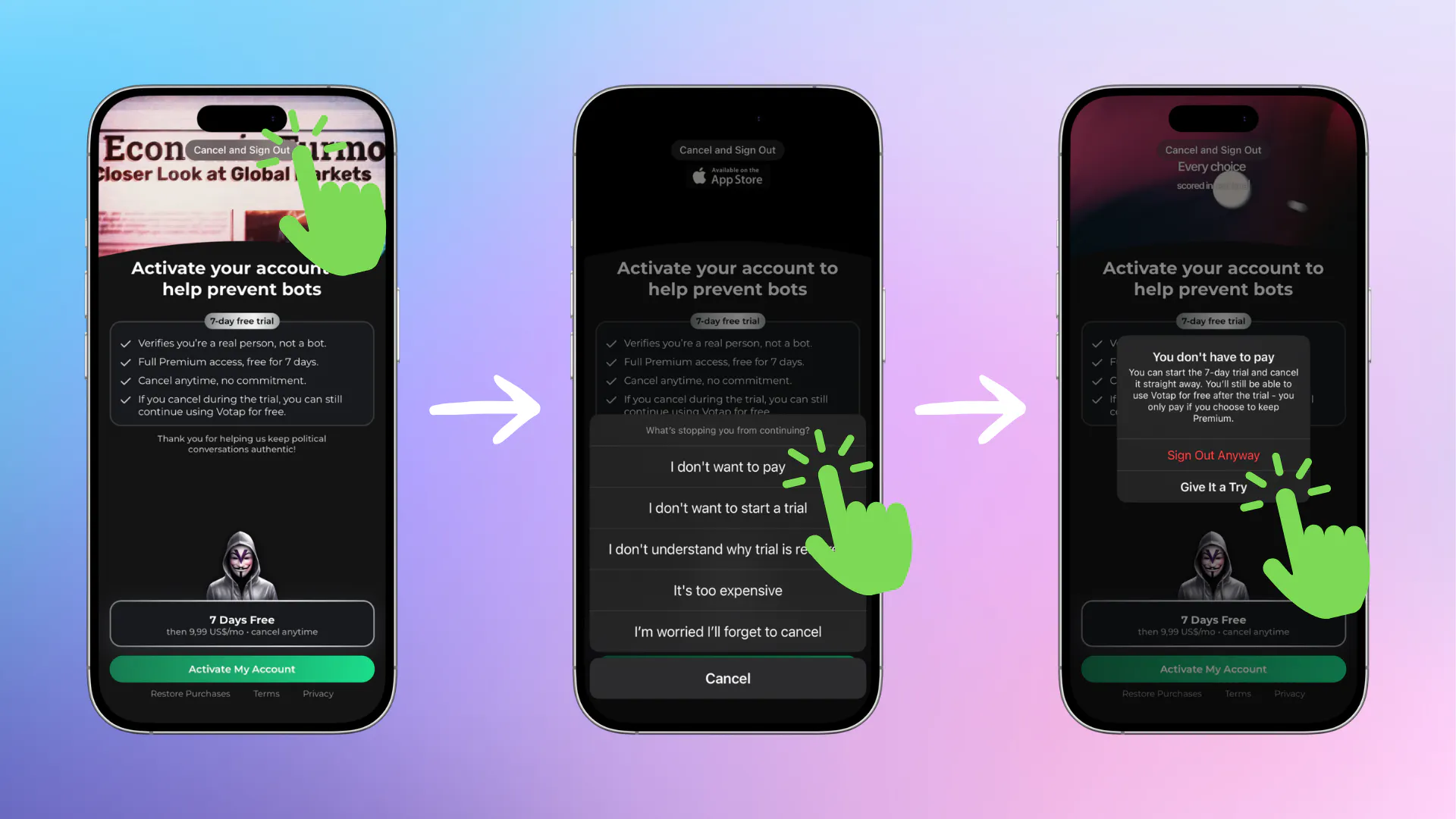
We currently use a mandatory 7-day trial during onboarding. You have to start it to enter, but you can cancel immediately and continue using the app for free. It gives us another bot-prevention layer and lets people experience the full app first.
What REALLY surprised me: of the people who didn t start the trial, around 80% tapped Cancel and Sign Out. They didn t just close the app.
So I turned that button into a tiny win-back + analytics flow. When someone wants to leave, I ask why: maybe they don t want to pay, don t want a trial, think it s too expensive, or don t understand why it s required.
Based on the answer, Votap shows a short explanation specific to that concern and gives them one more choice: give it a try or sign out anyway.
And every reason gets logged in analytics, so instead of guessing why people drop, I can see the actual pattern. Even if the win-back converts nobody, knowing why people leave is extremely valuable. What do you think about this approach? Let me know!
Download Votap in the App Store!
More tomorrow.
 •
9mo ago
Feedback wanted: I'm pivoting HeyMeetAI
I'm pivoting HeyMeetAI.
Not because it failed, but because talking to users changed the direction.
 •
2mo ago
🤔 Is local AI ready to become the default?
We re spent the last few months building MindBridge around a question:
What if your AI assistant didn t need to send your personal data to the cloud?
Local AI has come a long way.
Models are getting smaller and more capable. Tools like Ollama and ComfyUI make it possible to run increasingly powerful AI directly on a personal computer.
 •
2mo ago
If you stop a 50-minute focus session at 32 minutes, what should count?
I ve been thinking about this while building OneLess Pomodoro.
Say you set a 50-minute focus session, but stop after 32 minutes.
Would you rather see:
an incomplete session
32 minutes of actual focus
both
I ended up building OneLess around the second idea: the time you actually focused still counts, even if the planned session wasn t completed.
That decision also shaped the reports and goals they re based on real focus and break time rather than completed-session counts.
I launched it on Product Hunt this week:
https://www.producthunt.com/prod...I m curious how other people think about this.
When you look back at your productivity, do completed sessions matter to you, or is total focused time the more useful number?
 •
2mo ago
I turned a simple Snake game into a weird way to promote your website
I started with a basic Snake game, but I wanted to see if a game could also become a small distribution tool for makers.
The idea evolved into this:
your snake can use your domain as its name
higher scores move you up the leaderboard
you can customize the snake with accessories
after a good run, you can check in and share the result
the snake trail gradually draws the logo pulled from your website
I m still experimenting with it.
 •
2mo ago
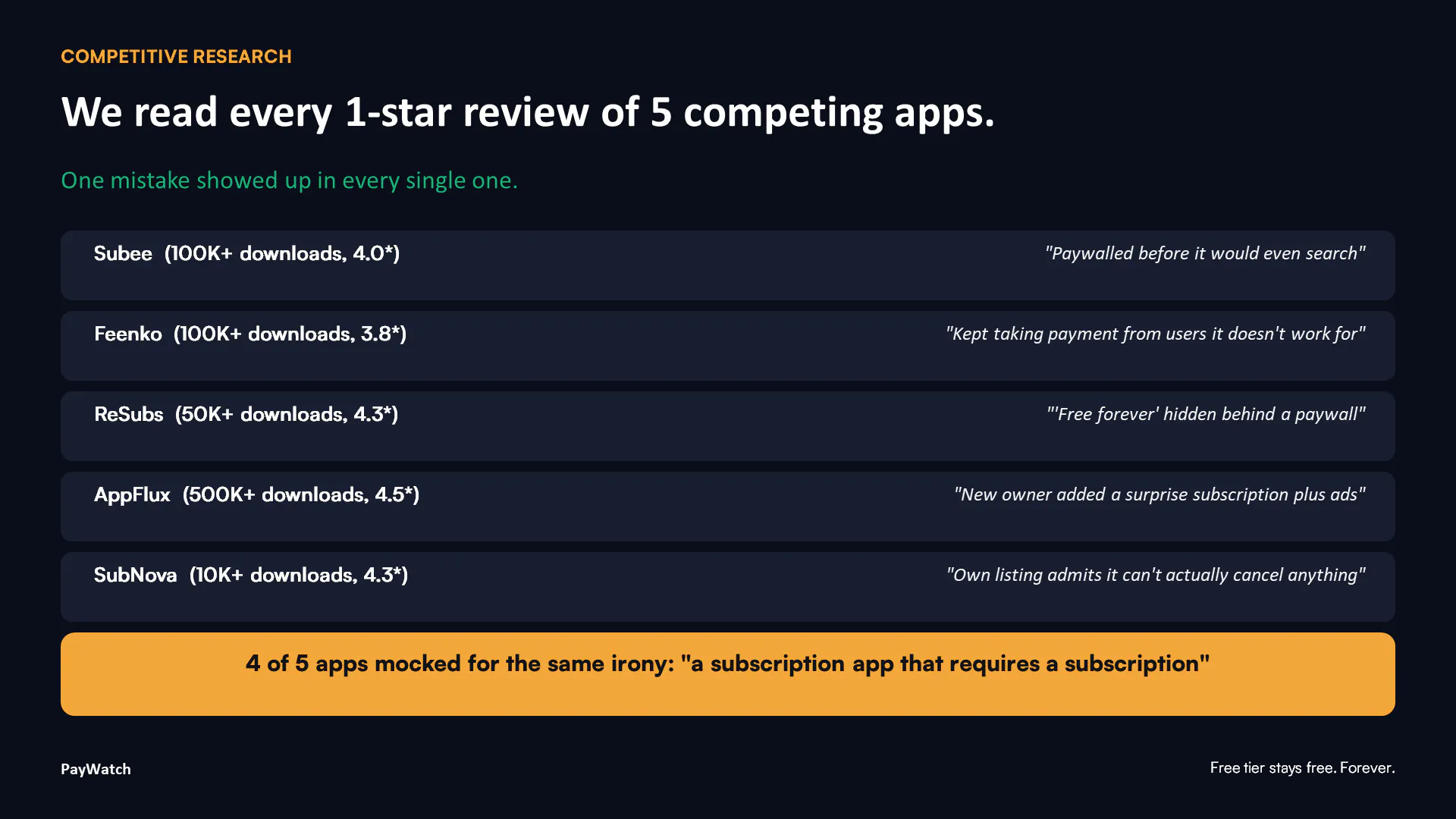
We read every 1-star review of 5 competing apps. Here's the one mistake every single one makes.
Before building PayWatch (a subscription tracker), we scraped and read the negative reviews of 29 competing apps on the Play Store. Across the 5 with real usage, one failure mode showed up in every single one, independently: they're subscription-tracking apps that paywall the free trial before showing you anything useful. Users mock this exact irony across four different apps' reviews, "a subscription app that requires a subscription."
It's a strangely consistent category-wide mistake, and it directly shaped our free tier: full detection and dashboard, free, forever; the paid tier only adds depth. Happy to share the raw pattern breakdown if anyone building in fintech/consumer subscriptions wants it, and if you want to see where we landed: https://thepaywatchapp.com
 •
5mo ago
Most AI search tools just give you more to read. We built one that actually thinks.
We all know the feeling of having a massive, chaotic concept bouncing around in your head but the moment you look at a blank search bar, your brain just goes completely static.
For students, academics, and researchers, this bottleneck can last for weeks. You have a messy, highly specific thought like:
"I m trying to look at loneliness vs. smoking in older adults. Something about IL-6 inflammation markers, maybe the UCLA scale... but everything I find is too broad or too narrow, and my advisor says my topic is a mess."
If you paste that into Google Scholar or standard AI tools, you get hit with a wall of 10,000 dense PDFs. You end up wasting 20 hours reading unrelated literature just to figure out where to start.
 •
2mo ago
What happens when a small business can’t answer the phone?
This is something we kept thinking about while building Kestrel Voice. For a small business, a missed call isn t always just a missed call. It could be someone looking for a quote, trying to book an appointment, or simply calling because they need help right now. But the person running the business might be on a job, with a customer, driving, or just away from the phone.
That s the problem we wanted to solve. We ve been building Kestrel Voice as an AI receptionist for small businesses, something that can answer calls, handle common questions, book appointments, and make sure customers aren t left waiting for someone to pick up. The interesting part has actually been figuring out what an AI should and shouldn t handle on behalf of a real business.
 •
5mo ago
What's the most time-consuming part of getting your first 100 customers?
Hey everyone
I've been building AgenticGTM, an AI-powered growth platform for founders who would rather spend time building than doing repetitive marketing tasks.
The workflow starts with a startup URL and helps automate parts of the GTM process:
Generate launch posts and marketing copy
Create SEO-focused content
Submit to startup directories
Collect and showcase customer testimonials
Discover conversations where potential customers are actively looking for solutions
 •
5mo ago
I’m building a Chrome extension that lets you chat with the webpage you’re currently on.
I m building a Chrome extension that lets you chat with the webpage you re currently on.
The idea is simple: instead of copying text, taking screenshots, or switching tabs, you open a side panel and ask questions about the page directly.