I built my wedding planning app with a lot of AI help. I m a former wedding coordinator, not a software engineer, so Claude Code and Codex were a huge part of making it real.
But the more I talked to actual couples, the more I realized I was deeper in the AI adoption bubble than many of my users.
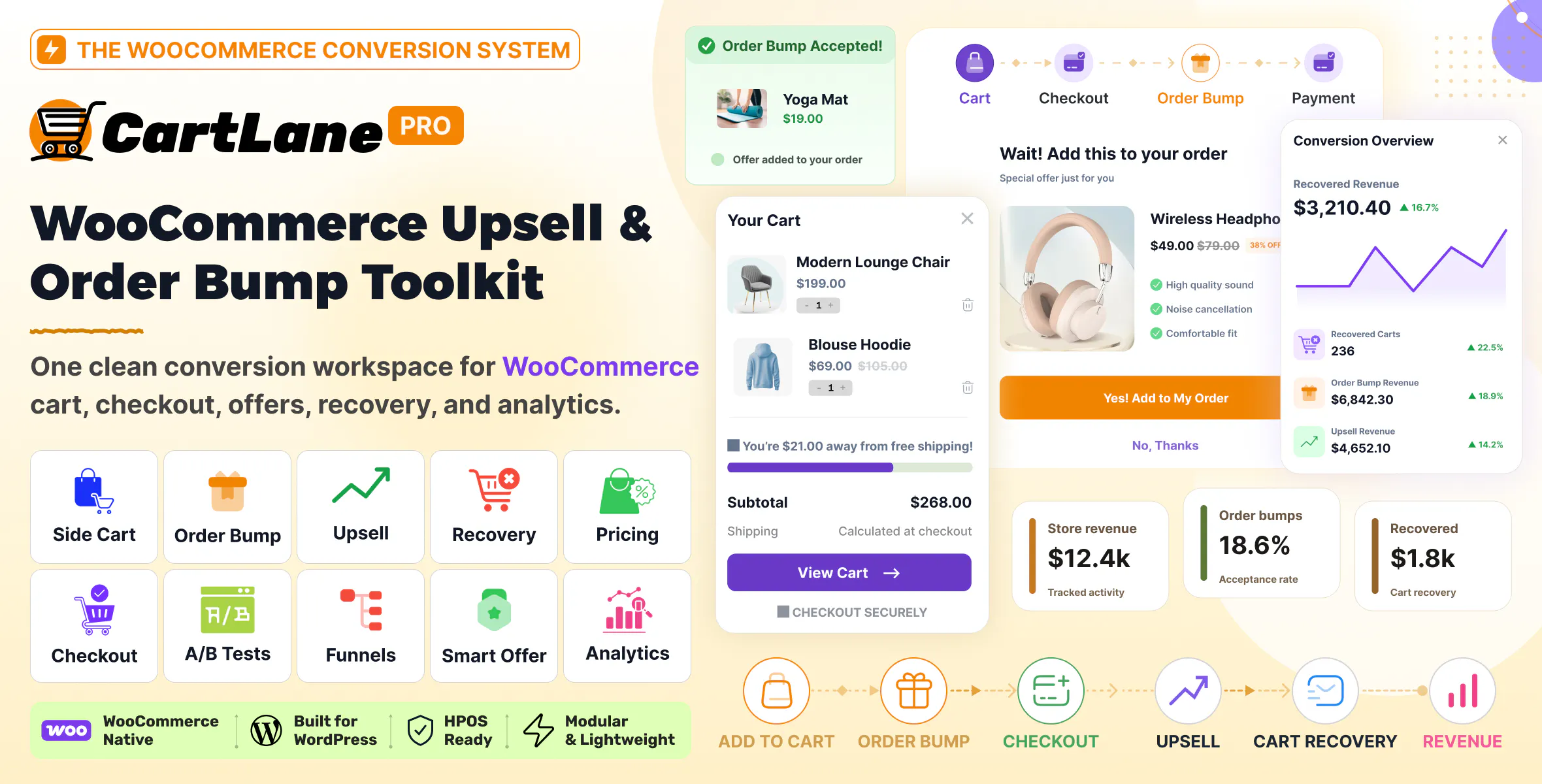
Over the past several months, I've been building CartLane, a WordPress plugin focused on helping WooCommerce stores increase revenue without adding more traffic.
Instead of installing multiple plugins for different conversion features, the goal is to bring everything into one modern, lightweight workflow.
We build Simplify, and before that we were the customer with the problem.
Our own consultancy, OneBonsai, ran on eight separate tools: HubSpot for CRM, invoicing in another tool, Notion for docs, BambooHR, a recruiting tool, an expense tool, a scheduling tool, and a Google Sheet for cash flow that one very tired person maintained by hand.
Every Friday, someone spent three and a half hours retyping the same numbers between four of those tools. Not because it was hard. Because the tools didn't share anything, so a person had to be the connection between them.
We moved our own 25-person team onto Simplify and wrote up what actually happened, including the parts that didn't improve. Migration took longer than our own homepage promises. We kept two of the old tools on purpose. Statutory accounting still sits with our accountant, that part doesn't change.
Just shipped an update to my SaaS Expense & Usage Auditor it now flags wasted subscription spend the moment usage data is imported, instead of waiting for someone to open a report. Cross-references what you're paying for against who's actually logging in (via Google Workspace, Microsoft 365, or Okta exports), and surfaces the exact $ recoverable per tool. Also just packaged it as a single Windows .exe no install, no terminal, nothing to configure. Runs entirely on your own server, sold as a one-time license instead of another subscription (a little ironic that most SaaS-waste tools are themselves SaaS subscriptions). Tested it on a mock 25-tool dataset found $6.98M in recoverable waste from checking just 4 of the tools.
A privacy-first, AI-powered desktop assistant with voice synthesis, persistent memory, and local model inference. Mimic AI runs entirely on your local machine using Ollama for language models and supports Browser TTS and Qwen3-TTS for voice synthesis.
I'm Toni, founder of MailNudgeApp, launching today.
I created it because I saw the same thing happening all the time: someone would send a quote or proposal, wait for a response... and then forget about it. The client would move on. The deal would fall through. Not because of laziness, but because of the sheer number of open conversations that had to be managed manually.
MailNudgeApp adds a reminder button to Gmail. Set it up in two clicks, forget about the reminder, and Chrome will automatically notify you if there's no response. No additional apps required. No need to leave Gmail.
I'm the founder of Staff Scheduling, a cloud-based employee scheduling and workforce management tool.
I originally built it after seeing how much time businesses were spending creating weekly schedules in spreadsheets, handling shift swaps, leave requests, and team communication manually.
A bit of context: I'm a UX/UI designer who got tired of wireframing ideas that hadn't been validated yet. So our team built Bunzee a workflow that goes from raw idea all the way to a handoff-ready structure in one session.
The flow: market validation competitor analysis PRD IA structure + design direction + MVP scope extraction.
That last part is new. We added it because the most common question we kept getting after people finished the PRD was: "Okay, so now I still have to figure out the actual screens myself?"