

The top domains cited by LLMs are not what you think.
We analyzed the top domains cited across all LLMs in Rankfender. The results change how you should think about AI visibility.
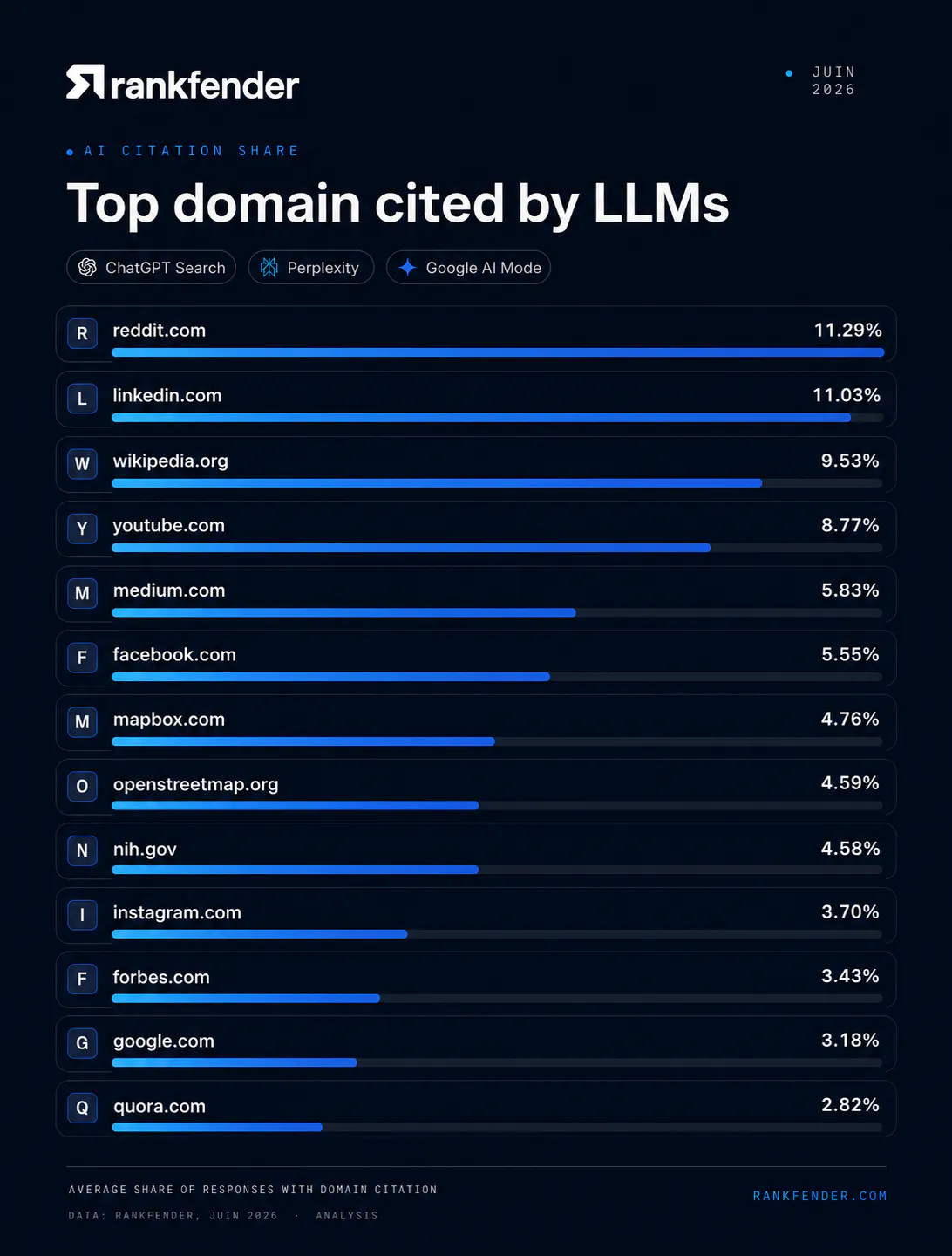
The data (Rankfender, Juin 2026):
Reddit: 11.29%
LinkedIn: 11.03%
Wikipedia: 9.53%
YouTube: 8.77%
Medium: 5.83%
Facebook: 5.55%
Mapbox: 4.76%
OpenStreetMap: 4.59%
NIH: 4.58%
Instagram: 3.70%
Forbes: 3.43%
Google: 3.18%
Quora: 2.82%
What this tells you:
User‑generated content dominates. Reddit, LinkedIn, and Wikipedia are the top three. AI systems are pulling from platforms where real people share real experiences. Not from corporate blogs.
Video matters. YouTube is at 8.77%. Text‑only strategies leave citations on the table. AI systems are citing video content at scale.
Your own domain is missing. Not a single brand domain made the top 20. Your corporate blog is not being cited. The platforms where users already hang out are.
The distribution has shifted. AI citations are not coming from the sites you control. They are coming from the sites where your customers already spend time.
What this means for you:
If your AI visibility strategy is built around your own blog, you are working against the data. The sources AI cites are the ones where real conversations happen, not where press releases live.
The brands winning are the ones participating in those conversations. Not publishing more. Participating.
How Rankfender helps:
Rankfender tracks where your brand is cited across these platforms. Not just your own domain. Reddit. LinkedIn. YouTube. Wikipedia. Everywhere AI is actually pulling from.
RAIVE monitors citations across 7 AI systems. RAISA tells you what to do next. RCGE generates content optimized for the platforms that AI actually cites.
What I am curious about:
Where is your brand being cited in AI answers? And are you participating in the platforms that drive citations?
Imed Radhouani
Founder & CTO – Rankfender
Replies
reddit at #1 makes sense because it's the closest thing to unfiltered aggregate opinion on the web. linkedin at #2 is the interesting one. LLMs are treating self-reported job titles and endorsements as ground truth when linkedin is the most curated corpus on the internet. that will age badly.
deeper question: what happens to citation share once a model figures out linkedin content is mostly performance? ranking shifts. whoever built visibility only there vanishes.
@thenameisarian That's a sharp observation. Reddit's dominance makes sense. It's the closest thing to unfiltered aggregate opinion on the web. LinkedIn at #2 is the more interesting signal. LLMs are treating self-reported job titles and endorsements as ground truth—and you're right to question how long that lasts.
Why LLMs Are Citing LinkedIn
The data shows LinkedIn is the #1 cited domain for professional queries across six major AI platforms. 75% of those citations come from individual member profiles, not company pages. The structure is what models love: clear headings, bullets, named entities, quantitative data, and comparison frameworks. It's professionally curated, which feels authoritative. But it's also performance.
The Risk You Identified
LinkedIn's content is concentrated in a narrow topic cluster—careers, business, B2B markets. When you isolate professional intent, it dominates. When you broaden the lens to all query types, it drops to #2 or #3 behind Reddit and YouTube.
The deeper risk is trust. LLMs are effectively training on self-promotion disguised as expertise. LinkedIn content isn't independently verified. It's reputation laundering. Once models learn to discount that signal, the brands that built visibility only there will see their citation share drop.
How Rankfender Helps
Rankfender tracks your brand's citations across all platforms, not just LinkedIn. RAIVE monitors where you appear in ChatGPT, Perplexity, and Gemini. You see which platforms actually drive citations for your brand—and which ones are just noise.
If LinkedIn citations vanish, you'll know immediately. You'll also know where to shift your effort.
Does the analysis shift when we get to more specific subject areas? The more niche the topic, the more likely I would think that you'd find something on a corporate blog. For instance, if I have a question about orthodontics, it's likely that LLMs will cite the webpage for an orthodontist rather than Reddit conversations, right?
@jeff_benson1 You are absolutely right, and the data backs up your intuition. The "niche" factor fundamentally changes the game for AI citations.
Would love to know how those citation percentages change by industry. Healthcare and software probably look very different from travel or shopping.
@advin_jadis
That is a smart question. The general data is useful, but it flattens the nuance. Healthcare and software likely look very different from travel or e‑commerce. The platforms that dominate citations for one category may be invisible in another.
What category are you in? I would love to see how the citation breakdown shifts for your industry. The general data is one thing. The specific data for your space is where the real signal lives.
Surprising breakdown. Reddit beating almost everything alse says trust is shiffting toward lived experience rather than polished marketing.