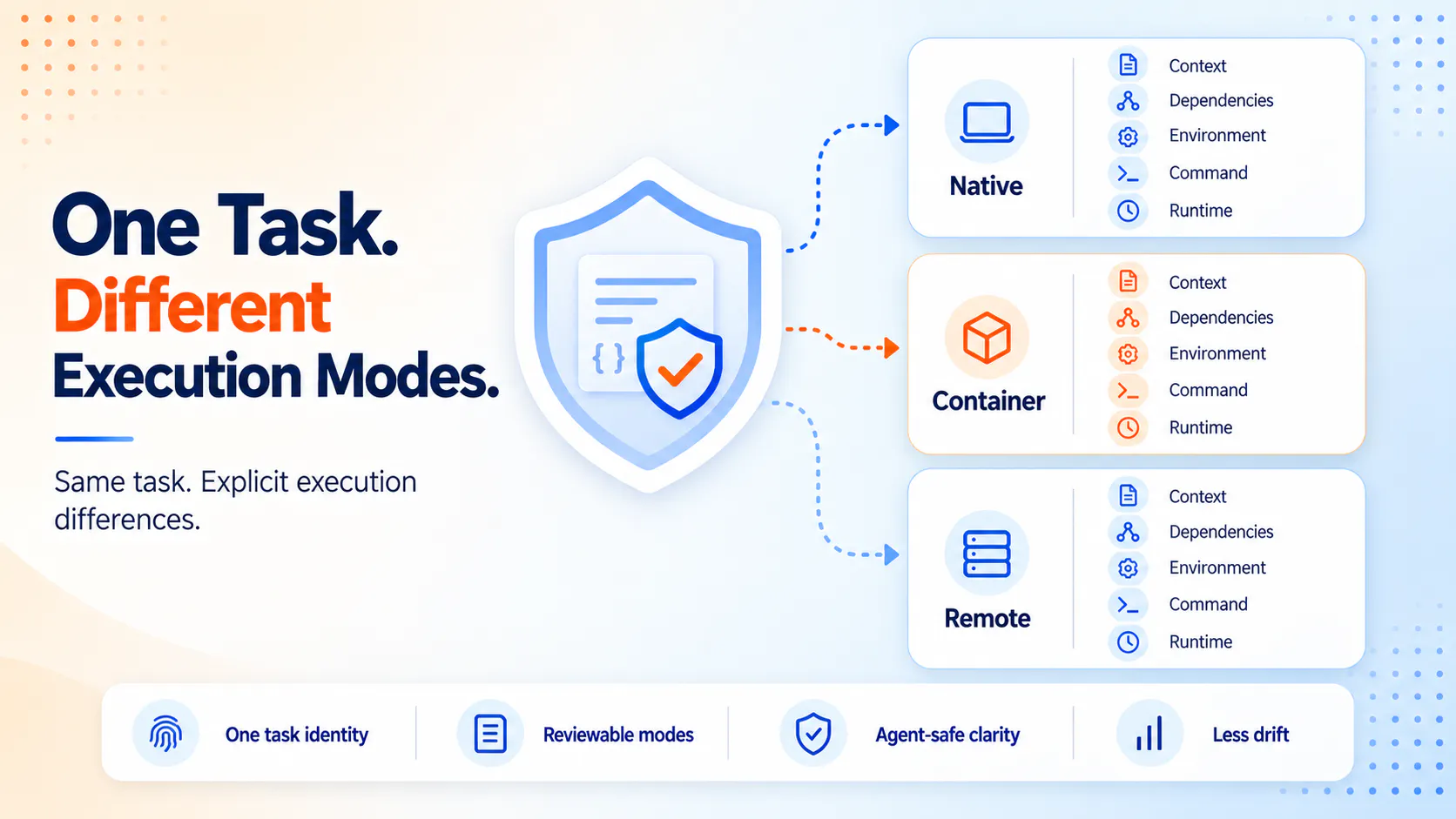
Ota lets one task declare native, container, or configured remote modes. The contract makes differences in context, dependencies, environment, command, and runtime explicit, while developers, CI, and AI agents discover the same task.
If you've been following along and would like to support us we would appreciate a star of GitHub: https://github.com/ota-run/ota
A repo can look fine until it is run in a different environment. Native setup, Docker, CI, and remote execution often carry different assumptions, and most teams only discover the mismatch when something breaks.
Ota makes those execution paths explicit so a repo can declare how it should be prepared, verified, and run in each environment.
Where does drift cost your team the most today: local setup, CI, containers, or remote environments?
An agent can have the correct command and dependencies, then still fail because Postgres wasn t ready when an integration test started. Teams often handle this with a README instruction: Start Postgres first. But developers, CI jobs, and agents can easily miss it. With Ota, the dependency lives in the execution contract:
requires_services: - postgres
Ota can start the declared service and check its readiness before running the task. This creates one consistent, reviewable execution path for humans, CI, and AI agents. Want to see it in practice? Request a free demo at demo@ota.run.
I built Ota after years of watching the same thing happen: you clone a repo, follow the README, and hit a wall because the project s actual setup changed, while docs and run paths drifted out of sync.
I wanted a reliable way to make the ready-to-run and safe state explicit, not tribal, using an execution contract in `ota.yaml` that humans, CI, and AI agents can use.
So if you want to ask about how Ota works under the hood, how execution contracts are structured, onboarding pain, or where we re taking governed repo execution for AI workflows, I m here.
AI agents are becoming part of everyday development, but most repos still don t have a clear way to tell an agent what is safe to run, what needs to be checked first, or which commands are actually trusted.
That gap is what we re thinking about with Ota: making repo execution knowledge explicit enough for humans, CI, and AI agents to follow without guessing.
We're live! If repo setup drift, execution inconsistency, or governing what AI agents are allowed to run in a codebase is something you've thought about, today is a good day to check out what we've been building.
You can find us here: https://www.producthunt.com/prod...
Two months ago, we launched Ota on Product Hunt for the first time.
It was an amazing experience. We met developers, founders, and open source maintainers who helped us see the problem more clearly. Since then, we've shipped dozens of improvements, refined the product, improved onboarding, and listened closely to feedback from real repositories.
So we're coming back this Friday.
If you've ever joined a repo and wondered "what am I actually supposed to run?" or "why does this work locally but fail elsewhere?", that's the problem we're tackling.
Ota v1.6.26 raises the bar for governed repository execution: - explicit authority for governed execution - stronger AI-agent and sandbox boundaries - trusted replay verification - bounded runtime and lifecycle proof - clearer container ownership and image evidence The goal is simple: less assumed execution truth, more enforceable boundaries and evidence. I m now speaking with engineering teams that have complex repositories, growing coding-agent usage, or recurring local-versus-CI drift. For a small design-partner cohort, Ota will: - assess one to three selected repositories - produce reviewable execution contracts - pressure-test agreed native, container, and CI paths - separate repository problems from Ota platform gaps - report exactly what was proved and what remains unproved If repository setup, CI drift, or unreliable agent execution is costing your team time, I d like to learn how it shows up for you. Comment below or contact me at adamma@ota.run