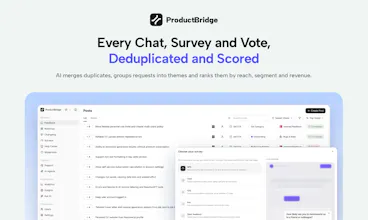
Most teams run a helpdesk, a feedback board and a survey tool, then copy between them all week. ProductBridge is one system. An AI agent answers support chats from your help center, calls your APIs via tools, workflows and MCP, and hands off when it should. Every chat, survey and vote is captured, deduplicated and scored by reach and revenue, so your roadmap runs on evidence, not opinions. Ship it and everyone who asked is notified. MCP for Claude, ChatGPT and Cursor. Flat pricing, free plan.
This is the 2nd launch from ProductBridge. View more
ProductBridge
Launching today
AI-native customer support and feedback agent
Most teams run a helpdesk, a feedback board and a survey tool, then copy between them all week. ProductBridge is one system.
An AI agent answers support chats from your help center, calls your APIs via tools, workflows and MCP, and hands off when it should. Every chat, survey and vote is captured, deduplicated and scored by reach and revenue, so your roadmap runs on evidence, not opinions. Ship it and everyone who asked is notified. MCP for Claude, ChatGPT and Cursor. Flat pricing, free plan.
A user submits feedback that makes you roll your eyes. Maybe it sounds unreasonable, or oddly specific, or feels like too much efforts. You almost ignore it and then something clicks.
@byalexai Yes! ProductBridge groups related feedback and surfaces recurring themes and pain points across your connected channels. That helps you spot issues customers are starting to mention more often and investigate them early, before they affect more people.
"Hands off when it should" is the sentence I'd want to stress test - what's the actual signal that triggers a handoff? Confidence score, specific intents that are always routed to a human, or something else? An agent that's slightly too confident about when it can resolve something on its own is worse than one that escalates too often, and that failure mode doesn't show up in a demo.
@galdayan Fair challenge. Today, handoff happens when the agent can’t answer from its available content, a workflow routes the conversation to a human, or a conversation hits its reply or credit limit. You can also build explicit routing rules around customer responses.
Your point about overconfidence still stands: recognising that it can’t answer is the part that needs stress-testing. Those controls don’t guarantee it catches every case, and I wouldn’t claim otherwise.
@hareesh_vemasani appreciate the honesty there, most teams pitching this would just claim it's solved. the reply/credit-limit fallback makes sense as a safety net, but it's really the "can't answer from available content" detection that's doing the heavy lifting - that's the part I'd want to see tested against edge cases before trusting it on real customers.
Report
So youre telling me, i can finaly stop copying text from support tickets into Slack and pretending its a "product management"?😅Whats the funniest feature request your AI has helped spot so far?
@kostfast Haha, “copy-paste into Slack” has had a long run as a product workflow 😂 That’s exactly the busywork we’re trying to take off your plate. No funniest-request winner to share yet, but this comment deserves a spot in our launch highlights 😅
@nick_csu Thanks! That’s the idea 😊 You can check customer feedback and create or update roadmap items right from Claude or Cursor. Fewer tabs, more context while you’re building!




Congratulations on the launch 🚀
ProductBridge
Thanks a lot for the support,@abhishek_ambad !
Great to see that the team listened and built in more continuity for customer records and closing the loop. Congrats on the launch!
Scarlett.
Can ProductBridge also help identify feedback trends before they become bigger customer pain points?
ProductBridge
@byalexai Yes! ProductBridge groups related feedback and surfaces recurring themes and pain points across your connected channels. That helps you spot issues customers are starting to mention more often and investigate them early, before they affect more people.
Dial
"Hands off when it should" is the sentence I'd want to stress test - what's the actual signal that triggers a handoff? Confidence score, specific intents that are always routed to a human, or something else? An agent that's slightly too confident about when it can resolve something on its own is worse than one that escalates too often, and that failure mode doesn't show up in a demo.
ProductBridge
@galdayan Fair challenge. Today, handoff happens when the agent can’t answer from its available content, a workflow routes the conversation to a human, or a conversation hits its reply or credit limit. You can also build explicit routing rules around customer responses.
Your point about overconfidence still stands: recognising that it can’t answer is the part that needs stress-testing. Those controls don’t guarantee it catches every case, and I wouldn’t claim otherwise.
Dial
@hareesh_vemasani appreciate the honesty there, most teams pitching this would just claim it's solved. the reply/credit-limit fallback makes sense as a safety net, but it's really the "can't answer from available content" detection that's doing the heavy lifting - that's the part I'd want to see tested against edge cases before trusting it on real customers.
So youre telling me, i can finaly stop copying text from support tickets into Slack and pretending its a "product management"?😅Whats the funniest feature request your AI has helped spot so far?
ProductBridge
@kostfast Haha, “copy-paste into Slack” has had a long run as a product workflow 😂 That’s exactly the busywork we’re trying to take off your plate. No funniest-request winner to share yet, but this comment deserves a spot in our launch highlights 😅
Cortex
The integration with MCP sounds like a huge time saver for developers using Claude and Cursor.
ProductBridge
@nick_csu Thanks! That’s the idea 😊 You can check customer feedback and create or update roadmap items right from Claude or Cursor. Fewer tabs, more context while you’re building!