
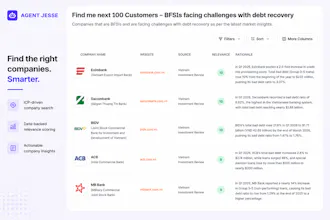
Sales teams have been stuck with stale databases for 15 years. Jesse changes everything.. the first internet-wide search engine built for sales & marketing. Ask in plain English: "Find newly opened soccer facilities in the Midwest needing turf solutions." Jesse scans the live web and finds the right buyers in the market today. We are an anti database company, we don’t scrape and store stale databases and sell them at premium. Every lead is found fresh from the live internet and delivered.



Free Options
Launch Team / Built With


Framer AI AgentsDesign and publish professional sites with AI
Promoted


Looks good - but for someone who already uses LinkedIn SalesNav - how's it different and what more can it add??
@its_grs
Fair question, and honestly Jesse is more complement than replacement if you already live in SalesNav.
Three real differences:
Data source: SalesNav knows what is on LinkedIn. Jesse reads the open web, news, funding, company sites, local directories, reviews, so it catches what LinkedIn underrepresents, recency signals like a fresh raise, and the local SMB long tail (salons, clinics, agents) where LinkedIn is thin.
Query model: SalesNav is structured filters bounded to LinkedIn's fields. Jesse takes a plain-English ICP and reasons over it, so you can ask for things there is no filter for, "recently raised Series B and hiring AEs," "uses Salesforce," a specific pain point, and still get matches.
Output: every result comes ranked with a rationale and a source, so the why-it-matched qualification is already done and auditable, and you can export it or pipe it into a workflow instead of working inside LinkedIn.
Where SalesNav might is mostly useful: if your ICP maps cleanly to its filters and your targets are all active there, it is excellent.
Jesse helps you when the criteria do not fit those filters, the targets live off LinkedIn, or you want a reasoned, exportable list rather than manual qualification.
Plenty of people run both.
@maulikdoshi
Thanks Maulik.
Really appreciate this, you described the exact itch we built Jesse to kill, and we are only getting sharper from here.
Does it have MCP integrations yet?
@saurav_gopal
Yes, we have an MCP server that exposes Jesse's search as tools (find companies, find people, fetch results), so any MCP client can run a search and get the results right in the flow.
It works today with the key-based clients, Claude Code, Claude Desktop, Cursor, and the API, by pasting your Jesse API key.
It is in request-only beta right now, so reply or DM and I will get you early access.
Nevertheless it will be fully public in 2 to 3 days.
Side note: if n8n is also on your radar, the template is already live in the n8n gallery (search 'Jesse'). Same API key."
So proud to see Jesse out in the world today. 🚀
I've watched the team pour everything into this, late nights, endless user calls, and a stubborn refusal to ship just another stale database when the whole industry said that's just how it works.
The live-internet search is genuinely wild, but what I'm proudest of is how obsessively we listen to users. Every piece of feedback gets read and acted on, and it shows in how fast this thing keeps getting better.
If you've ever burned an afternoon building a lead list only to find half of it was wrong — this one's for you. 🙌
@gautham_madhavan This is beautiful- huge congrats to the whole team for the launch and on building something that actually solves the stale-list pain so many of us have lived through. The live-internet search is the real delta, and the fact that you’re obsessively listening to users and shipping fast is what turns “wild concept” into “daily tool.”
I’ve burned way too many afternoons assembling lists that go half-bad before outreach, and Jesse’s approach is exactly what SDR teams need to stop that waste.
Let’s get Jesse into Top 5 of the Week.
I think the live web search can be a huge delta in tools like these. It can solve for the freshness of the data always there in the tool.
I think this is a cool concept. Looking forward to testing this out. All the best for the launch, guys.
@rohitsrivastv Exactly- freshness is the biggest delta, and live web search at query time is what keeps data from decaying the moment it hits a database. That's the core unlock for timing-sensitive outreach.
Thanks for the kind words and the launch congrats! When you test it, try prompts that encode recency (e.g., "VP of Sales who recently changed roles at Series B SaaS") to see how the signals surface. If you hit any edge cases or want help tightening your ICP criteria, I'm here.
All the best
Congrats on the launch! I love the idea of fresh data!
I searched for my ICP and buyer intent from 2023 and 2022, and the results turned up, which initially had me thinking this was old cached data. After reading more about the product above, it could be that my search criteria were wrong. I didn't specify a timeframe, so it's odd that those old buyers' intent was listed.
I ran out of credits while attempting to prove this tool could work for me, so I couldn't purchase a subscription.
Cant wait to try this. Have had my own share of struggles with stale databases.
@itsshrey Thanks, Shreyas. It will be really awesome to have you use Jesse and share more detailed feedback with our product team.