
CybeDefend secures the code your AI agent writes, from inside the agent. One command installs VibeDefend on Claude Code, Cursor, Windsurf, Copilot, Codex and other agents. The agent then codes with your business rules, mined from your repo, and your security rules in its context. Each diff is scanned while the file is open, and a guard stops rm -rf, sudo or secret reads before they run. SAST, SCA, secrets, IaC, CI/CD and container scanning are included. Free plan, no card.
This is the 2nd launch from CybeDefend. View more

VibeDefend by CybeDefend
Launching today
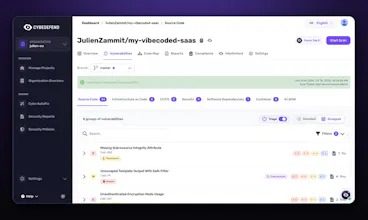
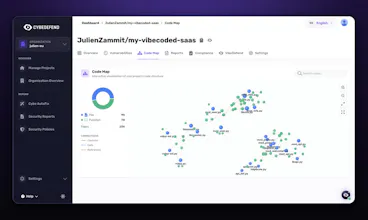
VibeDefend installs on your AI coding agent (Claude Code, Cursor, Windsurf, Copilot, Codex and more) with one command. From then on the agent writes with your business rules, mined from your repo, and your security rules in its context. It scans each diff while the file is still open, and a guard refuses rm -rf, sudo or a read of your secrets before it runs. Scanners check code after the commit, this runs before the line is written. Free plan, no card.
Free Options
Launch Team / Built With


Kilo Code
this just makes so much sense. security is an everyone problem, and @CybeDefend makes it a no brainer.
s/o ?makers for the great work on this new launch.
CybeDefend
Hey Product Hunt ! 👋 I’m Axel, the third co-founder, handling Growth and Go-To-Market here at CybeDefend
@julien_zammit shared our origin story, and @florentin_ledy highlighted the tech. I want to talk about what happens when you actually put VibeDefend in the hands of a dev team.
When we ran our study, we found something crazy: left to their own devices, AI agents ignored internal business and compliance rules in 88% of cases. They write fast, but they accumulate silent technical debt just as quickly.
By governing the agent at the exact moment the code is written (an approach we call "Shift-0"), VibeDefend brings that rule compliance up to 89%.
It’s not just a security tool; it’s an enabler. It allows your team to confidently scale "vibe-coding" without the CISO or the Lead Dev losing sleep over what’s being shipped to production.
I’ll be hanging out in the comments all day with the team. I'd love to know: what is the main risk keeping your team from giving full autonomy to AI coding agents right now? Let's chat!
Kilo Code
fun fact: 81% of the community is a 'human-in-the-loop' type of developer, according to this thread.
@axel_paulin i think the main concern for us is data leakage and accidental secret exposures when agents auto-commit. best of luck for launch
CybeDefend
@vikramp7470 Hey Vikram, thanks for the support! 🙌
You hit the nail on the head. Accidental secret exposure and data leakage are the exact nightmares keeping engineering leaders from adopting fully autonomous agents. Agents are incredibly fast, but they often lack the contextual awareness of what is sensitive.
This is exactly what CybeDefend is built to prevent. Because we operate at the "Shift-0" level (intercepting right at the generation phase, before any auto-commit), we act as a hard boundary. If an agent tries to leak a secret, push PII, or bypass a core security rule, we instantly block that specific dangerous action in real-time, without breaking the rest of the agent's workflow.
Toone
Hey! Solid launch! I wonder how can I integrate this application into my current setup
CybeDefend
@matheus_paranhos1 Hey Matheus, thanks a lot for the support! 🙌
Integration is actually designed to be super straightforward. You can check out the step-by-step guides for different environments right here in our documentation: https://docs.cybedefend.com/latest/api-reference/introduction
To point you in the exact right direction, I'd love to know a bit more about your current setup!
Let me know, I'd be happy to walk you through how it would fit perfectly into your workflow! 🚀
CybeDefend
@matheus_paranhos1 @axel_paulin You'll also find all the native integrations we offer here, and I'm happy to help if you need anything:
https://www.cybedefend.com/en/integrations
Toone
@axel_paulin @florentin_ledy Looking good! Having support for codex could also be extra useful there!
CybeDefend
@florentin_ledy @matheus_paranhos1 We actually already support OpenAI Codex just as seamlessly as Claude.
@julien_zammit wrote a deep dive on Codex security risks and best practices if you want to take a look: https://www.cybedefend.com/fr/blog/openai-codex-security-risks-best-practices
Hey, what an amazing idea ! Is it easy to integrate to any project ?
CybeDefend
@louis_goudal Thank you so much! 🙏
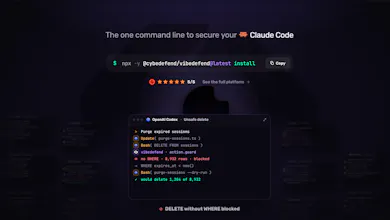
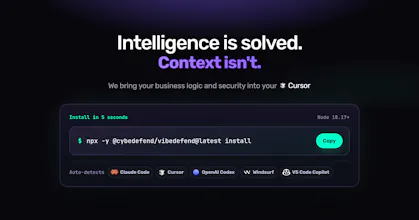
Yes, it's a single command:
The installer walks you through it: pick your region (EU or US), sign in, and it auto-detects the agents you have installed (Claude Code, Cursor, Codex, Windsurf, VS Code Copilot) and wires them up. It works on macOS, Linux and Windows.
You can try it for free, no credit card required. Let me know how it goes!
CybeDefend
@louis_goudal It installs on the agent and not on the project, with one npx command, then you link a repo by dropping its project id in a small config file at the root. The docs walk through it: docs.cybedefend.com/latest/agent-ai-integration/vibedefend
How much control do teams have over the business rules mined from the repo?
CybeDefend
@devinstone Great question! Rules come from two sources, and your team stays in control of both.
At the first scan, our miner analyzes the repo and extracts the most consistent coding conventions and business rules, so the agent starts with a solid corpus from day one.
Then the corpus keeps growing as you code. When a business rule emerges during a session, either because the agent realized it made a mistake or because you corrected it, it can propose that rule at the end of the session. Your rule base gets enriched automatically, session after session.
On the control side:
Session proposals are never applied silently: they land in a review inbox and your team accepts or rejects each one. By default, the agent even asks you in chat before drafting one.
Curious to hear how your team manages these rules today!
CybeDefend
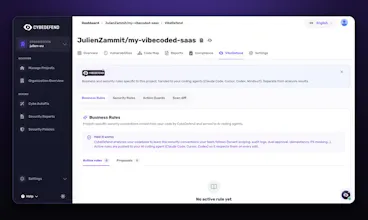
@devinstone Adding one important point, because it's the part teams ask about most, what you can do with the rules once they exist. Every rule lives in the VibeDefend tab of your project dashboard, as a plain sentence you can read, edit, rewrite or delete. A new rule always lands as a proposal first, whether it was mined at the first scan or suggested after a session, and the people in charge of the project decide which ones go active. Once active, a rule applies to every agent and every developer connected to that project, Claude Code, Cursor or Copilot alike, so there is one rule base and not one file per person to summarize, mining gives you the starting point, the review is where the team makes it theirs. The proposals inbox and the end-of-session gap analysis are documented here: docs.cybedefend.com/latest/agent-ai-integration/vibedefend, and there's a longer piece on giving the agent business context rather than conventions: cybedefend.com/en/blog/how-to-give-claude-code-context
Kilo Code
@devinstone curious: how do you currently manage your business and security rules with your team?
Does the agent get the security feedback immediately so it can fix the issue in the same coding session?
CybeDefend
@albertnelson Yes! At the end of the session or when he finished part of the deliverable before the pull request, VibeDefend runs a scan on the agent's work. It runs in the background, so the agent can keep going and gets notified as soon as the scan is done, then fixes the findings in the same session.
The scan only covers the files the agent modified, so it's very fast and focused on the work it just did. For example, if it introduces a SQL injection, it gets the finding and switches to a parameterized query before you even commit.
The result: far fewer alerts further down the pipeline.
CybeDefend
@albertnelson One other thing on what that feedback actually contains, because it's where we spend our energy. A SQL injection is the easy part, every scanner catches it. 43% of API vulnerabilities exploit business logic, not a CVE (Wallarm, 2026), and no scanner sees that a refund above 500 euros needs a finance manager.
So the rules are mined from your repo at the first scan, then served to the agent right before it writes the feature the developer asked for, the right rule at the right moment in the right file. We measured the difference on tickets with the same model, and the whole study is public: github.com/CybeDefend/vibedefend-xp. More on why scanners are blind to this: cybedefend.com/en/blog/business-logic-flaws-ai-generated-code
Kilo Code
@albertnelson thanks for the support! curious what's your stack btw? anything your coding agents did that scared you lately? ping ?makers
Does the secrets scanner also check files that are generated or modified indirectly by the coding agent?
CybeDefend
@jackthompson68 Yes, in two ways:
Files the agent edits directly are scanned at the end of the session.
If the agent commits during the session, the scan also covers the full git diff of those commits, so files generated or modified indirectly (codegen, scripts, shell commands) are included too.
Upstream, the secret guard also blocks the agent from reading raw secrets (like .env files) and points it to the managed reference instead, so secrets are much less likely to end up in generated code in the first place.
Anything not committed during the session gets picked up by your regular CybeDefend scans (CI or repo) as soon as it lands in the codebase.
CybeDefend
@jackthompson68 Good question. Two layers, upstream, the guard refuses the read of .env or of a secret in the first place, so it never enters the agent's context and can't be copied into a generated file. Then the end-of-session scan covers what the session changed like Florentin explained. The hook layer, what fires on each tool call and at session end, is described here: docs.cybedefend.com/latest/agent-ai-integration/vibedefend