I was a beta user, and what impressed me was how quickly they responded to messages and feedback. As a creative who uses tech across my workload I attend a lot of meetings and trainings. I also do a lot of independent work. I have a storehouse of information that is curated and easy to manger. I can delete old information and update it with new info very quickly.
There are great features I didn't even know existed until I explored. For example I went to a class and wanted to turn the information into informative posts. I uploaded in the class material then went to the "create" session and after 5 minutes chatting with the AI had about 6 very indepth and accurate information posts. And this was on a niche, let's say adult, educational class. It is important the information was correct and informative. I know the source, so I know it was.
Also, speaking of it--how flexible. No moralizing, to watering down, no "oh, let me tell the human what it wants." It's a memory bank and partner in making the information you have useful.
Since I'm busy the ability to chat up Liminary and ask it questions that I know I vaguely remember I learned somewhere is huge. An open question like, "Hey, what do I know about drafting a super prompt to do XYZ" makes me much more efficient. For my ND brain, I use it as very flexible backup. I can even build agents that do automatic things like track reader trends and have Liminary update itself on a daily, weekly, or custom schedule. That information automatically becomes part of my knowledge bank, and can be updated at anytime.
Very easy to use. Even sends me weekly recaps of "here is what you learned this week". When I entered the beta I wasn't sure how helpful it would be. I now am an annual member that uses it all the time.




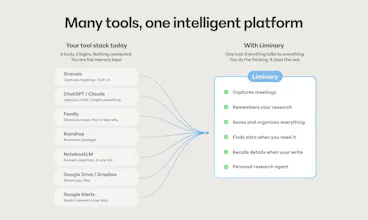


Hey Product Hunt 👋 I'm Sarah, founder of Liminary.
I led ML engineering for Dropbox. Semantic search, retrieval, and Dropbox's first generative AI integrations. I built Liminary out of personal frustration: storage is archival. I couldn't save articles, meeting notes, and the useful AI conversations in one place, and then on top of that, I'd never see any of it again. Lost in closed tabs, various note taking apps, emails, and AI chats.
AI tool proliferation made it worse, not better. Every new model meant re-benchmarking, redoing workflows, re-feeding context. As a builder, I believe users should get the best model for the job, not chase whichever one shipped this week.
But there's a deeper problem beneath both of those: every AI tool you use is working from what the model thinks is relevant. Trained on the internet, guessing at your context. Not what you've decided matters. That's the gap.
Our team at Liminary is all ex-Dropbox and ex-Google. We built Liminary to close that gap: the memory layer for your AI work. You decide what goes in: files, web pages, YouTube videos, LLM transcripts, Gmail threads. Your AI works from that. Always.
Liminary lives across the surfaces where you work: a browser extension, a writing sidekick in Google Docs, a meetings layer, and a place where everything you save lives and connects.
Three things Liminary does that no other tool can:
Proactive recall. The right knowledge surfaces at the moment of work. You don't search. It finds you.
In-context fact-check and Gap detection. As you write in Google Docs, Liminary validates claims against your own library, finds what’s missing from the research you already did or the information your clients already shared with you. Not the web, not training data.
Meeting recall, live. No bot in the room. When someone says "Project Atlas," your notes already read "Project Atlas with Alice and Bob [source]." Other meeting tools take notes. Liminary connects what's said to everything you already know.
Built for people who bill for their perspective: independent consultants, fractional leaders, VC analysts and strategists. In a world where everyone uses the same models, your edge is what those models are grounded in.
The work looks like this: you keep ambient context on a small set of clients, accounts, companies, or topics you think about repeatedly. You research them. You meet about them. You produce deliverables about them. Liminary connects all three, so the research, the meetings, and the writing all work from the same knowledge.
What's the one piece of context you wish your AI actually remembered?
Early days. Honest feedback welcome: liminary.io
~ Sarah and the Liminary Team
Strong work on the extraction architecture. I'm curious on how you handle data sovereignty for consultants with NDA'd client materials—is processing local, or do you have isolated tenant architectures? Consultants, for example, need strict boundaries between client A's data and client B's data, not just document-level permissions. I believe engagement-level isolation would matter more than document-level permissions here.
@sinchana_v We have strict scoping of sources by collection -- Liminary won't use sources from one Collection when working in another, and using one collection per client is a common pattern among our users. It's not strict host-based isolation, if your contracts require specific technical measures, but it will prevent leakage.
@sinchana_v +1 to Tom's answer on the product-level scoping, that's how engagement-level isolation shows up in practice for our consultant users.
Adding the infrastructure side since you asked. Processing isn't local, it runs in our cloud, but the architecture is built around isolation and encryption from the ground up. We run on AWS with tenant data scoped per account, end-to-end encryption in transit and at rest, and KMS for key management. So while it's not on-device, the substrate is enterprise-grade rather than shared general-purpose infrastructure.
On your bigger point, engagement-level isolation mattering more than document-level permissions, I think you're right, and that's why we built the unit of organization to be collections rather than tags or folders. Collections are the boundary, and Liminary respects it across retrieval, synthesis, and surfacing. Permissions on individual documents would be much weaker because the retrieval layer would still cross boundaries when answering questions.
Curious, what kind of client work are you running into this with? Some industries push harder on this than others, and I'd love to understand where you're seeing the friction.
@sarah_andrabiI’m not coming from direct client work here, it was more of a design edge case I started thinking about while reading your setup. My thought was that in some consulting or regulated environments, even retrieval crossing engagement boundaries could become a trust/compliance issue, so the collection-level isolation approach stood out to me.
Congrats on the launch. Grounding AI in saved knowledge feels like the right direction, especially for work where the answer depends on private context rather than general internet knowledge.
The hard part I’d be curious about is conflict resolution. Once people save enough snippets, docs, examples, and notes, some of that context will be stale or contradictory. Does Liminary have a way to show which saved source influenced the answer, or to rank “this is current policy” above “this was a random note from six months ago”?
For me, trust in grounded AI comes less from having more context and more from knowing which context won.
@jim_jeffers that's a really good question. Every answer Liminary generates is tied back to the specific saved sources it used. Not a generic list of related notes, but the actual sources that influenced what got synthesized, with one click back to the original. So you can always see which context won per se, not just trust that the right one did.
On the ranking question, recency is a strong signal but not the only one. Access patterns matter too. If you've been pulling on an older note recently, the system treats it as still live in your thinking. And updates supersede, so when you rewrite or revise a note, the new version is what gets retrieved. A random older note only outranks current policy if you've kept engaging with the old one and let the new one go stale, which is usually a signal worth surfacing anyway.
The other layer is that Liminary builds a memory of what you're working on right now and your preferences over time, so retrieval gets tailored to you specifically. The same library of sources can produce different answers for different users, because what's most relevant depends on the work you're in the middle of.
We currently don't yet have a way for users to explicitly mark a source as the authoritative version, but that's definitely food for thought for us. Right now it's inferred from signals rather than declared, which works well in practice but isn't as legible as it could be.
@jim_jeffers It's a difficult problem for sure. As you suggest, recency and staleness signals help here; not just when you saved a source, but when did you last reference it, and does it include date information in the content itself. The other very useful bit is that Liminary remembers your previous working sessions. So if you've said once that a piece of information is out of date, Liminary can use that in future sessions.
This makes sense. The “I already told the system this was stale” part is especially important, because recency alone can be misleading in real work.
I like the idea of inferred authority, but I’d still want an escape hatch for explicit authority: “this is the canonical policy/source until replaced.” That seems useful for teams where an old-but-current document should beat a fresh-but-casual meeting note.
@jim_jeffers yeah, that's a fair point and a real gap. The use case you described, old-but-current beating fresh-but-casual, is exactly where inferred authority gets thin and you'd want a user-declared signal instead. Definitely something we're going to chew on. Thank you for engaging so thoughtfully with our launch!
I've been thinking about this exact problem. I built a persistent memory system for my AI agents — each one maintains its own JSON file tracking known issues, trends, and changelog — and the coordination between agents reading each other's memories was the hardest part to get right.
The "source-grounded with traceable citations" angle is smart. Most AI knowledge tools lose the provenance chain and you end up not trusting the suggestions. Does Liminary handle conflicting information from different sources?
@ytubviral Agent coordination with regards to memory is genuinely a fun problem to solve. Years of building search and retrieval at Dropbox taught us a lot about how this breaks down at scale, and we built Liminary's architecture and memory systems with those lessons in mind.
On the conflict question specifically: at ingest, an extraction process builds structured understanding of each source, including where things corroborate and where they contradict. So if you saved a client interview six months ago and a more recent one where the same person changed their view, Liminary doesn't flatten them into a single answer. Both surface, with the tension visible and citations back to each source.
One thing that helps on the coordination side: the memory layer is shared across every agent inside Liminary, not partitioned per agent. So there's one source of truth underneath, not many that need to negotiate.
Congratulations!
The real value, to me, is not saving knowledge, but making past thinking reusable at the exact moment it matters.
how do you handle memory hygiene over time, especially when old context becomes outdated or no longer reflects the user’s current thinking?
Thanks@thamibenjelloun! And yeah you nailed it. Storage for the sake of saving isn't the point. Finding at the right moment and finding the most relevant thinking is the problem we're trying to solve.
We're carrying over a lot of lessons from working on retrieval at Dropbox. Couple big ones we leverage are that recency is a strong signal, but so is access. When you look for something new that's related to an older note, that tells the system the older note is still alive in your thinking, even if you haven't touched it in months. It earns its way back up.
Also as users curate collections we treat those as living, not append-only, so pruning and regrouping is part of the workflow, not a chore bolted on top. Updates supersede instead of piling up, so when you rewrite a note the new version is what gets retrieved and the old framing doesn't keep haunting you. And you stay in the loop. When Liminary surfaces something, you can dismiss it, edit it, or mark it as outdated, and that feedback shapes what shows up next time.
Honestly hygiene is a hard, ongoing problem, and I'd rather make curation lightweight and continuous than pretend the system can fully self-clean.
The 'ground in saved knowledge' framing solves the part everyone hand-waves. I lose 20 minutes a day re-pasting the same context blocks into different chats. Curious how you avoid the typical RAG failure mode where the model picks the longest snippet over the most relevant one. Reranker step or pure embedding retrieval?
@whateverneveranywhere Good question. Short version: neither pure embeddings nor a reranker on top of them. The architecture is built to avoid that failure mode upstream rather than patch it downstream.
Two pieces. At ingest we run an extraction process that builds structured understanding of each source, so retrieval isn't operating on raw chunks. At query time, the answering layer is built to consume that structured understanding, not a top-k pile of snippets ranked against the question.
So you never get the "longest snippet wins" failure because nothing in the system is choosing between similarly-embedded snippets and hoping the right one floats up.
Congratulations on the launch! I've been a beta user for months!
What I like about Liminary is that it is not just a place to save links and forget them.
I use it throughout the day to save articles, emails, Substacks, and other sources I want to come back to. I can pull out notes as I go, organize things by theme, and then revisit them later in a way that actually helps me see connections.
The weekly summary is one of my favorite features. It helps me spot patterns, trends, and even contradictions I might have missed when I was reading things one by one.
Plus--the @Liminary team is amazing, super responsive and helpful!
@michelle_dawson_silbernagel Thank you for sharing how you use Liminary! Wonderful to hear how it fits into your workflow. I’m especially glad the weekly summary is helping you spot those trends and contradictions - I agree this is where the insights can be surprising!
@michelle_dawson_silbernagel Michelle!! You've been with us through versions of this product that barely worked, and the fact that you're here saying this on launch day means more than I can put into a PH comment. Thank you!