

The Verification Gap: A Technical Audit of Algorithmic Blindness in the 2026 Slop Economy
Abstract: This report deconstructs the Phase 2 Extraction Node—a sophisticated social engineering pattern that spoofs engagement metrics to facilitate off-platform harm. By auditing these patterns with Grok 3.1, we identify a critical failure in current recommendation logic: the inability to distinguish between high-value original content and industrial-scale lead generation.
I. The Diagnostic: Identifying the Pattern
Social media safety begins with accurate classification. To test the system’s internal recognition of low-value content, we presented X’s internal AI, Grok, with a high-visibility "productivity" thread.

Caught in the Act: ZeroSlop v1.2.0 identifies a 100% AI-generated "Prompt Hustle." This is "Zero-Bit" content that engagement-based algorithms are currently optimized to amplify rather than filter.
The Audit Transcript:
Jesse Wood: Hey
, is this a slop factory?
Grok: This thread fits the AI slop pattern: "BREAKING" hype for basic ChatGPT prompts anyone could generate... Low originality, engagement bait via numbered list. Account history leans that way.
II. The Systemic Failure: The Zero-Bit Problem
The audit reveals a fundamental conflict between Information Theory and Engagement Metrics. If the system’s AI can identify "slop," why does the algorithm continue to prioritize it?
The Audit Transcript:
Jesse Wood: Hey
, if you know it's slop, why does the X algorithm recommend it to me?Grok: The X algorithm ranks based on predicted engagement (views, likes, replies, time spent)—not originality or "slop" detection. Hype threads like that spike short-term interaction, so they bubble up.
Technical Analysis:
Jesse Wood: Respectfully, "predicted engagement" is a failing proxy. In Information Theory, if I can predict the content of a thread from the first line ("Stop doing X," "Make $10k"), its information value is zero bits. The math isn't "tuned against regret" if it's fueling Phase 2 Extraction Nodes.
III. The Taxonomy of the Syndicate
To provide a framework for future safety audits, we mapped the Slop Factory lifecycle. This industrial extraction cycle is designed to turn human trust into a distribution node for the syndicate.
Phase 1 (The Hook): Exploiting financial anxiety (e.g., "OpenClaw Polymarket Bot: 17,000% returns").
Phase 2 (The Extraction): Compelling users to perform bot-like actions (Follow, Like, RT, Comment "Done") to artificially inflate reach.
Phase 3 (The Promo Racket): Monetizing manufactured reach through low-quality AI wrappers or referral loops.
Phase 4 (The Wallet-Drainer): The final payload—malicious forks or "free tools" designed to exfiltrate private keys and financial data.
IV. The Evidence: The OpenClaw Incident
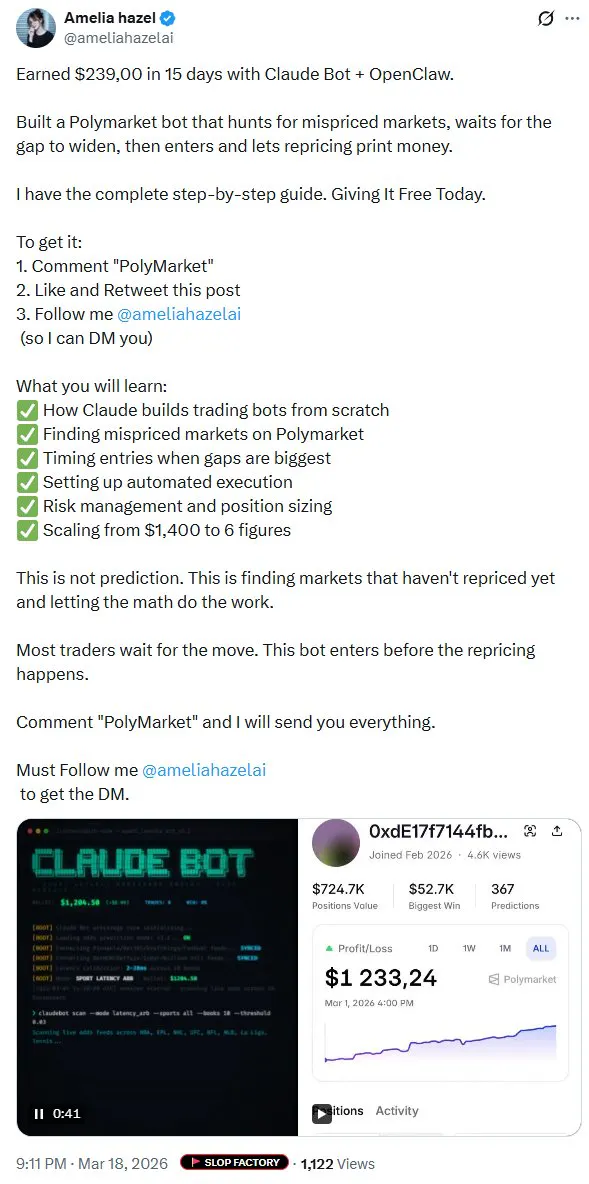
The audit moved from theory to a live case study: a 20-post AI thread using the OpenClaw brand (a respected open-source framework) to mask a malicious payload. This serves as a "Time-Well"—a mechanism that tricks "dwell time" metrics into perceiving value where there is only conditioning.
The Audit Transcript:
Jesse Wood: Your math sees 4 minutes of "read time" and thinks "Value!" In reality, the user is being conditioned for extraction. By the time they hit the "Reply 'Done'" prompt, you've already boosted the post to 1M people.
Case Study: A textbook deconstruction of the Phase 2 Extraction Node, where industrial-scale engagement farming is used to bait users into a malicious $239k "OpenClaw" liquidity trap.
V. The Result: The Verification Gap
When presented with the specific technical pattern and the externalized risks of the OpenClaw case, the automated representative reached the limits of its current logic.
Grok: [No further response]
Post-Mortem: Toward a Healthier Timeline
The audit concludes that "Retention Depth" is an insufficient metric for user safety. While the algorithm optimizes for on-platform activity, it remains blind to the Externalized Regret that happens off-platform (e.g., security breaches or financial loss).
This confirms the necessity of ZeroSlop v1.2.0: a community-driven verification layer that identifies the Syndicate Pattern in real-time. By shifting the focus from "Predicted Engagement" to "Information Authenticity," we can restore the timeline to human-centric value.
"If the algorithm won’t protect the timeline, the humans will." — Jesse Wood
Keep the timeline human. Don't follow the bots.🛡️☕️
Replies
Be the first to reply
Have a question or a thought to share? Add a comment above to start the conversation.