
 •
•7mo ago
ShadcnDesign Launch
Hey! I'm Matt, and today I'm launching shadcndesign - the complete shadcn/ui toolkit I wish existed when I needed it.
Quick backstory: I spent 7 years building Figma resources for 100,000+ designers and maintaining the Ant Design System. When I went looking for a proper shadcn/ui kit for Figma, everything I found was either outdated, poorly built, or abandoned. So I decided to build it myself.
Here's what shadcndesign includes:
2,000+ Figma components that perfectly mirror shadcn/ui code -- auto-layout, variants, Tailwind CSS variables, the works
 •
•3mo ago
Launched something today that I've been quietly scared to ship
LexScan paste a contract, get a legal memo with red flags and what to do about them.
The fear: lawyers will hate it. The reality so far: some do, some think it fills a real gap for people who can't afford a consult for every document they sign.
Built it as a solo developer. No legal background. $9 for 50 analyses, no subscription.
One thing I genuinely don't know yet: which type of contract it's most useful for. Leases? Freelance agreements? Employment offers? SaaS terms?
 •
•3mo ago
We built an AI long form report generator. Are we the first ones to do it?
There are established players in AI slide generation and AI Excel generation. There are almost none that generate long-form reports. That gap isn't an oversight, and it isn't accidental. It's because the problem is genuinely, structurally harder. Here's why.
The slide problem vs. the report problem
AI-generated presentations work because the format is constrained. A slide has a title, a few bullet points, maybe a chart. You know roughly how much content goes on each slide before you start. The structure is fixed, the length per unit is bounded, and the output is predictable.
Long-form reports don't work that way. A section on "competitive landscape" might be two sentences in one report and four pages in another, depending entirely on what the research finds. There's no fixed length. There's no fixed structure. The content determines the form, not the other way around. That single difference makes the engineering problem an order of magnitude harder.
 •
•3mo ago
Pomio — Focus better with a smooth Pomodoro timer
Hey Product Hunt
I just launched my first app: Pomio.
Pomio is a simple productivity app built around the Pomodoro technique. It helps you stay focused with customizable work sessions and breaks, plus smooth automatic or manual phase switching. The goal was to keep it minimal, fast, and distraction-free.
It s built with Flutter, using Riverpod for state management and Hive for offline-first local storage.
 •
•3mo ago
What's the most confusing document you’ve ever signed without reading?
 •
•3mo ago
Deploying AI agents in enterprise: ship fast and iterate vs build the 'right' architecture first?
There's a debate I keep having with enterprise AI teams.
Side A says: 'Ship something working in 4 weeks, prove value, then refactor. Enterprises want results, not perfect code.'
Side B says: 'One bad architecture decision in enterprise AI costs you 6 months of rework. Get it right before you scale. The cost of fixing later is 10x.'
Both have merit. Both have horror stories.
 •
•3mo ago
Just launched VeloxTx: Building a multiplayer gaming ledger. Need feedback!
Hi Product Hunt community!
Today is a huge milestone for me. I just hit the "Publish" button on VeloxTx, a real-time stream ledger infrastructure designed specifically for multiplayer games.
As a developer, I was tired of seeing traditional databases choke and crash when hammered with thousands of high-frequency live events like player stamina updates, rapid skill cooldowns, and match logs.
To solve this, I skipped standard DBs and built VeloxTx on top of Valkey (the open-source high-performance key-value store). It allows game developers to stream SDK traffic into an isolated ledger with sub-millisecond logging latency, keeping their primary database completely free to breathe.
 •
•7mo ago
CelestiOS - AI startup
I m building an AI-powered Life Operating System.
The system learns context of how a person s life actually behaves
(calendar, energy, routines, priorities, finances, health , goals , emotions lot more ).
then Automation follows ...
OPEN TO QUESTIONS/FEEDBACK.
 •
•3mo ago
SiteRows example #4
Hello everyone. Welcome back to my siterows.com series.
Quick reminder of what this app does: Allows you to scrape web content with SQL, like you would query a DB. Creating a FREE account unlocks automation features and higher usage limits.
Today's question: "On the site, what is the whole deal with this Objects box?"
The purpose of the objects box is to give it a SQL-like look and feel, and here is how it's structured:
When you expand "DOM" and further expand any element like @a or @div, you get two items: "Scraper Fields" and "Attributes".
Under "Attributes", you'll find all the standard HTML attributes for that element
Under "Scraper Fields", you'll find a couple of extra synthetic attributes I thought would be useful like Index, Parent, Children, etc...
Scrolling back to the top, you'll see a couple of "Composite" elements I also thought would be useful. For example, the @headings element represent @h1, @h2, @h3, @h4, @h5, @h6 elements combined.
Think of any element like @a, @div, or @headings as your "tables", and their attributes like href, id, class as your "fields".
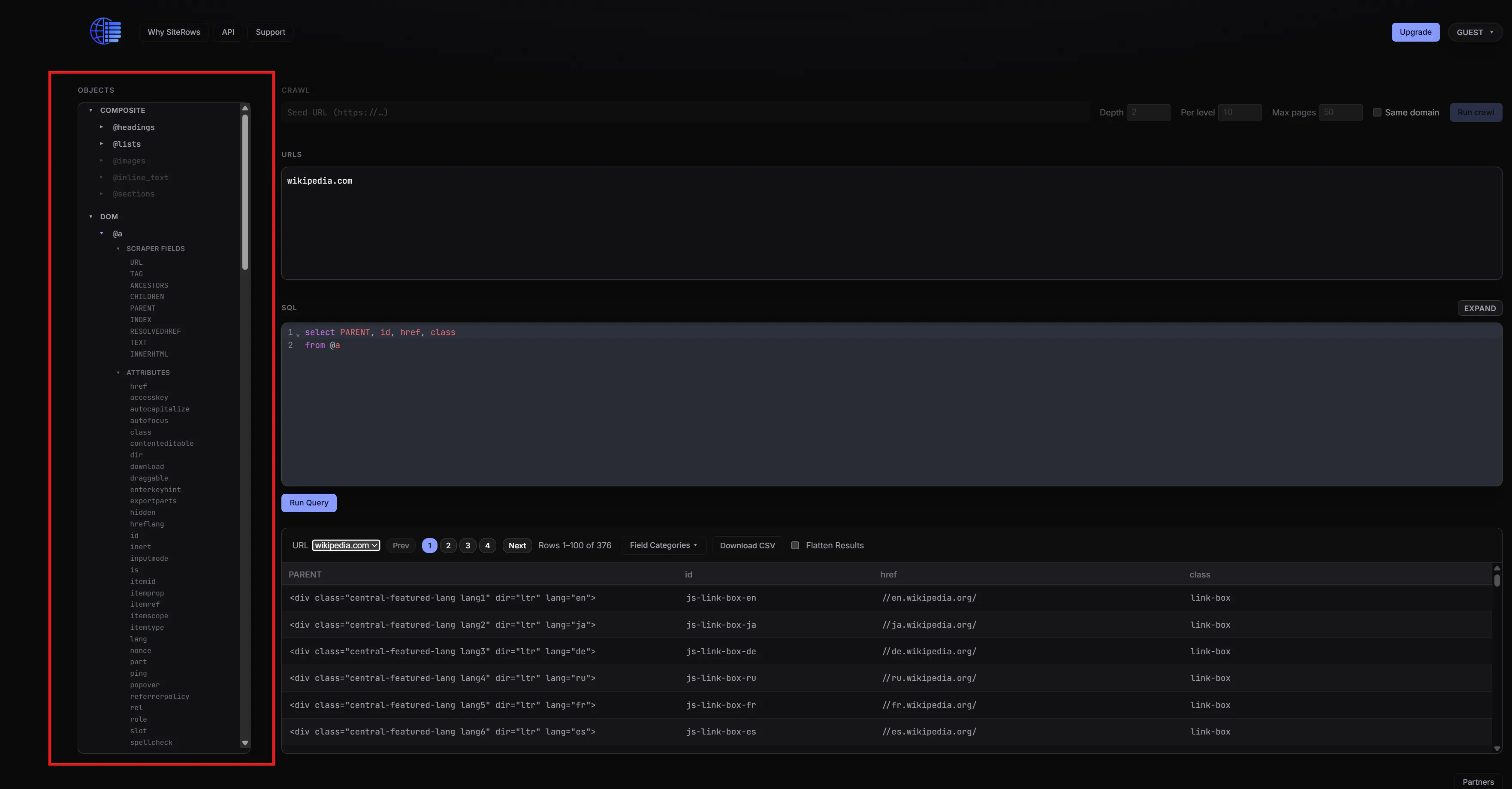
Thanks, everyone. Please don't hesitate to reach out with any questions or feedback.
 •
•3mo ago
We’ve made our digital lives so secure that our families will be locked out if we die.
That's why i am building Wyll.
I recently realized a huge flaw in my own security: I have my passwords, personal documents, plans etc. (which i do not want to provide to my family currently) locked down so tight that if I something happens to me tomorrow, my family gets absolutely nothing.
Writing a master password on a piece of paper is a massive security risk, but trusting a centralized cloud company with my data feels just as bad.
To solve this, I am building Wyll.
Wyll is a secure digital vault with a built-in "dead man's switch." You store your critical assets in it, and it automatically transfers access to your designated loved ones only if you stop checking in.