

Google just gave you a Search Console report for Instagram, TikTok, X, and YouTube.
On July 7, 2026, Google introduced platform properties in Search Console. It is a new property type that helps you understand how your social and video posts perform on Google Search and Discover.
Here is what it actually does.
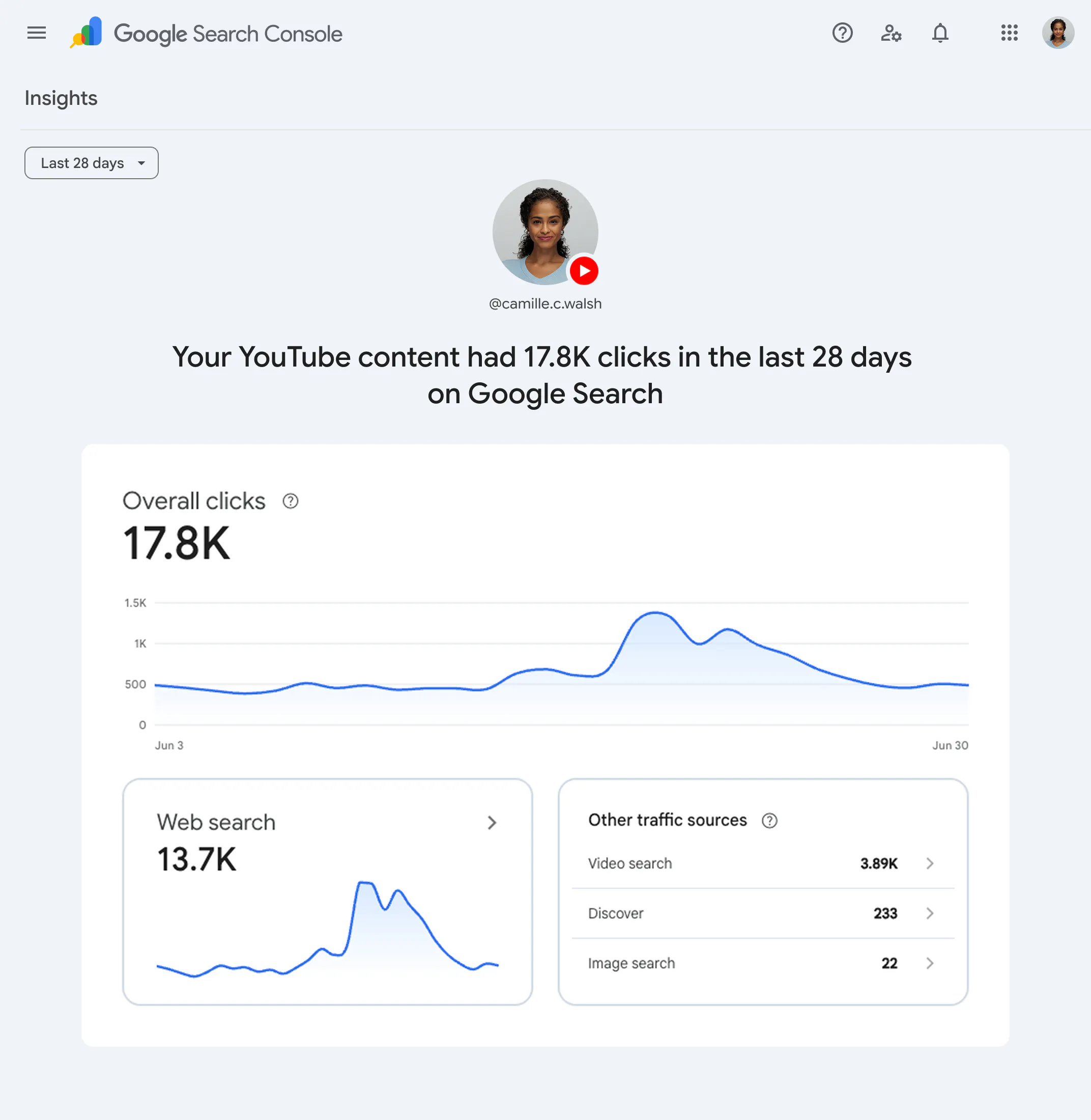
You can now track performance for four platforms: Instagram, TikTok, X (Twitter), and YouTube. For each platform, you get a dedicated Search Console property that shows you clicks, impressions, and the search terms that lead people to your content.
The data is structured. You can see your total clicks and impressions, and filter by post to see which specific content drives traffic. You can also export the data for further analysis.
There is an Insights report that gives you a high-level overview of recent traffic trends, your top-performing posts, and how people discover your account on Google.
There are Achievements that track milestones, like reaching a new threshold for total clicks from Google Search in the last 28 days.
The setup is straightforward. You go to Search Console, select "Add property," choose one of the four platforms, and follow the verification steps to securely authorize the connection. The feature is rolling out gradually over the coming weeks.
Why this matters.
Before this, if you were a creator on Instagram or YouTube, you had no direct visibility into how your content performed on Google Search. You could guess. You could use third-party tools. You could not see the actual search terms driving traffic to your posts.
Now you can.
What this means for creators and brands.
If you publish on social platforms, your content is discoverable on Google. The search terms that lead people to your posts are now visible. You can optimize your social content for search in the same way you optimize your website.
How Rankfender fits.
Rankfender tracks your brand's visibility in AI answers across ChatGPT, Perplexity, and Gemini. The new Search Console report gives you the Google Search side of social visibility. Together, you get a complete view of how your content performs across both search and AI platforms.
What I am curious about.
Will you set up platform properties for your social accounts? What do you expect to learn?
Imed Radhouani
Founder & CTO – Rankfender
Replies
This is a pretty big update. will historical data be available too, or does tracking only start after the property is connected?
@ashir_murtaza1 You're right to ask! this is an important detail. Based on the available information, historical data will not be available for these new platform properties.
The tracking only begins after you successfully verify and connect your account. Search Console does not appear to have retroactively collected this data for social platforms before the feature's launch.
Here is what that means in practice:
No backfill: You won't be able to see data from before you set up the property. The performance history starts from the moment of verification.
Start building history now: As one analysis put it: "The sooner you verify, the sooner you start building a history of cross-platform search data you can actually learn from" .
It works like standard Search Console: The data is reported separately for each platform property, allowing you to review performance for Instagram, TikTok, X, and YouTube independently.
Default reporting window: Search Console applies a default 28-day window to the Insights and Performance reports, which is consistent with other parts of the product.
The feature is rolling out gradually over the coming weeks. Once you have access, the best approach is to verify your accounts as soon as possible so you don't lose any more time building that valuable search performance history.
Interesting update. I think this is another sign that social content and SEO are becoming more connected.
@hosseinyazdi Exactly. The wall between social and search is dissolving.
For years, social content lived in its own ecosystem. You optimized for the platform, not for discovery. Search was a separate channel. Now Google is giving you the search data for your social posts. The same search terms that drive traffic to websites are now visible for Instagram, TikTok, and YouTube.
That changes things. The creators who treat their social content as searchable assets will have an advantage. The ones who ignore it will still be optimizing for the algorithm, not for discovery.
Thanks for surfacing this. If this becomes a long-term feature, it's honestly a bigger shift than most people realize. For years SEO, social, and content teams have been working from completely different datasets and attribution models.
The interesting part for me is finally seeing visibility data for content that previously lived in a black box. A lot of creators have been guessing which platform actually drives discovery. Having something closer to Search Console-style reporting could make content decisions way less speculative.
Nice breakdown. I wonder if this will encourage creators to optimize captions and titles more like blog content instead of just for platform algorithms.
@joseph_parker3 Yes, I think it will.
For years, creators optimized for the platform algorithm. Now they can see what actually brings people from Google to their content. That's a different incentive.
The ones who pay attention will start writing captions and titles that work for both. Not just to go viral on TikTok or Instagram, but to be found on Google. That's a shift that changes how you think about content creation. It's a shift that changes how you think about content strategy. It might be the first feature that truly bridges the gap between social media and search engine optimization.
Really interesting feature. Do you think smaller creators will benefit just as much or is this mainly useful once you have consistent search traffic?
i woder how short videos will be tracked. reels, shorts and tiktoks might need different insights.
@bradywilfaqn To be honest, that's a really sharp question, and the official announcement doesn't go into that level of detail.
This feels like an important shift because social content is no longer just “platform-native distribution.” It is becoming searchable inventory. For founders and creators, the useful insight may not only be which posts get clicks, but which search intents Google associates with their brand or category. That can influence product messaging, landing pages, and even what topics a company should keep owning publicly. I like the connection you made between Search Console data and AI visibility because the next reporting layer probably has to show both: where people discover you in search, and where machines summarize or recommend you. Curious whether Rankfender plans to combine those signals into one brand visibility score or keep them separate for diagnosis.