
 •
3mo ago
Do you care who built the software you use?
 •
3mo ago
AI made your team ship 2x the code. Your reviewers didn't get 2x the eyeballs
Two numbers from the same telemetry dataset (22,000 developers, two years) that explain most of the AI-productivity debate: in high-AI-adoption quarters, median code review time rose fivefold and merges with no review at all rose 31.3%. A queue that quintuples while more people climb over the turnstile means the bottleneck moved. It didn't disappear.
The output side is everything the demos promised: tasks per developer +34%, code-heavy tasks +210%. The absorption side is where it curdles: bugs per dev +54%, incidents per PR more than tripled, commit-to-production lead time +480% where organizations measured it.
Our read: this is arithmetic before it's culture. Generating a PR now costs roughly one sentence of intent. Accepting it still costs a human, reading at human speed, with human working memory. When one side of a pipeline drops its marginal cost by orders of magnitude and the other side doesn't move, the constraint relocates to the expensive side. It has nowhere else to go.
Every fix we've seen sorts into two buckets. Compressing acceptance lighter or no review converts review cost into incident cost, payable later with interest. Leveraging acceptance is the unglamorous bucket that works: smaller PRs (size is the axis authors control, and it moved +51% the wrong way), artifacts that arrive carrying their own evidence test output, the exact command to re-run so review shifts from reconstructing intent to checking claims, and machine passes before human attention.
 •
3mo ago
How do you actually remember useful things you find online?
I ve realized that my biggest productivity problem isn't finding information.
It's finding it again.
I can spend 10 minutes finding the perfect tutorial, article, tool, or GitHub repo and think, I'll come back to this later.
Then two weeks later, I remember that the resource exists but have no idea where I found it.
 •
3mo ago
When should an AI agent be allowed to remember?
Agent memory can be useful, but a confident guess from yesterday can turn into a trusted fact today. In our QA process we decided that a remembered selector or repair should only be returned when it points to concrete evidence: a verified run, a passing test, or a repair that later passes. Recency and contradictions can lower its confidence. No evidence, no memory.
If you re building agents, what criteria make a memory trustworthy enough for automatic reuse?
 •
3mo ago
How do you serve "earned" media without ever exposing the full asset?
A design problem I've been stuck on and curious how others have solved it.
Say you want to gate parts of an image a user unlocks regions one at a time by completing a step. If you blur or overlay client-side, anyone can grab the original from the network tab, so the gating is fake.
The approach I've seen work: never send the original at all. The server composites a flattened image with only the unlocked regions and sends that. If unlocks are sequential there are only ~N+1 states, so each composite can be content-addressed and cached generated roughly once.
Questions for anyone who's shipped gated/earned media:
 •
3mo ago
I’m getting better at building products, but not at finding people to use them
AI has changed how I build side projects.
When I have a problem, I can now turn the idea into a working product much faster than I could before.
But I've noticed that building faster hasn't solved the part I struggle with most.
After I launch something, I often have no real users to talk to.
 •
3mo ago
how do you get organic promotion on socials?
I see a ton of promotion on X and I know a lot of it's fake, but certain founders and teams seem to be really incredible at staying in the dialogue. Small or large, they have their employees, customers, and all manner of discussion about their product happening in public. A product has to be good enough to talk about for sure, but I imagine this strategy is probably the best CPM you can get nowadays (even better than UGC). Two recent examples that come to mind: the getstanley.ai launch and the monaco launch.
Every company becomes it's own little show with a cast of characters (founder, employees, customers) and they create moments on social that are both relevant for their product and for the community. Anyone here notice the same thing? How well do you think that works?
 •
3mo ago
The screen that confuses your AI agent also confuses your new users
Something we keep running into on client work, and I haven't seen anyone name it.
When you paste a screenshot into Cursor or Claude and ask for a change, the agent sometimes edits the wrong element. Everyone treats this as a model problem. Crop harder, describe the element in text, wait for better models.
But watch which screens it happens on. It's never the simple ones. It's the dashboard with 5 competing panels, the settings page with 3 things called "Account", the pricing section where 2 buttons look equally important. The agent picks the most visually dominant element and gets it wrong because the screen has no clear hierarchy.
 •
3mo ago
I started treating AI experiments like product experiments, not just prompts
I've noticed that when I use AI for a business problem, it's very easy to keep changing the prompt until the output looks good.
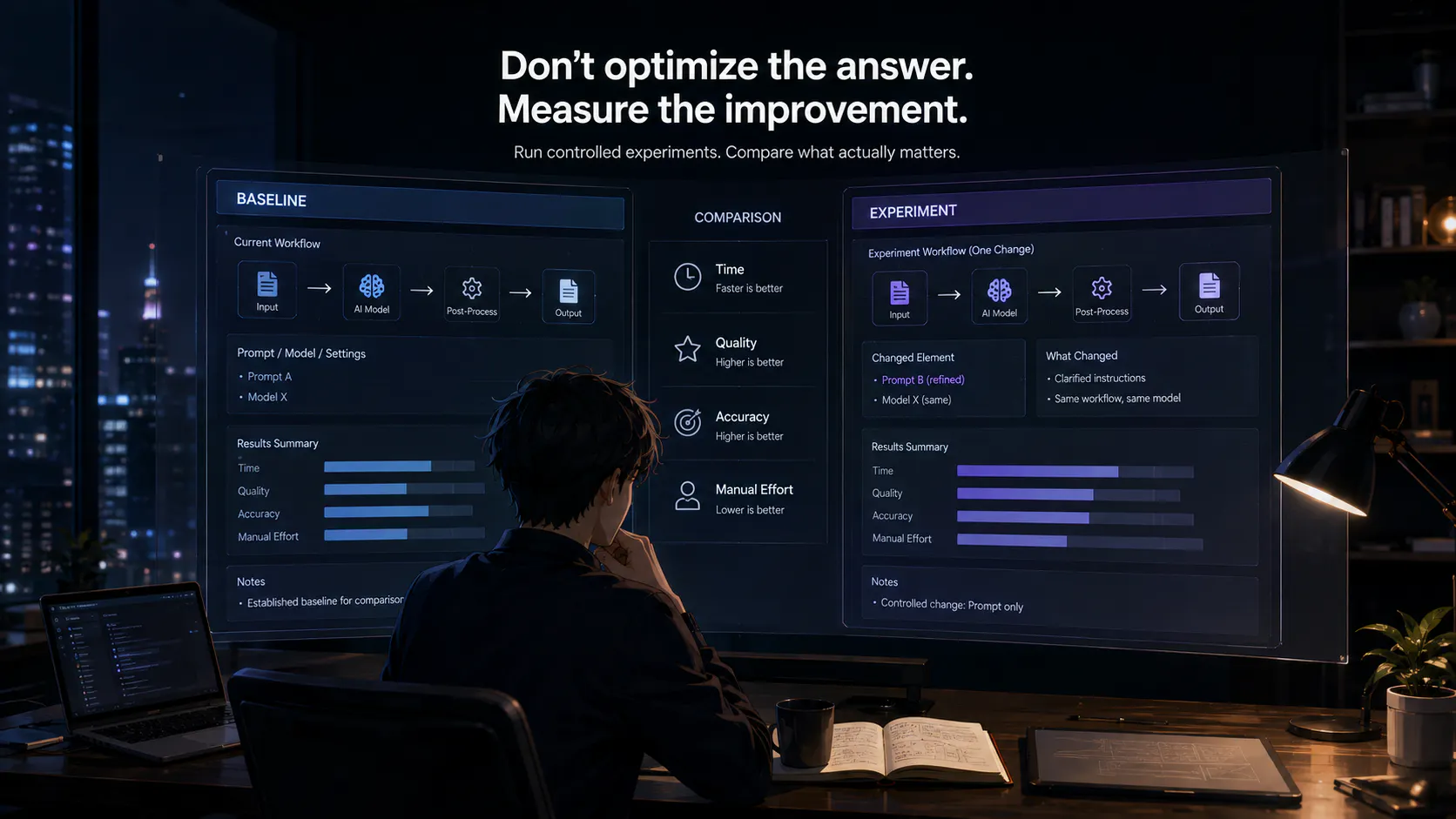
That creates a weird problem.
 •
3mo ago
AI Literacy Gap is Insane
A Martech founder made me understand the gap that surveys and reports never could.
We're on social media 24/7 surrounded by people talking about AI, so it starts to feel like AGI is inevitable. Step outside that bubble and millions and millions still don't know a thing.
I realized this after a conversation with a martech founder who builds AI agents for a living. And the fun part is, he actually admits the AI agents he builds are basically wrappers nothing groundbreaking or earth-shattering.