

I started treating AI experiments like product experiments, not just prompts
I've noticed that when I use AI for a business problem, it's very easy to keep changing the prompt until the output looks good.
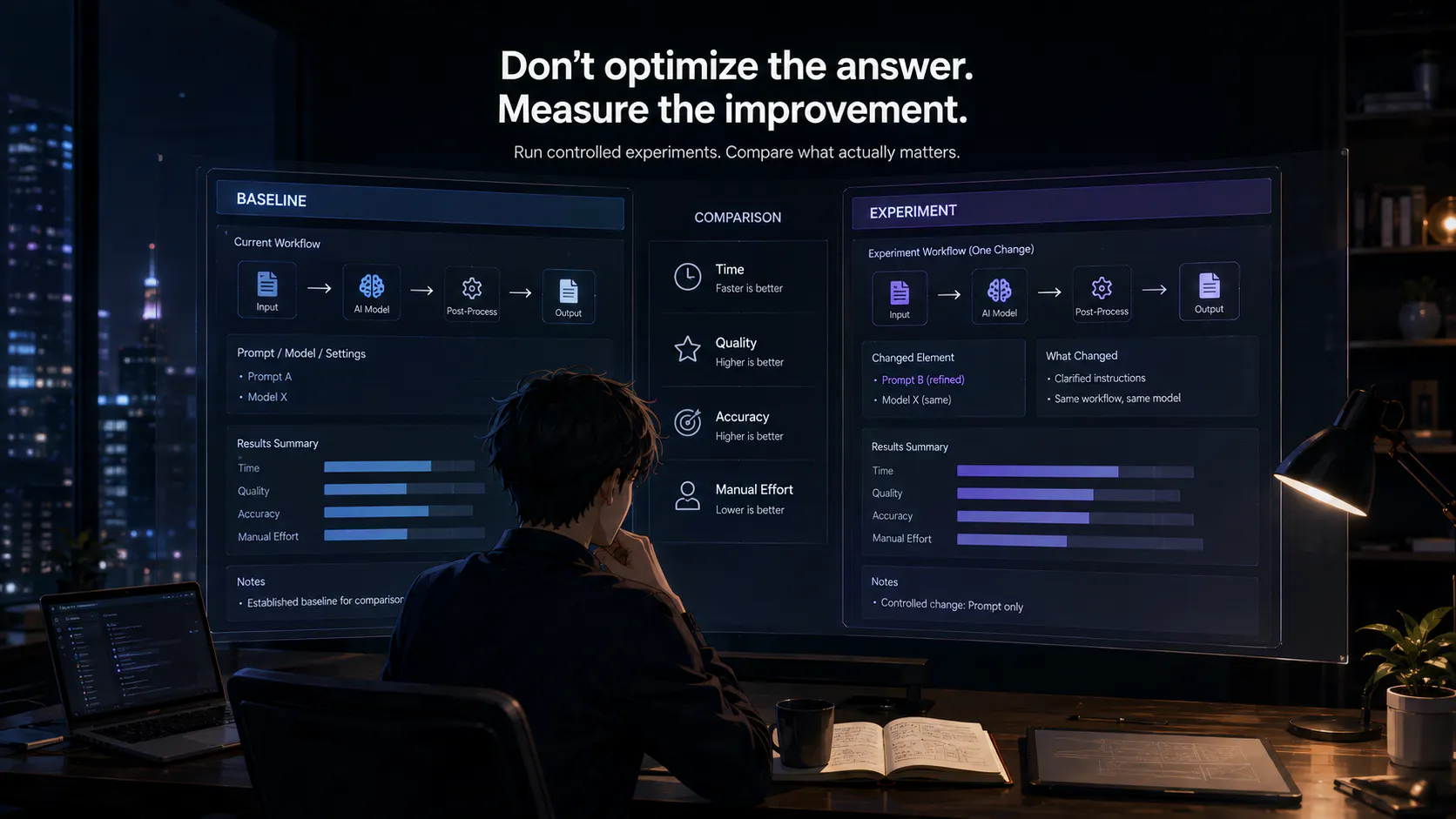
That creates a weird problem.
You can end up optimizing the answer without knowing whether you've improved the process.
So I've started treating AI experiments more like product experiments.
Before changing anything, I write down:
What am I trying to improve?
For example:
reduce research time
improve consistency
catch more edge cases
reduce manual work
Then:
What does the current process produce?
And:
What would count as a meaningful improvement?
Only after that do I start changing the prompt, workflow, model, or automation.
It sounds obvious, but it changes the experiment.
Instead of:
Prompt → better-looking answer → "seems better"
it's:
Baseline → change one thing → compare → keep or revert
I've found this especially useful because AI outputs can feel better without actually being more useful.
A longer answer isn't necessarily better research.
A more confident answer isn't necessarily more accurate.
A faster workflow isn't necessarily better if it creates more checking later.
I'm curious how other builders evaluate their AI experiments:
Do you keep a baseline and compare results, or mostly judge the output by whether it feels better than the previous attempt?
Replies
Be the first to reply
Have a question or a thought to share? Add a comment above to start the conversation.