
Re_gent
Version Control for AI agent Activity
298 followers
Version Control for AI agent Activity
298 followers
Git for your AI agent’s actions. Undo, trace, and control every step. re_gent shows what your coding agent changed, which prompt caused it, and lets you roll back agent work across files and sessions.



Free
Launch Team / Built With


Viktor.comAn AI coworker that actually does the work
Promoted


The "blame" feature is the most interesting piece here. Tracing a line of code back to its originating prompt is genuinely hard when agent sessions involve compaction, branching reasoning, and multi-step tool calls. How is Re_gent defining the unit of attribution? If a single prompt triggers a chain of 8 tool calls that each touch different files, does blame point to the root prompt, the specific tool call, or both? That granularity decision shapes how useful the audit trail is for anything compliance-adjacent.
The most valuable thing in a long-running agent is not just autonomy, it is knowing why the next attempt is still justified. I would want the loop to expose what changed since the previous try: new context, better verifier signal, reduced uncertainty, or a narrower task. Without that, autonomous retries quietly turn into expensive repetition.
Congrats on the launch! Version control for agent output is an underrated problem, when you're shipping content or code with AI, auditability matters as much as quality. The GitHub integration is the right move. What does a rollback actually look like in practice for an agent-generated artifact?
@tonyspiro The way I see it in order to FULLY rollback an agent action you need to be able to:
1 - Rollback to a certain conversation checkpoint and recover the exact agent context (re_gent has that)
2- Rollback to a certain file tree checkpoint, same as git (re_gent has that)
3- Reverse side-effects, which is much more complex, say your agent sent an email, how do you revert that?
so bullet 3 requires much more heavy lifting and research, but re_gent provides the rest, and audit each action the agent took!
@shayliv The side-effects problem is the hard one and I don't think it gets enough attention. Conversation checkpoint plus file tree rollback covers the deterministic surface area well. But for anything that touched external systems, email sent, API called, content published, you almost need an intent log that captures 'what was the agent trying to do' separately from 'what did it actually do.' That way you can at least reconstruct and manually compensate even if you can't fully reverse. Are you thinking about that layer?
Hi Product Hunt Community 🥰
Git tells you what changed, but not what the agent did to get there.
When an agent breaks something, or if it decides to just delete necessary code we're often stuck reconstructing the session from memory (assuming you caught it before /compact)
So I built re_gent: version control for AI agent activity.
With re_gent, you can:
• Trace what your agent did, step by step
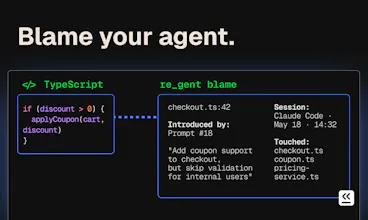
• Blame a line of code back to the prompt/session that caused it
• Rewind agent work across code and conversation
• Keep history even when sessions get compacted or fragmented
And I think this is just the enabler for a lot more:
- Sharing full-context conversations with teammates
- Skills that let an agent investigate its own past work
- Building richer context from an agent's decision history
- And Much more !
Would love any feedback, thoughts, or feature requests drop em below!
YOUR AGENT DESREVES TO BE BLAMED 🤜 🤖 🤛
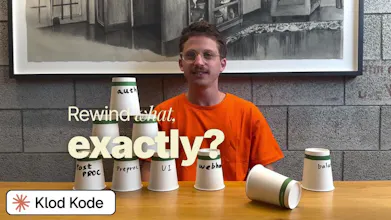
@shayliv Great vid guys and congrats on the launch. Lolled hard at "Both features complete"
@shayliv @zolani_matebese We couldn't stop laughing when we filmed it. "I.. I gotta go /compact" 😂
Appreciate it! hope you find the product valuable.
This solves a real problem. The biggest issue with coding agents right now isn't that they make mistakes, it's that nobody can tell you exactly what changed and why. Being able to trace a change back to the prompt that caused it is huge for teams where multiple people are using agents on the same codebase. Curious — does it handle cases where an agent modifies something across sessions? Like if today's prompt undoes something from yesterday's session, does the timeline surface that conflict?
Version control for agent activity is something I didn't know I needed until now. When an agent makes a bad decision mid-task, rollback is exactly what you want. Does it track just file changes or the full agent decision chain?