
Re_gent
Version Control for AI agent Activity
298 followers
Version Control for AI agent Activity
298 followers
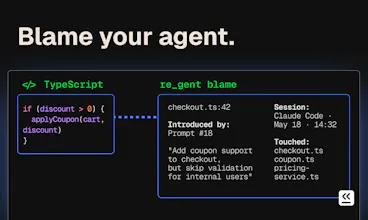
Git for your AI agent’s actions. Undo, trace, and control every step. re_gent shows what your coding agent changed, which prompt caused it, and lets you roll back agent work across files and sessions.



Free
Launch Team / Built With


EneyProactive AI for Mac. Free test, 20,000 credits.
Promoted


Linking agent file changes to the exact prompt that triggered them is genuinely novel. Most agent frameworks hand you a diff with no causal chain. We've been burned by cascading agent edits across services where figuring out which session introduced a bug takes forever. How do you handle rollback when the agent touched external state or APIs? Is it purely file-level undo or does re_gent track side effects too?
@retain_dev Thank you! appreciated.
At the moment we are tracking only context and file states
We do want to try to track side effects but it requires a much more robust understanding of the change (perhaps through external llm / some sort of semantic understanding)
If you have any ideas we would we'd love to hear them!
Treating agent activity as a versioned artifact you can diff and revert is genuinely clever. Most teams just log outputs and hope. At RetainSure we've felt the pain of debugging a bad agent decision without any state history to trace it back through. Does Re_gent support mid-run checkpointing so you can fork from a specific state, or is versioning scoped to full run boundaries?
@anand_thakkar1 Thanks !!
Regarding the checkpoint / branching capability,
At the moment most of the coding agents have this capability out of the box (/branch for Claude Code).
But we do want to support "fork"-ing a conversation context & files for better collaboration and conversation management.
We have a detailed roadmap (with the fork functionality).
@anand_thakkar1 Appreciate it! Would love to see you join as a contributor. Lots of new capabilities in re_gent's roadmap.
@ashishbhosle7889 Yes it works with claude code and with codex and opencode.
Feel free to try and let me know what you think :)
@ashishbhosle7889 Agents deserve BLAME too 100%. Let us know what you think!
Does it store the natural-language prompt alongside the change, or only metadata about the session? Nice work!
@new_user___1402026d854e074177ea741 Both! :)
This hits a pain point I've run into personally. I added LangSmith tracing to my own agentic project specifically because when something broke mid-session I had no way to reconstruct which tool call or retrieval path caused it.. just vibes and scrolling. Re_gent feels like that same observability idea but applied at the file/code level, which is actually where it hurts more. The prompt-to-diff linking is the feature I'd use most.. knowing which instruction caused a specific file change is genuinely useful for debugging agent loops that go wrong on step 4 of 7.
Curious how you're handling branching though.. if an agent takes two different approaches across sessions on the same file, does re_gent track those as separate branches or does it flatten everything into one linear history? That distinction matters a lot once agents start doing exploratory work.
@akshaypal_bishnoi Thanks!!
Yes, we've thought of that too, very cool idea. we're debating how the experience for it should look like. do you have any thoughts?
@akshaypal_bishnoi Actually would love to hear how you tried to solve it using langsmith. Have you connected it directly to your coding agent?
Changes are also visible in Claude Code. So the value is that you can review changes in the history, right? Am I understanding correctly?
@natalia_iankovych AI Coding Agents let you see what was changed, but not why.
Also, once you close the conversation, the agent loses its memory regarding the intent of its change.
@natalia_iankovych Not only review, but understand why and rewind. Hope you find it valuable!
This solves a real pain point. I run 15+ automated agents in production and the worst debugging scenario is "something changed overnight and I don't know which agent did it." Right now my workaround is JSON audit trails per agent, but tracing a bad outcome back to the specific prompt that caused it is still manual detective work.
The multi-file rollback across sessions is the killer feature. Agent mistakes rarely touch just one file — they cascade. Does Re_gent handle rollbacks in systems where Agent A's output feeds into Agent B's input? That chain reaction is where most agent damage happens in my experience.