Self-Promotion
p/self-promotionShow off what you're working on
trending
•

1mo ago

Early Adopters

Hello friends! I wanted to spread the word that Stacktora.com is in full-swing with a few early adopters and we have recently onboarded our first paying customer! For myself, the founder and a builder, I am ecstatic that someone out there said, with money, that Stacktora is a tool that builders will use. I invite you to come check us out. We made the platform to be used for free but features like Push-to-GitHub and adding team members to workspaces is available on a paid Pro plan. Visit us at Stacktora.com B
•

19d ago

When a cost changes with the inputs, should the number or the assumptions lead the UI?

I am working on a small XAUUSD overnight-cost calculator, and the difficult part is not the arithmetic. It is making the result hard to misread.

•

19d ago

Launching today: let your users bring the AI subscription they already pay for

Every AI app I've built ended up with the same screen. Paste your API key, we'll store it. I never liked shipping that, and users don't love it either.

So I built ai-oauth-sdk. It lets someone sign in with the AI plan they already pay for, using the providers' real OAuth flows, the same ones their official CLIs use. The token stays on their device, so you never hold a key and you never pay for their inference.

Eight providers today: ChatGPT, Claude, Gemini, Grok, Copilot, Qwen, OpenRouter and Azure. Zero dependencies in the core package, MIT, and it runs in Node, the browser, React Native and the usual frameworks.

The OAuth was the easy half. What took the time was the things nobody documents. OpenAI's CLI client id is registered for one exact port, localhost:1455, and if it's busy the flow just fails with nothing useful in the error. Cross-Origin-Opener-Policy: same-origin quietly severs window.opener, so a popup callback completes and the parent never hears about it. Google validates redirect_uri strictly enough that a hosted callback is rejected outright, so the loopback URL has to be copied back by hand.

•

20d ago

Built a local-first tax handoff tool for messy bank exports

I m building LibertyFile One for a specific problem: ordinary U.S. freelancers and small businesses often reach tax season with CSV/OFX/QFX files from several banks, cards, processors, and marketplaces but no clean handoff for an accountant.

The app works locally in the browser or Windows app. It normalizes files, deduplicates rows, conservatively matches equal-and-opposite internal transfers, sends low-confidence items to manual review, and produces an accountant-ready ZIP plus a 2025 filing handoff for all 50 states + DC. SSNs and statement rows are not uploaded.

The core version is free. I d value feedback on the review flow, especially whether the exceptions list makes the unknowns obvious enough at normal zoom (14px minimum): https://tax.507643.xyz/

•

19d ago

AI API management becomes a team problem

Hi Product Hunt! AI API usage often starts as an individual developer workflow. One person tests a model, writes the integration, and ships a feature. But once a team starts building more AI-powered features, API management becomes a shared problem. Teams need visibility into: - Which models are being used - Where documentation lives - How usage is tracked - How API access is managed - How different workflows connect Without a clear system, the workflow becomes scattered and hard to maintain. ChinaRouter is built around this problem. It provides a unified AI API gateway and admin dashboard for developers, AI builders, and teams. Website: https://chinarouter.net/ Curious to hear from teams building AI products: how do you currently manage model access and usage?
•

19d ago

Why we are not building another AI chat interface

Hi Product Hunt! A lot of AI tools focus on the user-facing layer: chat interfaces, prompt tools, agents, and content generation. Those are important, but we became more interested in the infrastructure layer behind AI products. When developers build with AI APIs, they need to manage practical things: - Model access - API workflow - Usage visibility - Documentation - Dashboard management - Team coordination These problems are less flashy, but they become important once an AI product moves beyond experimentation. That is why we built ChinaRouter. ChinaRouter is a unified AI API gateway and admin dashboard. The goal is to make the operational side of AI API usage clearer and easier to manage. Website: https://chinarouter.net/ Would love to hear how other builders think about the API management layer.

Why AI API workflows become messy as projects grow

Hi Product Hunt! When building a small AI demo, working with APIs usually feels simple. You pick a model, send a request, test the response, and move on. But once the project grows, the workflow becomes more complicated. The hard part is often not the model itself, but everything around it: - Where do you compare available models? - How do you track usage across projects? - Where do developers find integration docs? - How do teams keep API access organized? - How do you avoid switching between too many dashboards? This is the operational layer of AI development, and it is easy to underestimate. We built ChinaRouter to make this layer easier to manage. ChinaRouter is a unified AI API gateway and admin dashboard for model access, usage lookup, documentation, and dashboard workflows. Website: https://chinarouter.net/ For people building AI products: what part of AI API management becomes painful first?

What indie makers need when building with AI APIs

Hi Product Hunt! For indie makers, building with AI APIs usually starts fast. You test a model, build a prototype, and ship something small. But as the project grows, small workflow problems start to add up. You may need to: - Try different models - Check usage more often - Keep documentation nearby - Manage API access - Understand what is happening across projects For solo builders and small teams, the best tools are usually the ones that reduce operational friction. ChinaRouter is our attempt to create a cleaner AI API workflow for developers, makers, and teams. It brings model marketplace access, API gateway workflow, usage lookup, documentation, and dashboard management into one place. Website: https://chinarouter.net/ If you are an indie maker using AI APIs, what tools do you wish existed?
•

19d ago

Building a cleaner operating layer for AI APIs

Hi Product Hunt! We are launching ChinaRouter today. The product comes from a simple observation: as AI products grow, the API workflow around them becomes harder to manage. Model quality gets most of the attention, but builders also need a clear operating layer for: - Finding and comparing models - Managing API workflows - Checking usage - Reading integration docs - Accessing a dashboard - Keeping the workflow understandable for teams ChinaRouter is a unified AI API gateway and admin dashboard designed around this layer. It is not meant to replace AI models or become another chat interface. It is focused on helping developers and teams organize the workflow around AI API usage. Website: https://chinarouter.net/ We would love feedback from developers, AI builders, and teams working with AI APIs. What would make your AI API workflow easier to manage?

537 clicks from DiscountHub to partner stores in 20 days
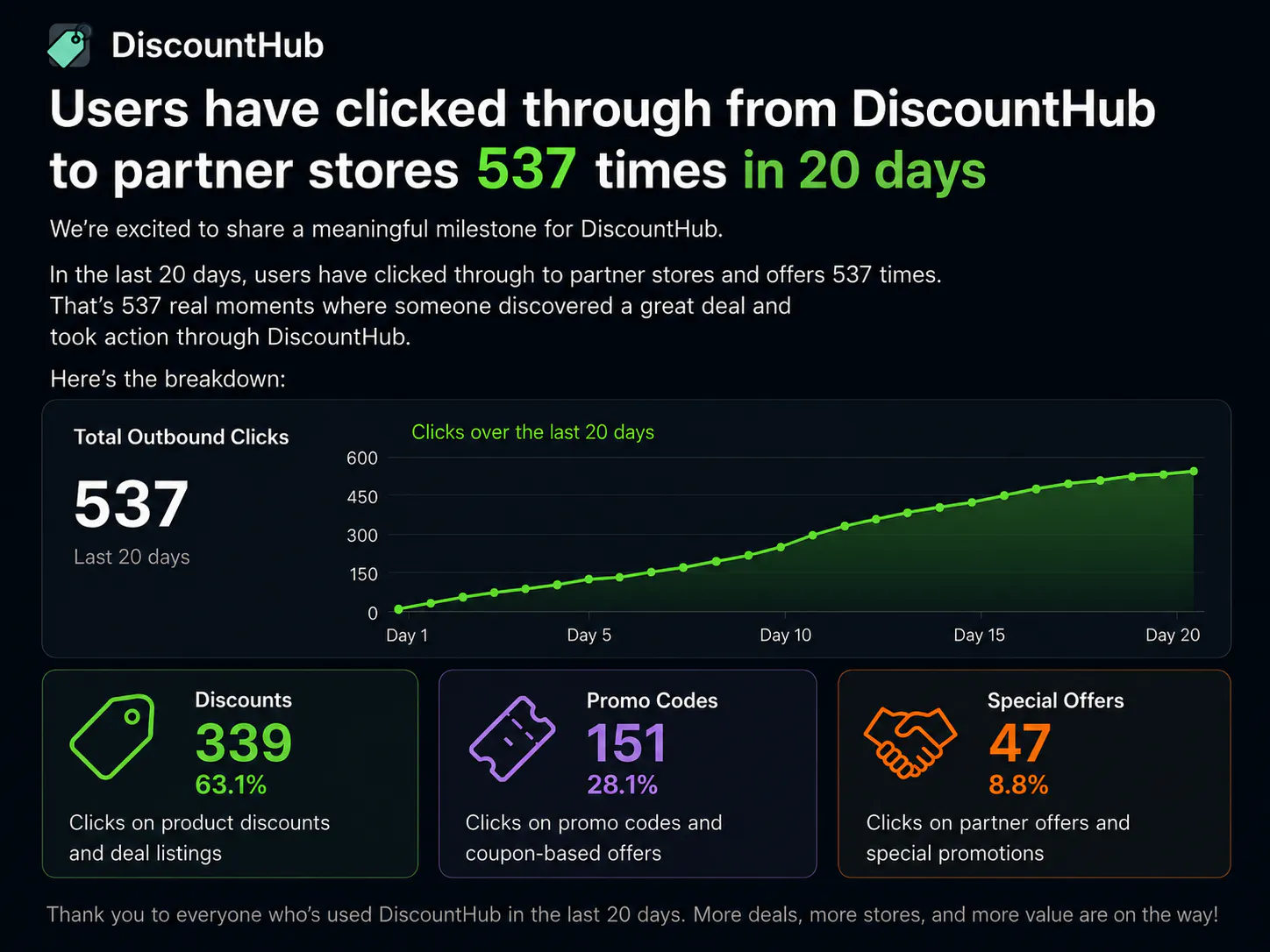
Twenty days ago, I updated the DiscountHub backend and improved outbound click tracking.

Since then, users have clicked through from DiscountHub to external stores and offers 537 times:

First
Previous
•••
666768
•••
Next