•
•4mo ago
"What should we eat?" the hardest question to answer.
Hello everyone!
I m thrilled to announce that SoloPlate will launch tomorrow, an AI-powered meal assistant built to kill "Decision Fatigue." I created this using @Base44after realizing that for many of us, the hardest part of cooking isn't what you cook with, it's figuring out what to make. After a long day of work, the last thing you want to do is have to do more work.
SoloPlate is designed to be your digital sous-chef.
Decision-Free: AI helps you pick the perfect meal instantly.
Beginner-Friendly: Simple instructions for those new to the kitchen.
Watch & Learn: A dedicated video section for those who prefer visual guidance.
 •
•29d ago
Revenli: your properties finally have a brain, not just a spreadsheet 🏠
Every real estate tool I've ever used had the same flaw: it handed me another dashboard to feed. More data entry, more reconciling, more "I'll deal with it at tax time." The work never actually left my plate.
So I built the opposite.
Revenli isn't software you operate it's a team of AI agents that operate for you. You forward your documents and step back. Behind the scenes:
A bookkeeper matches every invoice to your bank feed and flags only what it's unsure about no more month-end reconciliation marathons.
A tax strategist keeps you audit-ready year-round and tells you the moves to make before the deadline, not after.
A financial advisor watches your actual numbers and tells you when to buy, hold, sell, or refi the decisions most of us make on gut and hope.
 •
•13d ago
Launching in 10 days: free color analysis from an actual photo. Poke holes in my pitch?
siOsi reads one selfie or any picture and returns your 12-season color type, undertone, gold vs silver, and whether your hair color fights your skin tone then grades the makeup you're actually wearing: flash white-cast, oxidation, coverage. 1st check-up: free, instant, no signup, 9 languages.
The one-liner I'm taking into launch day: "A quiz asks what color you are. siOsi looks." If that reads wrong to you, I'd rather hear it now than on the 22nd.
 •
•30d ago
Launch guard opinions
I'm an HVAC installer by trade, not a developer. Over the last few months I built LaunchGuard almost entirely with AI coding tools, nights and weekends around my day job a scanner that checks a codebase for the stuff that actually burns vibe-coded apps: leaked API keys, missing database security rules, vulnerable dependencies, that kind of thing. If it finds something, it can open a real GitHub pull request with the fix, not just tell you about it.
I built it partly because I got nervous about my own app after reading how many "vibe-coded" apps ship with exposed secrets or wide-open databases turns out it's a genuinely common problem, not a rare one.
Launching soon and honestly not sure how it'll land genuinely want opinions, not just upvotes. Happy to run a free scan on anyone's repo here if you want a real example instead of taking my word for it. Link's in my profile/comments if you want to poke around: [your URL]
 •
•29d ago
A free educational website, born out of an argument!
This one started from an argument, not an idea. I casually mentioned something I "knew" was true, someone fact-checked me on the spot, and it turned out that thing had been disproven years ago. Nobody had told me. Nobody tells anyone, honestly, once you leave school, corrections just don't reach you the way the original "fact" did.
That stuck with me.
We spend 12+ years being taught things with total confidence, and then the updates to that knowledge happen quietly in journals and papers most of us will never read. So I started digging into how many things I was taught that had since changed, and the list got long fast.
The early version of this was just a spreadsheet I kept for myself. It didn't feel like a "product" until I picked my own graduation year and had that same "wait, seriously?" reaction about six times in a row. That's when it became worth building properly, hand-verifying entries, organizing by subject, letting people pick their own year instead of just mine.
The hardest part honestly wasn't the build, it was the verification. Every entry needed a real source, not a vibe, so a lot of this became slow, manual fact-checking rather than fast shipping.
 •
•30d ago
Your income can safely be distributed to custom budget categories
MizuFlow Budget & Track
We've launched a week ago and are seeing results already :]
MizuFlow uses Plaid as the aggregator to help track your transaction history & detect your income source(s) so you can distribute it into custom budget categories. We track your subscriptions & bills so you're never out of the loop ensuring you receive price-alerts & reminders of upcoming bill cycles.
 •
•1mo ago
SHIM: an AI gateway that scrubs PII before it reaches the LLM
built this with two co-founders in Istanbul. the short version: you point your app at us instead of OpenAI/Anthropic/Gemini directly, we strip customer data, API keys, and other stuff that shouldn't leave the building out of the prompt, then forward it to whatever model you're using. under 100ms added latency. also gives you an audit trail if anyone ever asks "prove this was handled properly" (KVKK, GDPR, EU AI Act all want that answer eventually).
started building it after watching teams, including ourselves, paste real customer data into prompts without a second thought. figured there should be something sitting in between that catches it automatically instead of relying on everyone remembering not to.
we're mid build right now, MCP traffic support just landed alongside the LLM gateway. would love feedback from anyone dealing with this problem, or just tell me I'm wrong about something, that's useful too.
 •
•14d ago
I built a private Board of 10 for the decisions that keep you staring at the ceiling
Most important decisions do not arrive as neat tasks.
They arrive as: Should I take this offer? , Is this the right hire? , Do I launch now or wait? , or Am I seeing this clearly?
I built SUDHI because a normal chat window was not enough for those moments. One reply can sound convincing while still missing the customer, the cash, the downside, or the next practical step.
SUDHI gives one decision to a private Board of 10. Each seat looks at the same question from a different angle: strategy, operations, risk, customer impact, finance, growth, people, systems, research, and evidence.
 •
•13d ago
I built Assetio to see all my assets in one clear portfolio
I built Assetio because my assets were scattered across different places cash, currencies, crypto, gold, property, and investments and I wanted one simple view of everything.
Assetio lets you track assets in different currencies, view their combined value in your preferred reporting currency, and understand your portfolio s allocation, liquidity, and performance. Supported crypto and precious-metal prices can update automatically, while everything else can be entered and maintained manually.
Your portfolio stays private and syncs between your Apple devices through iCloud. There are no bank connections or complicated account setup.
I d genuinely appreciate feedback, especially on the onboarding, asset-entry flow, and which feature would make the app more useful to you.
 •
•29d ago
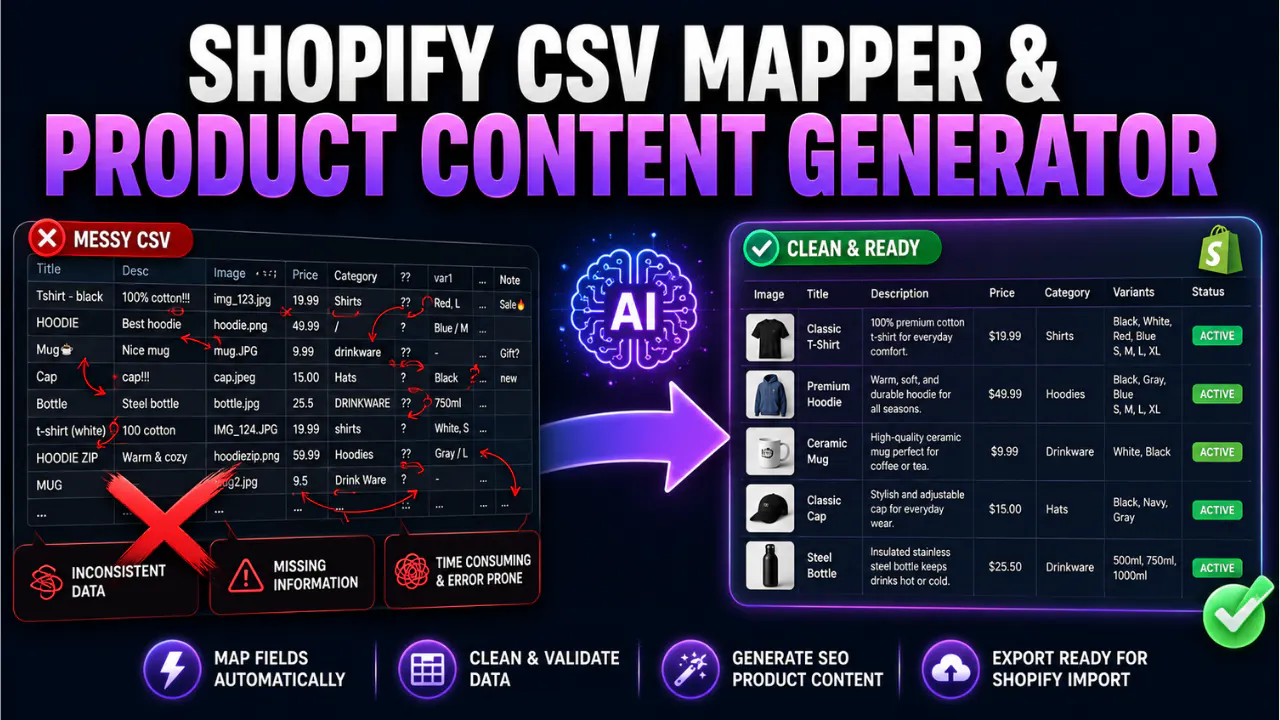
Map messy supplier CSVs to Shopify-ready files with AI.
I built DataMorph because I was tired of spending hours manually mapping supplier spreadsheets to Shopify format. Upload any messy CSV AI maps columns, applies markup pricing, generates SEO descriptions & titles download a Shopify-ready file. $7one timeor or $29/mo unlimited. No signup required.
https://www.datamorph.fr/