

We asked Reddit "what does AI do with our data?" — here's what ~50,000 views taught us
A few days ago we posted one simple question across r/OpenAI, r/ClaudeAI and r/artificial:
"A healthcare professional asked me: if I paste my patients' personal info into ChatGPT, is that a problem?"
It hit a nerve. ~50,000 views, dozens of candid replies. We read every one. The same three things came back, again and again:
1. Fear, not facts.
"No one except OpenAI truly knows what they do with the data — and that's what's so scary about it."
2. It's worse than people assume.
"Once you put that data in, it never leaves the system." — and on free tiers, "you can turn off training… it's just on by default."
3. The "fake name" trick doesn't hold. Someone suggested just using a fictitious name. The honest reply: "to save time, they stop doing it." Manual anonymization always loses to a deadline. And for health data, one comment was blunt: "it is 100% a HIPAA violation to enter patient information into ChatGPT."
But here's the part that made us build ONYRI Sanitize: across hundreds of comments, everyone said "don't paste sensitive data into AI" — and not one person could say how to use AI safely anyway.
That gap is the entire product.
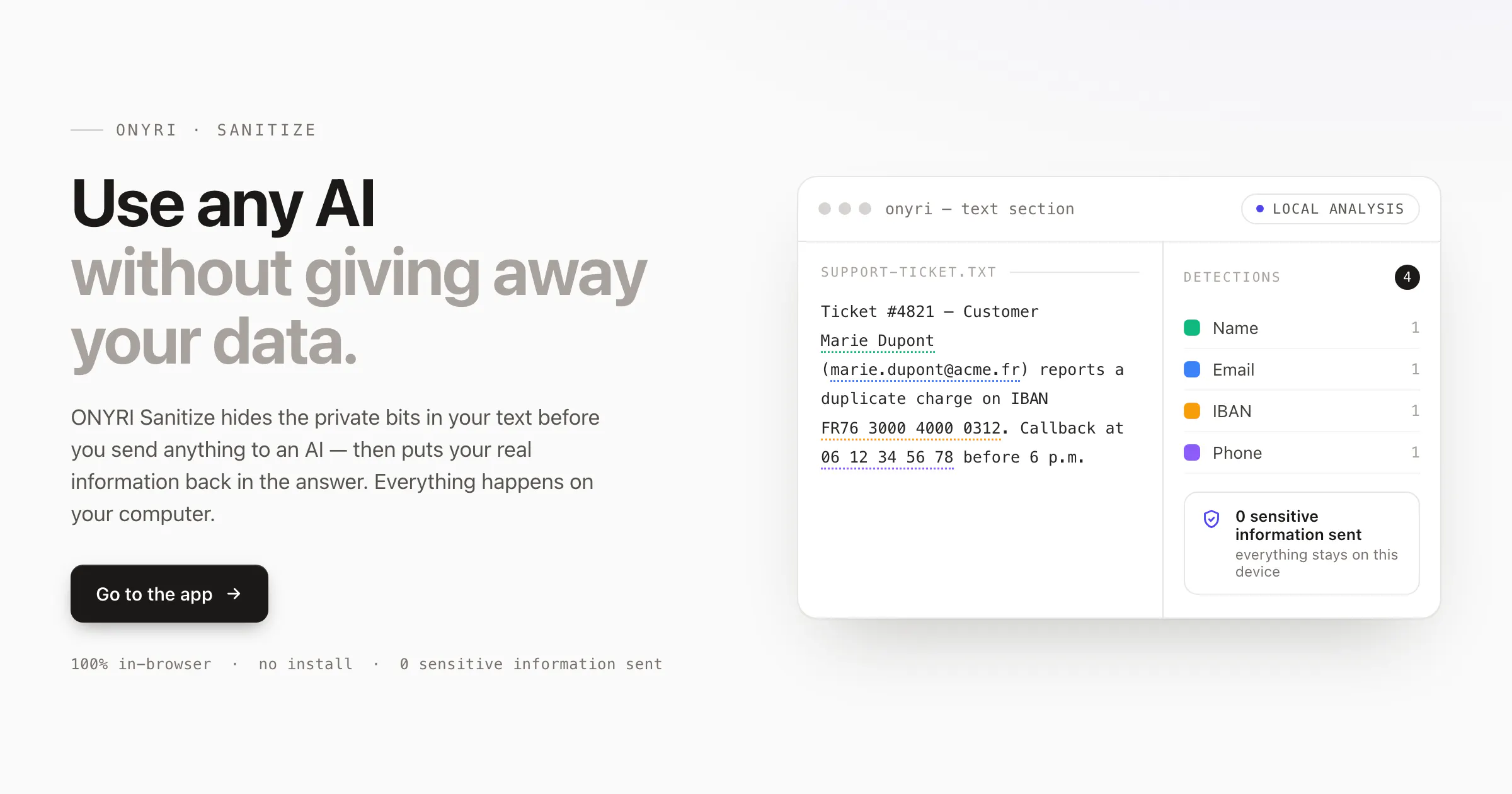
ONYRI detects the private bits in your text (names, emails, card numbers, patient data, API keys), swaps them for reversible tokens before anything is sent, and restores the real values right inside the AI's answer. It all runs in your browser — the token↔value mapping never touches a server. The AI helps; your data stays home.
To the healthcare pro who started the thread: yes, it's a problem — and now there's a fix. 🙂
👉 Try it on your own text: Link
What's the riskiest thing you've ever almost pasted into an AI? 👇
Replies
it reminded me of this old joke:
someone asked one computer "is there a God"
the computer responded "I do not know"
that person kept connecting more and more PCs asking the same the question and getting the same response
eventually, he connected all computers in existence and asked the same question and the response come back as ... "Now, there is!"