

If you're building a consumer app, what does your retention look like?
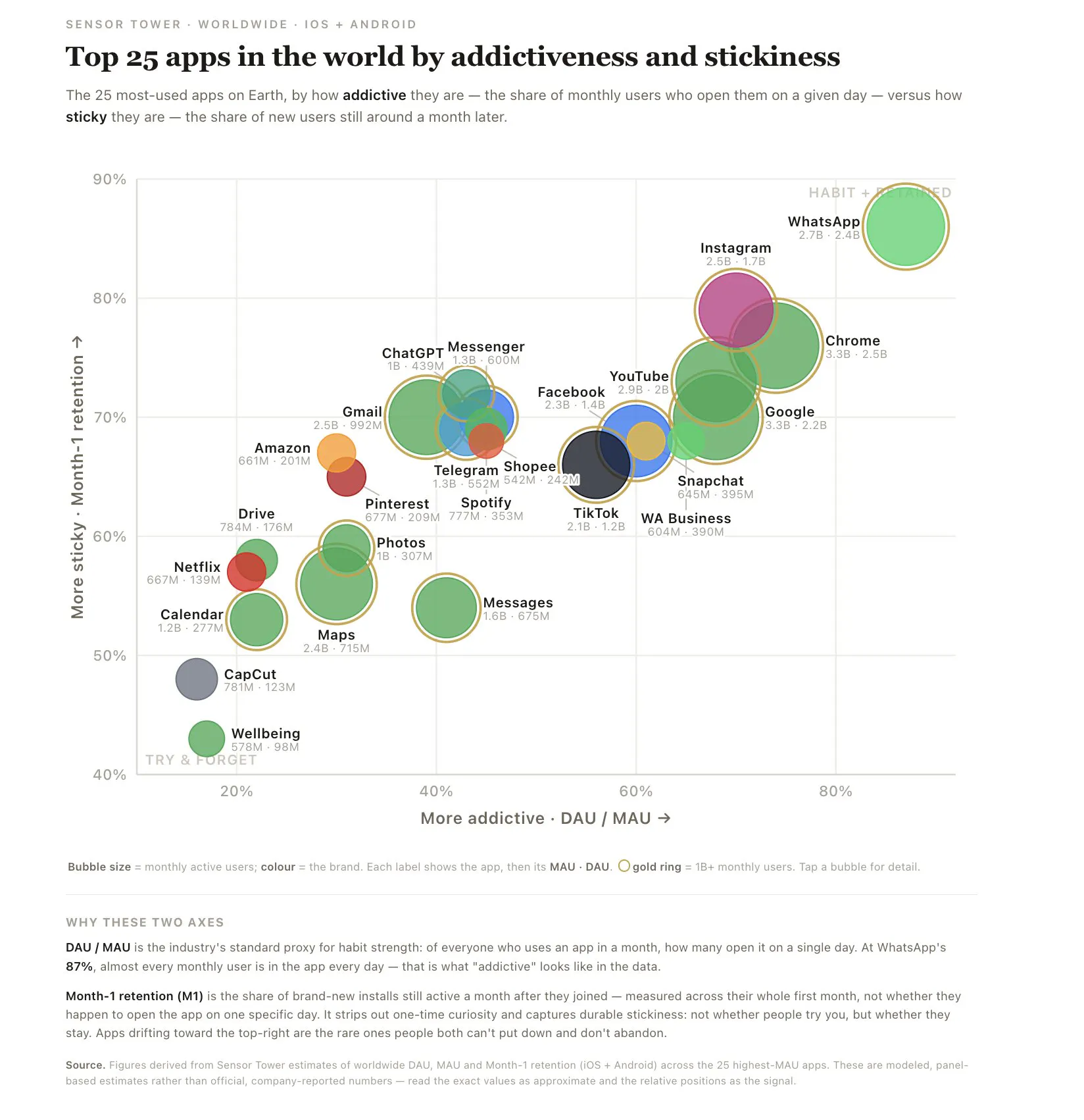
WhatsApp is posting numbers that no other app comes close to. It leads the world in addictiveness at 87% DAU/MAU and stickiness at 86% month-one retention, all while having 2.7B monthly users, the most of any non-preinstalled app.
A new Sensor Tower breakdown of the top 25 apps by these metrics reveals some surprising patterns. There are now 15 apps with over a billion users, and Google and Meta own 12 of them between them.
Telegram is the standout outsider here. It actually has more users than Spotify, Pinterest, Netflix, Amazon, and Snap combined.
ChatGPT's retention jumped from rank 20 to rank 5 in just two years, which says a lot about how quickly habits around AI tools are forming.
It's interesting how few new apps have broken into this list over the past decade; real innovation is clearly slowing down.
If you're building a consumer app, what does your retention metrics look like? Share in the comments.
Replies
My activation rate is around 60% which is higher than benchmarks. Returning users are around 40% (people who has come back 2+ times)
I cant not expect my consumer app reach those numbers. What I am building is not comparable. I wish!!
Fascinating data. I think it also shows retention isn’t just about features anymore—it’s about identity.
WhatsApp is sticky because your phone number basically became your identity.
With Pigeon Link, we’re testing the opposite approach: no phone numbers, just simple 3-word identities to connect and chat.
I’m curious whether making identity easier and more private helps people stick around longer—or whether it actually weakens the network effect.
Those WhatsApp numbers are wild, 86% month-one retention is honestly hard to even imagine hitting. The ChatGPT jump from 20 to 5 stood out to me too. Do you think that AI stickiness is durable, or more of a novelty curve right now? Also curious what "good" looks like for a smaller consumer app in your view.
Those WhatsApp numbers are wild. But I think this chart quietly makes a point that gets lost in the "I wish my app did that" reaction: look at the bottom-left "TRY & FORGET" quadrant. Not every app should be trying to climb toward the top-right.
I build offline, buy-once desktop utilities, so DAU/MAU is honestly the wrong yardstick for what I do — if someone opened my tool every single day, something would have gone wrong. The win is the opposite: solve the problem in five minutes, get out of the way, and be the first thing they reach for the next time that same need shows up. That's a kind of retention too — it just doesn't look like daily habit.
So my honest take on "what does good look like for a smaller app": it depends entirely on which quadrant you're actually trying to live in. A habit app and a utility have opposite definitions of a happy user. Judging a niche tool by DAU/MAU is a bit like judging a fire extinguisher by how often you use it.
Anyone else here building "try & forget" tools on purpose? Curious how you define success when daily engagement was never the goal.
I agree with the “try & forget” point.
Not every consumer product should chase WhatsApp-style retention. For some tools, success means the user comes back exactly when the problem appears again, not every day.
For my own developer/data products, I think more about “job-based retention”: did the user remember the tool when they had the same workflow again? That feels more honest than forcing daily usage on products that are meant to save time, not consume attention.
@rohanrecommends Hello, I think consumer retention is one of the hardest things to judge honestly, because it’s so easy to compare yourself to apps that live in a completely different category.
WhatsApp-level retention is almost impossible because it’s not just a product anymore — it’s infrastructure for people’s daily relationships. People don’t open it because they admire the features; they open it because their friends, family, work, and identity are already there.
For smaller consumer apps, I’d probably look less at “can we become a daily habit?” and more at “does the user remember us when the same need appears again?” Some products should be opened every day. Others are successful if they solve one painful moment so well that the user comes back next week, next month, or tells a friend.
The ChatGPT jump is interesting because it shows how fast a tool can become a habit when it fits into many different moments: work, learning, writing, coding, decisions, even random curiosity. That kind of broad usefulness is rare.
So for a new consumer app, I’d care most about activation quality, repeat intent, and whether users feel a little loss when the product is gone. Retention is not always addiction. Sometimes it’s trust.
I haven't launched a consumer app yet, so I don't have retention numbers to share.
One thing I've been thinking about while building is that retention shouldn't be measured against giants like WhatsApp or ChatGPT unless you're solving the same type of problem.
If my product solves one meaningful problem so well that users come back whenever that problem appears, I'd consider that a success. Daily usage isn't the goal for every product. Being the first tool people remember when they need it might be a better measure.