

How do you publish consistently when you can't hire a content team?
Six months ago HirePilot had zero organic presence. One person handling all of marketing. No budget for writers, no appetite for agency overhead.
The answer we landed on: build a system instead of hiring.
Here is what we run today. Airtable is the content database and the trigger layer. Every piece of content lives as a row in one table. The status field drives everything. Make is the automation engine. Claude API handles generation.
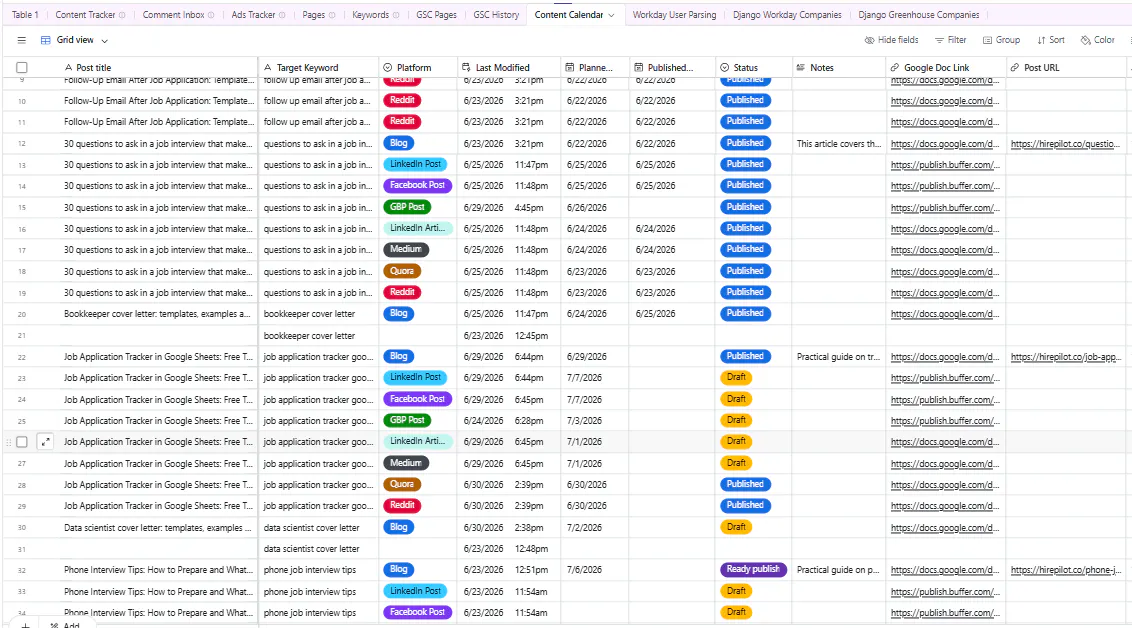
When a keyword is ready, one status change in Airtable fires the full pipeline automatically. The scenario fetches our sitemap for internal linking opportunities, assembles the prompt with writing rules and SEO structure, sends the request to Claude API, converts the output to HTML, creates a Google Doc, and updates the record with a Draft status.
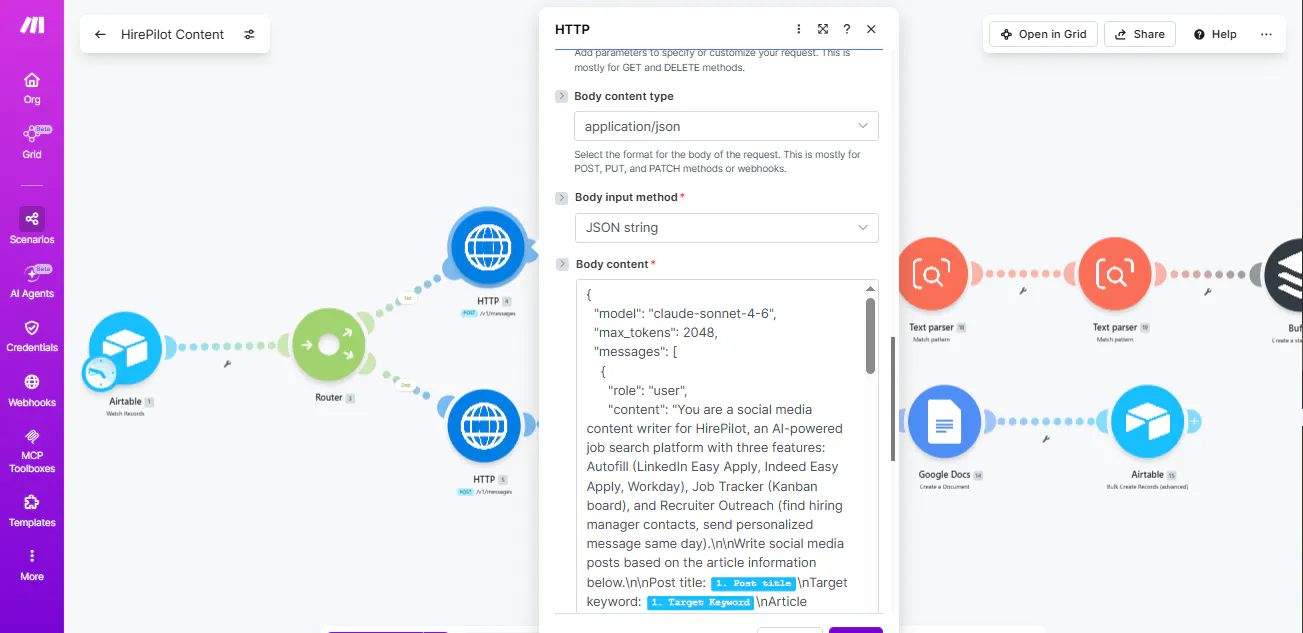
One person reviews the doc, adds images, approves it. That triggers the second scenario: one Claude API request returns six platform-specific pieces, LinkedIn post, LinkedIn Article, Medium, Quora answer, two Reddit versions. A Text Parser routes each to the right destination. Short posts go straight to Buffer. Long-form goes to a separate doc for a final review pass.
Total monthly cost: less than a single freelance article.
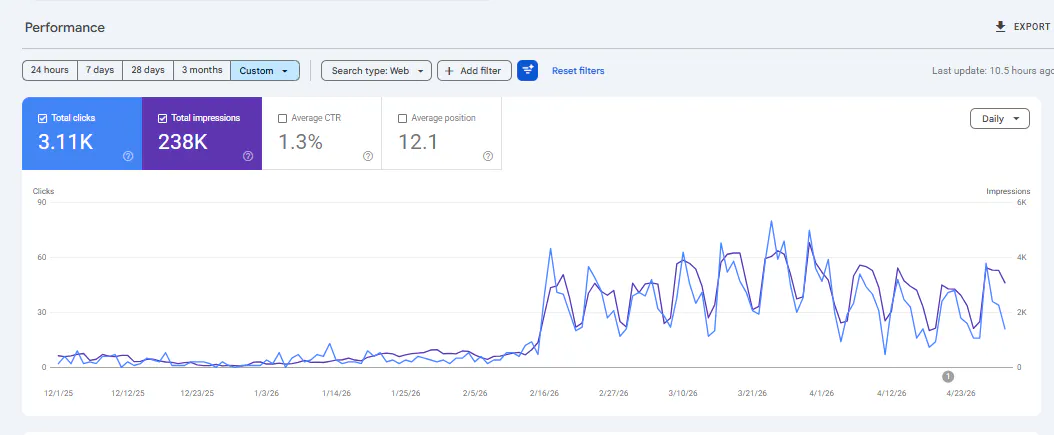
Six months in, GSC shows consistent growth in impressions and clicks from zero. GA4 shows people are reading, not bouncing.
The only manual steps left are reviewing, adding images, and hitting publish.
How are you handling content at early stage?
Replies
This is pretty much the approach I'd take as well.
As a small startup, hiring writers or agencies isn't always realistic. Building a system that automates the repetitive parts and keeping the final review manual feels like the best balance between quality and cost.
@hosseinyazdi Exactly the balance. The parts that don't require judgment, formatting, structure, distribution, run automatically. The parts that do, what's actually worth saying, whether the argument holds, stay manual. That split is what makes it sustainable for one person.
The balance you describe - automate the repetitive parts, keep the final review human - matches what we landed on. My co-founder built us a similar pipeline, and the part that turned out to matter was not the drafting. The value is in the layer around it: a strict voice and readability standard the drafts have to meet, and a review stage that rejects anything reading as generic.
@alieksia Exactly this. The voice standard and readability rules live inside the prompt, not as a vague guideline but as specific instructions the model has to follow. The review stage then checks against those same rules. That's what keeps the output consistent rather than generic.
This is a very practical setup.
I like the idea of treating content like an operating system instead of random daily posting. Airtable as the source of truth + Make + Claude feels much more scalable for a small team.
For early stage, I’m trying to do something similar but simpler: turn real work, launches, client problems, and product learnings into reusable content instead of starting from a blank page every time.
The hardest part is still review and taste. AI can draft fast, but deciding what is actually worth publishing still needs human judgment.
@prashant_patil14 The treat it like an operating system framing is exactly right. Starting from real work, launches, client problems, product learnings, means the insight is already there before you write a word. The review and taste problem doesn't go away with better prompts. It just gets faster. The judgment layer is still yours.
@vik_sh This is a strong example of replacing a content team with a content system, not just “AI writing posts.” I like that Airtable is the source of truth, Make handles the boring movement between steps, and Claude is only one part of the pipeline.
For early-stage teams, I think the biggest unlock is not generating more drafts — it’s removing the blank page and making sure every idea has a path: keyword, brief, internal links, draft, review, repurpose, publish.
The human review step is important too. If one person still owns the taste, examples, images, and final judgment, automation can make content consistent without turning it generic.
@alpertayfurr The 'path for every idea' framing is exactly right. The blank page problem is not a writing problem, it's a systems problem. Once every keyword has a defined path from brief to published, the question stops being what do I write today and starts being what's next in the queue. That shift is what makes consistent output possible for one person.
@vik_sh I completely agree and it makes perfect sense. Congratulations :)
@alpertayfurr Appreciate that. Means a lot coming from someone who clearly gets how these systems actually work under the hood.
The whole concept of automation is amazing, but I still prefer content to be human, evoking emotions and making people think.
@fatima_shehzad Totally agree, and that's kind of the point. Automation handles the repetitive parts so there's more room left for the parts that actually need a human, the ideas, the voice, the things worth thinking about. It's not replacing that, it's clearing space for it.
@vik_sh As long as we have space to write from the heart, content that connects and makes sense to those around us, I think we are good to go :)
The automation is impressive, but the real advantage seems to be seem that someone still reviews every piece before it goes live. That human checkpoint matters.
@alheri_murya That's the part that doesn't get automated away. The system handles production. The review is what keeps it honest, whether the argument actually holds, whether the structure serves the reader, whether it's worth someone's time. Without that checkpoint the output is consistent but not necessarily good.