

Why AI Agents Should Load Skills Only When Needed
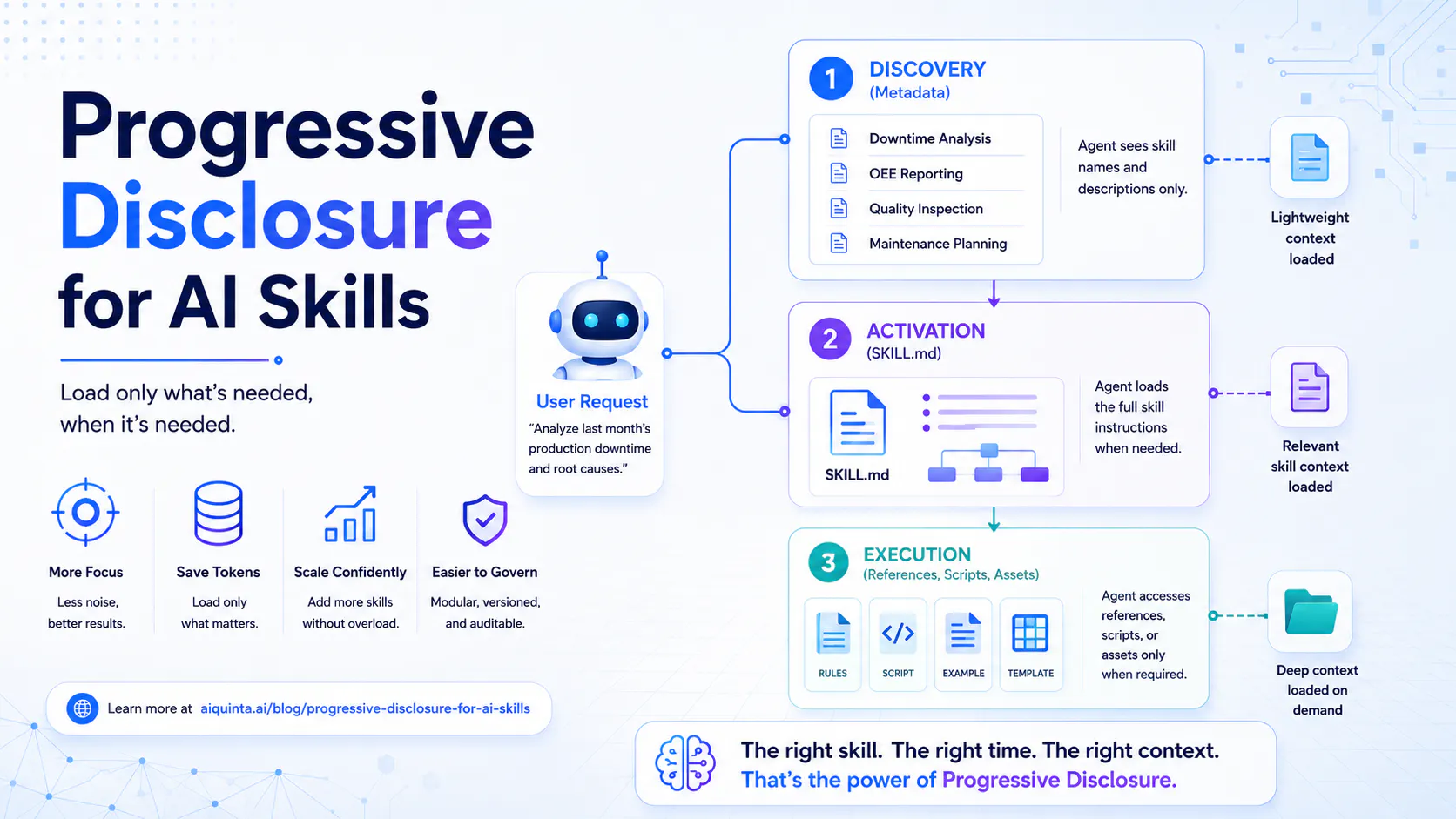
Many companies are building AI agents with more tools, more prompts, and more workflow instructions. But adding more context does not always make an agent better. In many cases, it creates noise.
This is where progressive disclosure for AI skills becomes important.
Instead of loading every skill, rule, document, and script at the start, the agent only loads what it needs for the current task. It may first see a short skill description, then open the full skill instructions only when the task matches. If deeper context is required, it can then access reference files, scripts, or templates.
This approach helps enterprise AI systems stay focused, efficient, and easier to govern.
For business teams, the value is clear. Progressive disclosure can reduce context overload, improve task accuracy, and make large skill libraries easier to scale. It also supports better control because each skill can be reviewed, versioned, and updated as a reusable business capability.
In enterprise environments, this matters. A finance agent should not load HR workflows. A manufacturing agent should not carry legal review instructions unless needed. A sales proposal agent should not process technical maintenance rules by default.
The future of AI agents is not about putting everything into one massive prompt. It is about designing modular skills that agents can discover, load, and apply at the right moment.
AIQuinta explains this concept in more detail in its article on Progressive Disclosure for AI Skills, including how it supports context control, scalable agent design, and enterprise AI governance.
___________
AIQuinta - An Agentic Enterprise Platform, where your knowledge base powers AI.
- Website: https://aiquinta.ai/
- Email: duc.nguyen@aiquinta.ai
Replies
Be the first to reply
Have a question or a thought to share? Add a comment above to start the conversation.