

The Critical Role of Memory in Enhancing Enterprise AI Performance
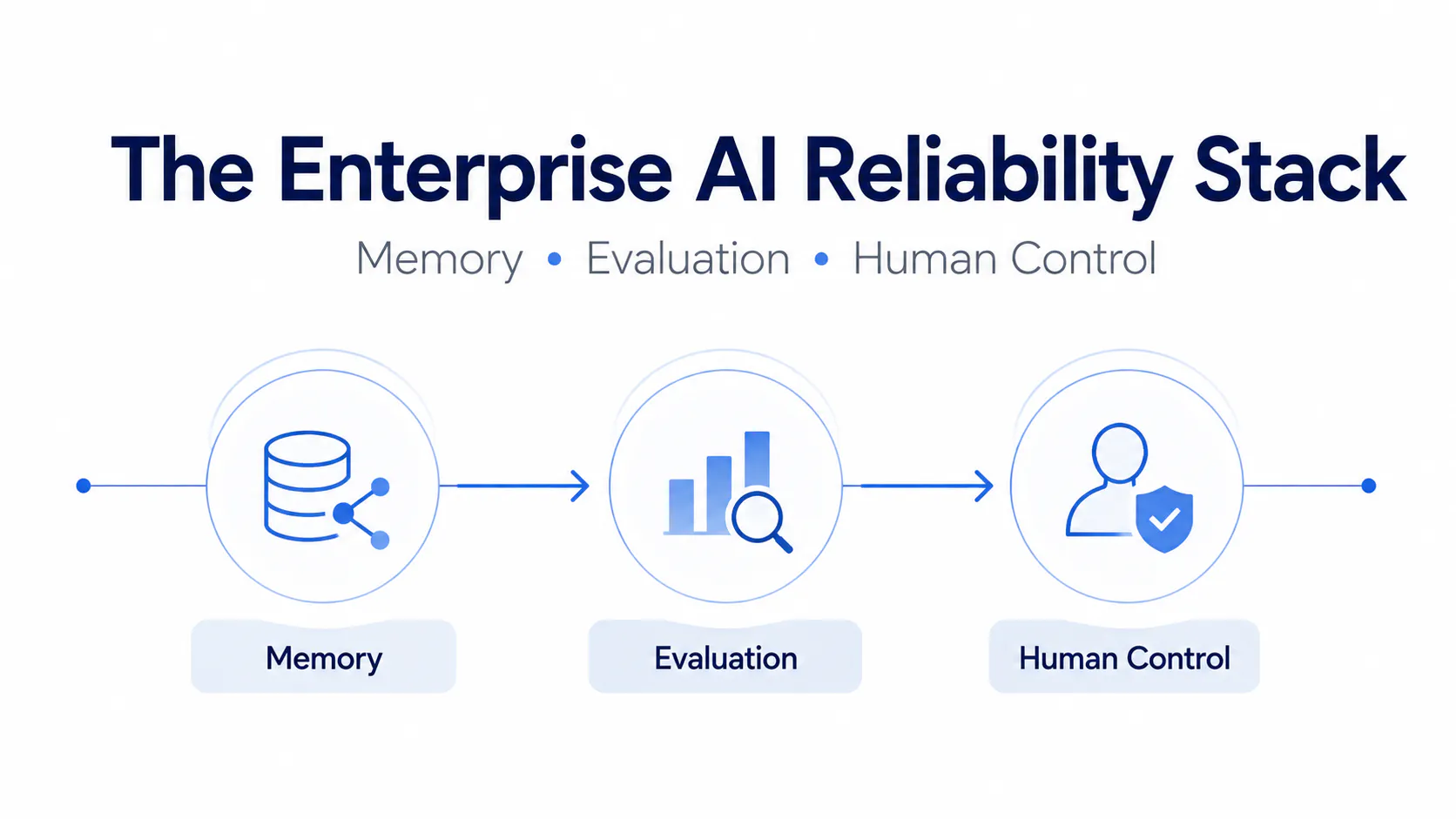
Enterprise AI becomes more useful when it can access organizational knowledge. It also becomes harder to govern. Reliable performance depends on connecting memory, evaluation, and human oversight into one operating system.
Enterprise AI memory promises a simple advantage: give AI access to company knowledge, and it should produce more relevant answers.
The risk is that more context does not automatically create better decisions.
An AI system can retrieve an outdated policy, select the wrong maintenance record, combine conflicting documents, or generate a confident conclusion that its evidence does not support. When AI agents can also trigger workflows or recommend operational actions, these errors become business risks rather than writing problems.
For enterprise leaders, the challenge is therefore broader than model accuracy. Organizations need to control the full chain from memory and retrieval to generation, evaluation, and human action.
Enterprise Memory Creates New Failure Points
Retrieval-Augmented Generation, or RAG, allows AI systems to use external information at inference time instead of relying only on knowledge encoded during training. The original RAG research described this as combining model knowledge with a retrievable external memory.
For enterprises, that memory may contain contracts, operating procedures, maintenance records, customer histories, policies, technical manuals, or internal research.
This improves freshness and relevance, but it creates another dependency.
If the knowledge source is outdated, incomplete, poorly permissioned, or incorrectly retrieved, the model may produce a polished answer from bad evidence. Research such as PoisonedRAG has also demonstrated that manipulated retrieval databases can influence generated responses.
Enterprise memory should therefore be treated as governed infrastructure. Data provenance, access permissions, version control, document freshness, and retrieval behavior all affect AI performance.
A Strong Semantic Score Does Not Equal a Reliable Answer
One of the most common evaluation mistakes is reducing AI quality to one number.
Different metrics measure different failure modes.
BLEU and ROUGE rely heavily on lexical overlap between generated and reference text. BERTScore uses contextual embeddings to measure semantic similarity, which makes it more tolerant of paraphrasing. BLEURT uses a learned evaluation model designed to better approximate human judgments.
Understanding how BERTScore and BLEURT measure semantic quality differently can help technical teams choose the right signal for a specific evaluation task.
Likewise, comparing BLEU, ROUGE, and BERTScore within an AI evaluation strategy shows why no single metric should become an enterprise “trust score.”
A response can be semantically similar to a reference and still contain the wrong contract value, machine ID, customer name, or policy interpretation.
Enterprise evaluation should therefore ask a different question:
Which type of failure are we trying to detect?
Evaluate the Memory-to-Action Chain
Reliable evaluation requires measurement at several stages.
First, evaluate retrieval. Did the system retrieve the documents required to answer the question correctly? If the right information never enters the model context, improving the language model will not solve the problem.
Next, evaluate grounding. Are the generated claims supported by retrieved evidence? Semantic similarity alone cannot answer this.
Then evaluate task performance. A customer-service assistant should resolve a case within policy. An engineering assistant should identify the correct procedure. A research agent may need complete evidence coverage rather than a short answer.
Finally, evaluate the cost of failure.
An incorrect internal FAQ response does not create the same exposure as an AI-generated production change, regulatory statement, or financial recommendation.
This is consistent with the risk-based approach used by frameworks such as the NIST AI Risk Management Framework, which treats AI trustworthiness as a system-level management problem rather than a one-time benchmark.
Human Oversight Should Follow Risk
Requiring human approval for every AI output defeats much of the value of automation.
But removing human oversight creates another problem: unclear accountability when the system is wrong.
A better model is risk-based intervention.
Low-risk and reversible actions can run with automated controls and periodic sampling. High-impact actions can require stronger evidence thresholds or explicit approval. Cases involving conflicting documents, missing evidence, policy exceptions, or actions outside an agent’s authority can be escalated automatically.
This changes human review from a universal bottleneck into a control mechanism.
It also raises a leadership question. As agents gain more autonomy, organizations must define who owns the final decision. The discussion around preserving human agency as AI agents take on more execution becomes relevant when AI begins operating across enterprise knowledge and workflows.
If responsibility is unclear, automation can create a dangerous gap where the machine performs the work while everyone assumes someone else verified it.
Practical Takeaways
Enterprise leaders can start with one high-value AI workflow and map its failure chain.
Identify the knowledge sources it depends on. Test outdated records, conflicting policies, missing information, ambiguous requests, and unsupported claims.
Measure retrieval quality separately from generation quality. Test factual grounding separately from semantic similarity. Evaluate business policy compliance separately from language quality.
Most importantly, set evaluation thresholds according to failure cost.
A system handling low-risk internal search should not require the same controls as an agent influencing production, finance, compliance, or customer commitments.
Conclusion
Enterprise AI performance will depend less on model capability alone and more on how well organizations control the systems around the model.
Memory provides context. Evaluation determines whether the resulting output is acceptable. Human governance determines whether the organization should act on it.
These functions should operate as one reliability stack.
The goal is no longer to prove that AI can generate impressive answers. It is to prove that AI can use enterprise knowledge reliably, within defined limits, and under clear accountability.
___________
AIQuinta — An Agentic Enterprise Platform, where your knowledge base powers AI.
- Website: https://aiquinta.ai/
Replies
Be the first to reply
Have a question or a thought to share? Add a comment above to start the conversation.