

The BMS Does Not Need More Alerts. It Needs Better Decisions
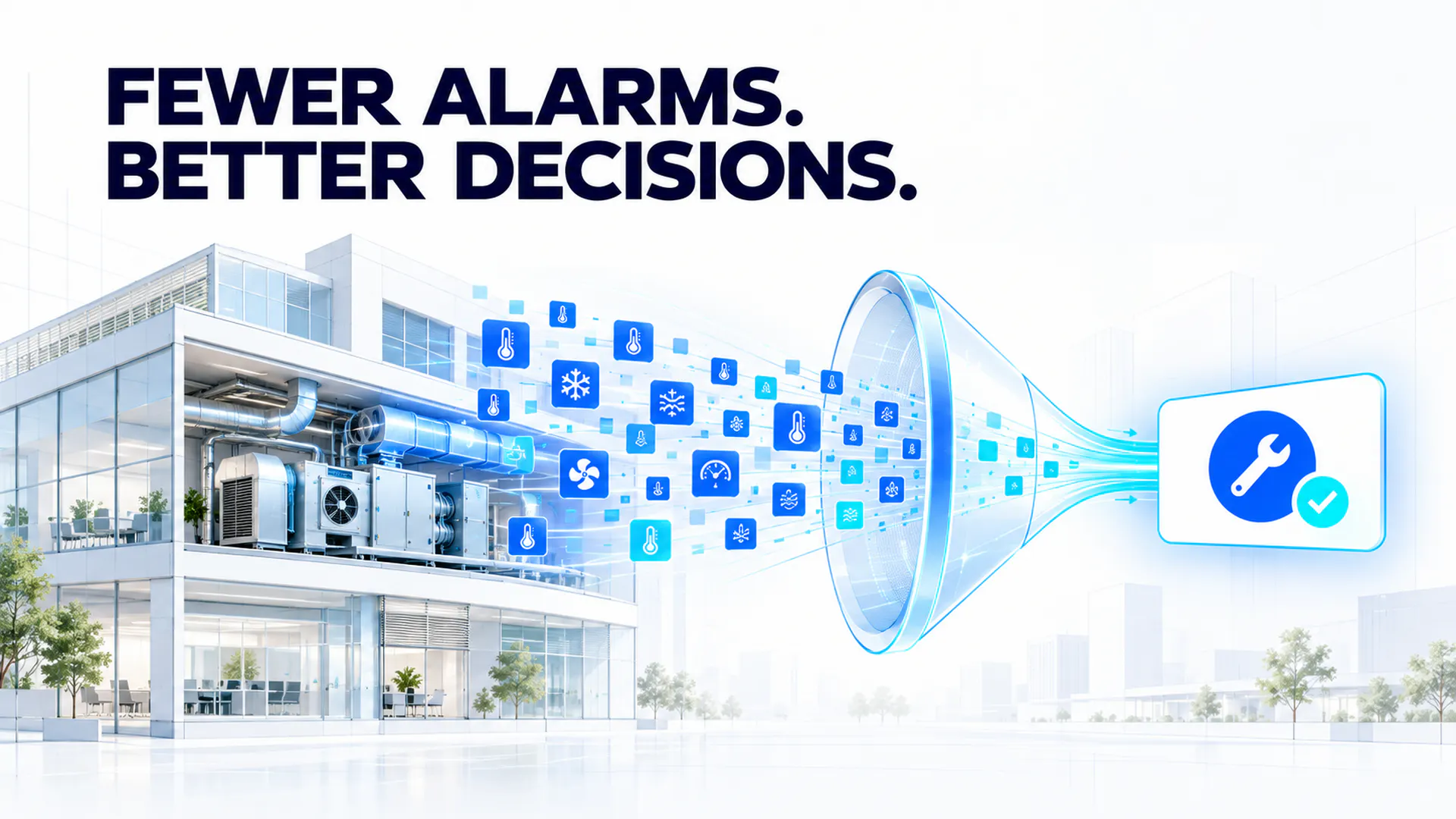
Building management systems are good at reporting abnormal conditions. That does not mean they are good at explaining what happened or helping a technician decide what to do next.
This is an executive issue. As portfolios add sensors, analytics, and AI, machine-generated findings can outgrow facility teams. Dashboards surface events while leaving diagnosis, priority, ownership, and verification unresolved, and forcing operators to reconstruct causes manually under time pressure across an entire portfolio.
The better objective is decision quality. Enterprises should design a governed path from signal to diagnosis to action, using deterministic alarms for known conditions, fault detection and diagnostics for causal reasoning, and AI for context-rich assistance.
Alarm volume is a weak performance metric
A falling alarm count may indicate better engineering. It may also mean thresholds were widened, notifications were suppressed, or faults went unseen. Conversely, a high count may come from one chattering sensor rather than widespread equipment failure.
Executives need outcome measures: repeated and standing alarms, acknowledgement and resolution times, recurrence after closure, confirmed fault rate, and findings that produce corrective work. A rare, severe alarm can outrank a frequent low-impact deviation.
Alarm rationalization begins with context. Low flow may be expected during startup and serious during occupied operation. Deadbands and delays reduce chatter, but wider filters can miss or delay detection. Teams need a documented method for reducing BMS alarm noise without hiding real faults, not a blanket target for fewer notifications.
Detection and diagnosis require different logic
An alarm usually states that a condition crossed a limit. Diagnosis asks which explanation best fits the evidence.
Suppose an air-handling unit cannot reach its supply-air temperature setpoint. The symptom could reflect inadequate chilled-water flow, a stuck valve, a drifting sensor, an incorrect setpoint, coil degradation, or an upstream plant problem. Escalating the temperature alarm alone transfers investigation work to the operator.
FDD evaluates commands, feedback, measurements, modes, schedules, and expected response. Rules suit well-defined behavior. Physics-based models represent system relationships; data-driven methods detect patterns that fixed thresholds miss. Choose by fault type, evidence quality, and consequence of error.
AI adds value after this foundation exists. It can retrieve work orders and manuals, compare incidents, summarize evidence, and rank causes for review. It should never replace hard safety logic or diagnose raw telemetry without validated methods.
The workflow determines the return
An accurate diagnosis that remains in an analytics queue produces no repair. The operating loop must connect detection, diagnosis, prioritization, assignment, correction, and verification.
Lawrence Berkeley National Laboratory research covering 550 buildings found median whole-building energy savings of 8% among FDD users. Researchers cautioned that other energy measures could have contributed. FDD can support measurable value when teams act; detection alone creates no savings.
Each case should include equipment identity, evidence, probable cause, confidence, consequence, recommended checks, and an owner. Work-order closure should verify that the condition disappeared and did not return. Feedback improves rules and exposes symptom-only repairs.
This is the business case for building a fault detection and diagnostics framework for BMS operations: shortening the distance between abnormal behavior and a verified operational response.
Governance protects performance at scale
Diagnostic logic changes as equipment ages, sequences evolve, and sensors drift. Every rule and model needs an owner, version history, validation record, and rollback path. Document required points, data quality, confidence thresholds, escalation, and conditions for automation.
Portfolio leaders should test transferability. A model may fail on another AHU with different sensors, sequences, climate, or load. Read-only deployment on one equipment family lets engineers measure false positives, missed faults, and usefulness before expansion.
Practical takeaways for enterprise leaders
Baseline current alarm behavior before buying another analytics layer.
Separate safety alarms, diagnostic findings, and informational events into distinct workflows.
Prioritize by consequence, persistence, asset criticality, redundancy, and evidence quality.
Start FDD with equipment that has adequate telemetry and meaningful failure cost.
Require explainable evidence and human review before any automated control action.
Measure resolved, verified faults rather than findings generated.
Conclusion
The strongest BMS programs do not ask how many alarms or AI insights a platform can produce. They ask whether the system helps the right person make a better decision soon enough to change the outcome.
That requires disciplined alarm engineering, explainable diagnostics, reliable data, ownership, and post-maintenance verification. AI can accelerate the surrounding reasoning and workflow, but cannot fix weak telemetry or undefined accountability. Designing the operating model around decisions makes building intelligence easier to govern and use.
Replies
Be the first to reply
Have a question or a thought to share? Add a comment above to start the conversation.