

Stop Turning Every BMS Alarm Into a Work Order
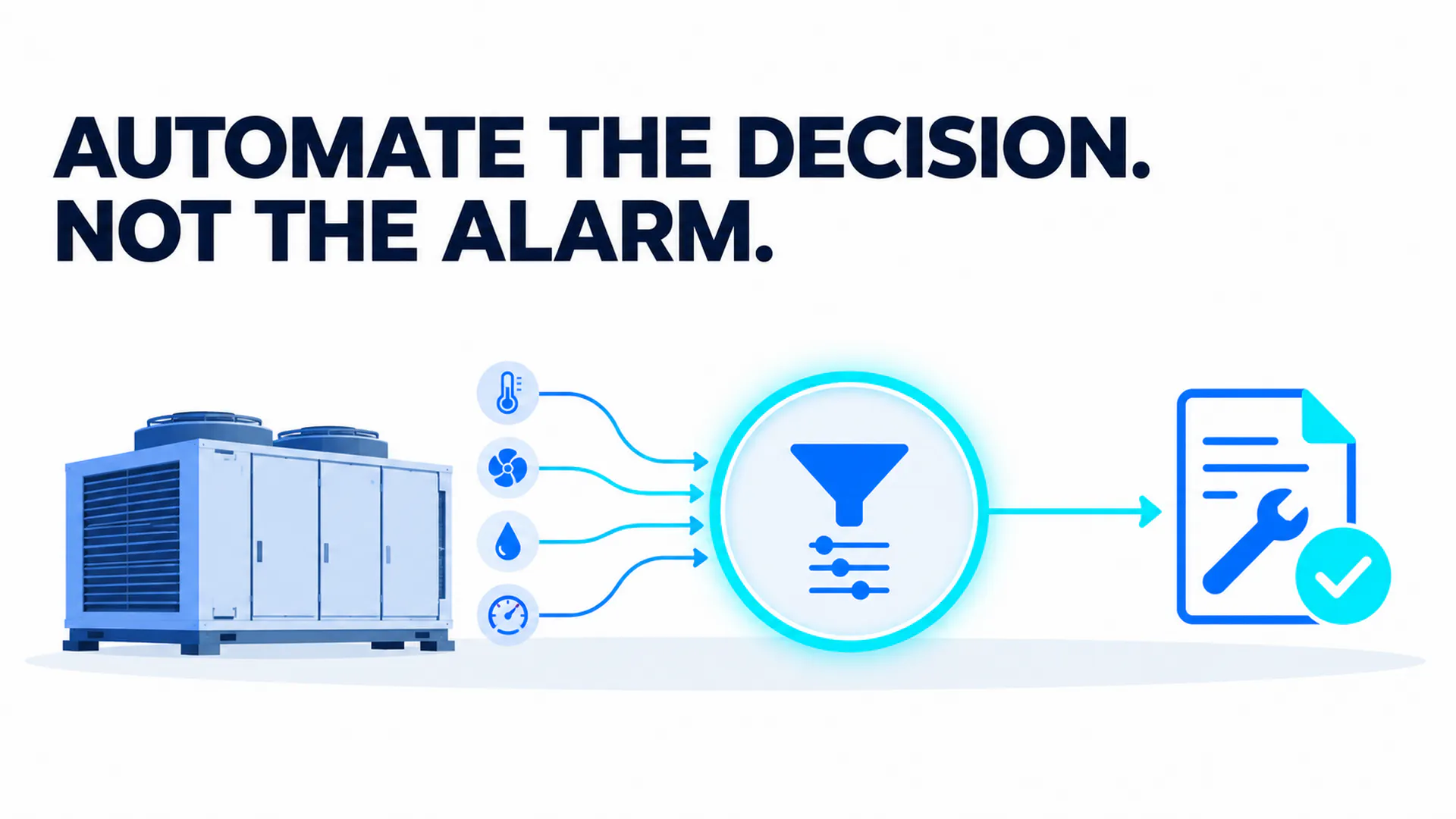
The strongest objection to BMS-to-CMMS automation is that it can worsen maintenance. If every alarm creates a ticket, nuisance events become work, faults produce duplicate tasks, and technicians close symptoms instead of repairing causes.
The integration may be technically successful while the operating model fails. Data moves faster, yet the maintenance backlog becomes less trustworthy across the portfolio and between maintenance teams.
Alarms and work orders serve different purposes. An alarm asks for attention. A work order commits labor, parts, and accountability. A governed admission layer must decide when an operating signal deserves that commitment.
A work order is a resource decision
A BMS may generate events for safety limits, communication loss, comfort deviation, equipment state, sensor quality, or energy performance. These conditions do not require the same response.
Low flow during startup may need no action. A failed pump can generate downstream alarms belonging to one incident. A drifting sensor may require inspection, but not urgent mechanical repair.
Direct automation ignores these distinctions. It treats event creation as evidence that maintenance should begin. The result is predictable: duplicated tasks, incorrect priorities, weak records, and declining technician trust.
The executive question is whether the enterprise can defend why a work order was created, assigned, prioritized, and closed, not whether an API can create it.
Insert admission control between detection and execution
An admission layer evaluates a signal before maintenance. It confirms persistence, relevant operating mode, known asset mapping, and whether the condition represents an actionable failure or inspection need.
It should group related alarms. If a chilled-water pump trips, downstream flow, pressure, and temperature deviations may share one cause. One evidence-backed incident is more useful than separate work orders for every symptom.
Priority follows consequence. Asset criticality, redundancy, affected spaces, safety exposure, service impact, and response time should shape the workflow. Alarm severity alone cannot represent business risk.
A practical framework for automating CMMS work orders from qualified BMS alarms should therefore control admission, correlation, priority, routing, and verification rather than automate ticket creation in isolation.
Asset identity is the control point
Automation cannot route work reliably if the BMS and CMMS disagree about equipment identity. A valid fault linked to the wrong asset can misdirect technicians, reserve the wrong parts, and corrupt maintenance history.
Each case needs trusted mapping between BMS equipment, point names, location, CMMS asset identifier, parent system, and owner. Version and review mappings when equipment, controls, or responsibility changes.
Across a portfolio, local names may vary, but the admission layer must resolve them to stable enterprise identities. Uncertain mappings should stop automation and request review.
Send evidence, not an alarm description
A useful work order should reduce investigation time. It should include the affected asset, observed condition, probable cause, supporting trends, operating mode, fault duration, priority rationale, recommended checks, and links to approved procedures.
This context defines AI's boundary. Deterministic rules retain authority over safety conditions and engineering limits. AI can assemble evidence, retrieve cases, summarize history, and draft work. Human approval remains appropriate when evidence is incomplete, diagnosis uncertain, or action costly.
Close the loop with operational verification
CMMS completion does not prove the fault disappeared. A technician may close work after resetting equipment or finding no defect. The BMS should verify that the original condition cleared and remained stable.
If the fault returns, reopen or create a linked case instead of marking success. Technician findings should update the record with confirmed cause, action, parts, evidence, and outcome.
This two-way feedback improves future qualification rules and makes maintenance history usable for performance analysis.
Measure automation quality
Ticket volume is a poor success metric. Track duplicate suppression, confirmed faults, false work orders, qualified detection-to-assignment time, recurrence, overdue critical work, and technician acceptance.
Governance should assign owners for alarm rules, asset mappings, priority logic, work-order templates, and automation permissions. Changes need testing, approval, version history, and rollback.
Practical takeaways
Automate qualified incidents, not raw alarm events.
Treat every work order as a resource commitment.
Block creation when asset identity or evidence is uncertain.
Group consequential alarms under one probable cause.
Attach diagnostic context before routing work.
Verify the physical condition after CMMS closure.
Conclusion
BMS-to-CMMS integration creates value when it improves maintenance decisions, not when it produces tickets faster. The missing capability is a governed admission layer that filters noise, resolves identity, groups evidence, applies business priority, and verifies results.
With that control in place, automation can shorten response time without overwhelming technicians or weakening records. Without it, the enterprise simply converts alarm fatigue into work-order debt.
Replies
Be the first to reply
Have a question or a thought to share? Add a comment above to start the conversation.