

Stop Choosing Building Metadata Standards Before Defining the Business Decision
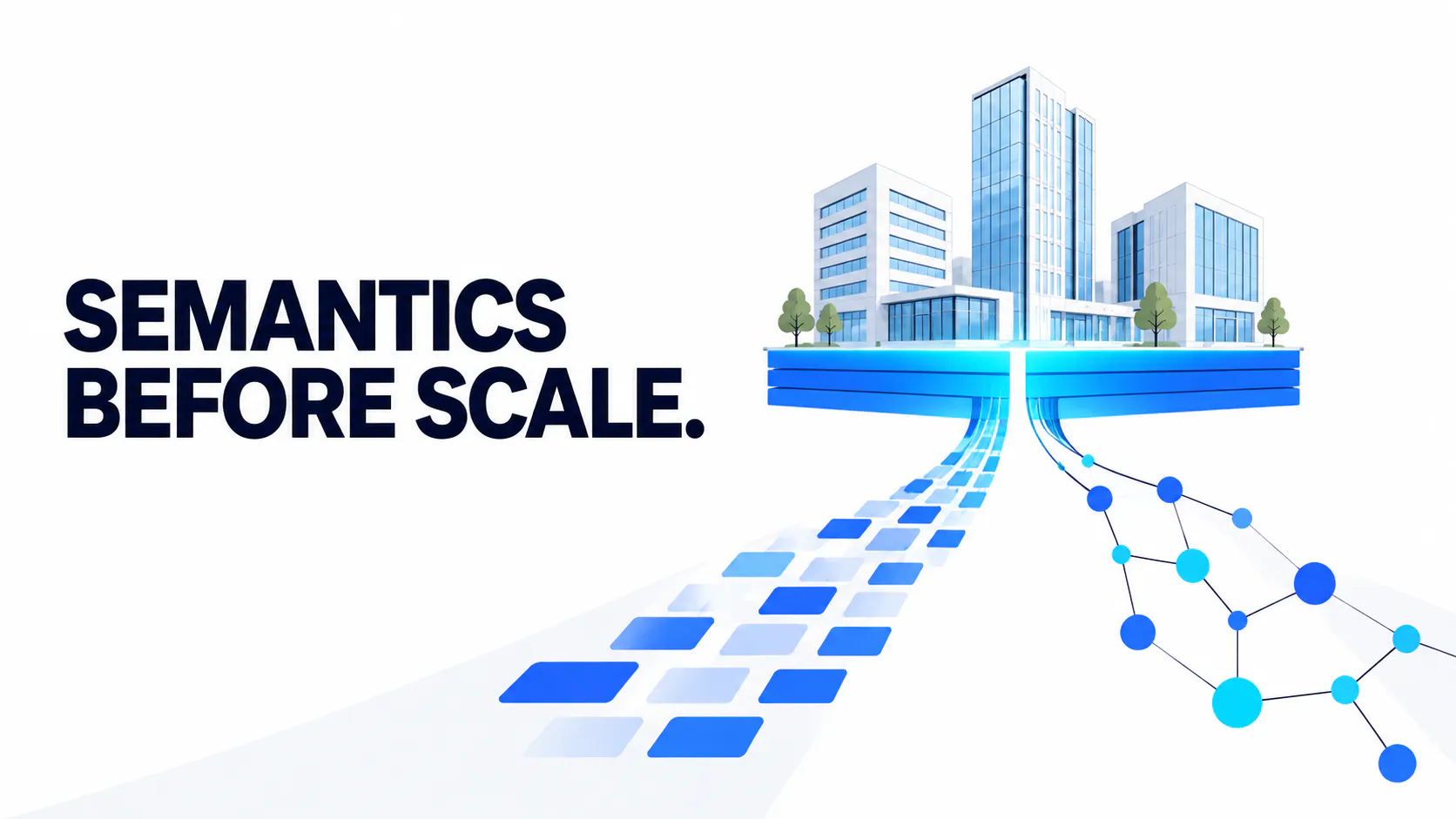
The strongest argument against investing in building semantics is simple: a better data model cannot repair a drifting sensor, a broken control sequence, or missing trend history.
That limitation defines its proper role. A semantic layer is not a cure for poor building data. It is a contract between operational systems and the applications consuming their data.
For CEOs, CIOs, CTOs, and facilities leaders, the real decision is therefore not whether Brick Schema or Project Haystack is superior. It is what decisions the portfolio must support, what context each application requires, and how that context will remain accurate as buildings change.
Schema selection is an operating-model decision
Teams often compare tags, ontologies, query languages, and vendor support before defining ownership and maintenance.
Who owns the model after commissioning? Who approves equipment changes? Can applications confirm that required points exist? Can another vendor reuse the mapped data?
These questions determine whether a semantic model becomes reusable infrastructure or another static integration artifact.
Ownership affects portability and future switching costs.
The target application should set the minimum data contract. Energy benchmarking may need meters, areas, schedules, weather context, and source provenance. Fault detection may also require topology, commands, setpoints, and operating states. An AI agent may need manuals, work orders, approved procedures, and permission boundaries linked to the same equipment identity.
Modeling everything before proving one workload creates cost without feedback. Modeling too little forces every application to reconstruct context through custom rules.
Compare workload fit, not terminology
The familiar claim that Haystack uses tags while Brick uses an ontology is now too narrow. Project Haystack's official documentation describes vocabulary, taxonomy, ontology, entity relationships, and formal definitions. Brick remains structurally distinct because its building models use RDF graphs, explicit relationships, SPARQL queries, and SHACL validation.
Haystack can reduce implementation friction where building automation platforms, integrators, and existing metadata already follow its conventions. Replacing usable source metadata may consume budget without improving the application.
Brick can offer a stronger fit when software must traverse relationships across equipment, systems, spaces, and sites. Its graph model can support reusable queries and formal checks that verify whether required entities and relationships are present.
A practical comparison of Brick Schema and Project Haystack for building data should therefore inform architecture decisions without turning the standards into competing procurement brands.
A hybrid architecture can protect existing investment
Enterprises do not always need one portfolio-wide source format. A site may retain Haystack metadata inside its established BMS or integration platform. An ingestion layer can preserve those identifiers, resolve entities, and transform selected relationships into a canonical graph for cross-site applications.
This separation creates an important control point. Source systems remain traceable, while enterprise applications consume a governed representation rather than thousands of local naming patterns.
The transformation itself must be managed as data. Each mapping should record its source identifier, schema version, confidence, reviewer, approval status, and modification history. Otherwise, the canonical model becomes detached from the systems it represents.
Hybrid design also has a cost. Teams must manage transformations, reconcile versions, and decide which model holds authority when definitions conflict.
Treat semantics as a managed product
A building data foundation needs a product owner, service levels, validation rules, and a change process. It also needs separate controls for semantic accuracy and physical data quality.
Semantic validation asks whether an air handler has the required points and relationships. Data-quality validation asks whether those points are timely, complete, and physically plausible. Passing one test does not imply passing the other.
Executive reporting should track application coverage, mapping completeness, unresolved conflicts, validation failures, stale relationships, and time required to onboard a new building. These measures show whether the semantic layer is reducing integration effort or merely moving it.
Practical takeaways
Begin with one decision or application, not the entire point estate.
Define the minimum entities, relationships, telemetry, and provenance that application requires.
Preserve useful source metadata before considering migration.
Assign ownership for mapping approval, versioning, validation, and change detection.
Test semantic completeness and sensor quality as separate controls.
Expand the model only when a proven workload requires more context.
Conclusion
The winning standard is not the one with the richer diagram. It is the one, or combination, that creates a maintainable contract between buildings and business applications.
Brick, Haystack, and hybrid architectures can all support enterprise value when selected against real workloads. Without ownership, validation, and lifecycle discipline, each can become another layer of technical debt. The executive priority is to build semantic infrastructure that applications can trust, teams can maintain, and the enterprise can reuse across its portfolio.
Replies