

Predictive Maintenance Fails When Prediction Becomes the Product
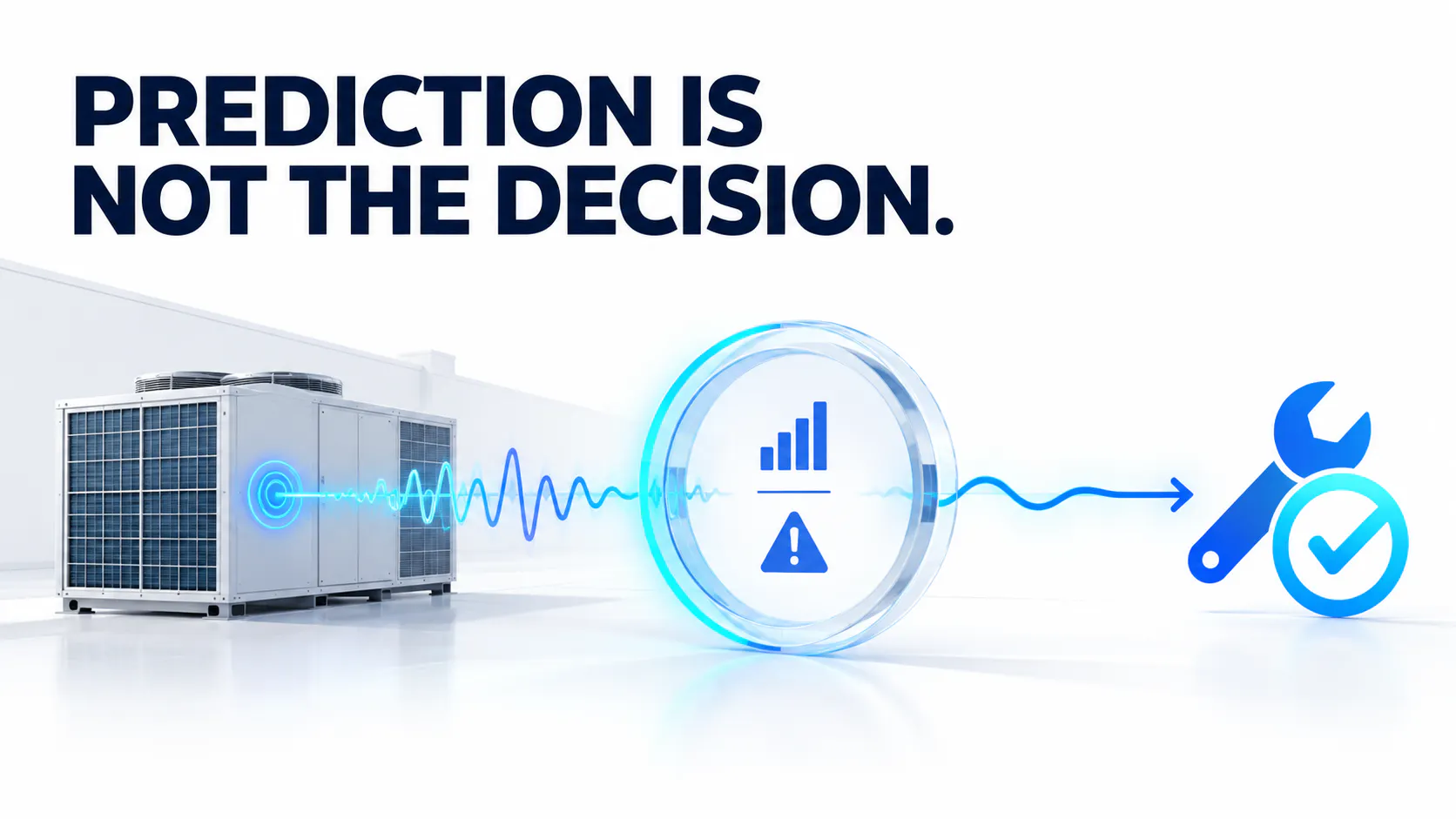
The strongest case against predictive maintenance is that earlier warnings can create more cost. Every investigation consumes engineering time. Premature intervention can replace usable parts, interrupt stable equipment, and fill maintenance queues with uncertain work.
Prediction is only one input to an asset decision. The outcome depends on an intervention policy combining technical evidence with consequence, confidence, redundancy, service windows, and the cost of error.
For enterprise leaders, the goal should not be maximum anomaly detection. It should be fewer unplanned failures without creating uncontrolled maintenance demand.
A forecast is not a maintenance decision
A BMS alarm reports a condition. Fault detection tests abnormal behavior. A predictive model estimates future degradation. None of these outputs decides whether a technician should act today.
Consider a pump drawing more current while producing the same flow. The pattern may indicate bearing resistance, an impeller problem, sensor error, or a temporary condition. Replacement could prevent failure or waste remaining asset life. Waiting adds evidence but increases exposure.
The decision requires context. Is the pump critical? Is redundant capacity available? Can inspection wait for a planned shutdown? How does the consequence of a missed prediction compare with a false positive?
Predictive maintenance becomes useful when these questions are encoded into operating policy rather than left for each technician to reconstruct.
Build an intervention policy, not another alert queue
An intervention policy defines the evidence and approvals required for each response. A low-confidence anomaly may enter a watchlist. A persistent, multi-signal pattern may trigger inspection. A high-confidence critical fault may justify planned work and reserved parts.
Separate technical severity from business priority. Efficiency loss on redundant equipment may wait for the next service window. Small drift in a component without backup may require faster action.
Many programs miss this operating layer. Teams invest in models and integrations, then send every finding into one maintenance queue. Noise moves from the BMS to the CMMS.
A more disciplined approach to turning BMS fault and alarm data into predictive maintenance action connects each finding to a response class, accountable owner, evidence requirement, and verification step.
Data confidence must travel with the prediction
Predictive models can appear precise on weak evidence. Sensor drift, missing samples, wrong units, stale timestamps, and incomplete equipment relationships can change a signal's meaning.
Attach a data-confidence record to every prediction. State which points contributed, whether they passed quality checks, when sensors were calibrated, which model version ran, and what evidence was missing.
Lower evidence quality should reduce automation authority. Complete, validated telemetry may support a work-order draft. Missing feedback should trigger human review or sensor validation before maintenance action.
ISO 55000 frames asset management around value, risk, cost, and performance. Predictive systems need the same logic. Model confidence matters only when linked to the consequence of acting or waiting.
Field outcomes create the learning loop
A predictive program cannot improve from notes such as “checked unit” or “issue fixed.” It needs structured outcomes: confirmed fault, failure mode, action, parts used, condition after repair, and recurrence.
This feedback distinguishes a useful early warning from a coincidental pattern. It also reveals whether the maintenance action solved the cause or only removed the symptom.
Executives should track decision performance: confirmed findings, avoided emergency work, inspection yield, decision time, recurrence after repair, unnecessary intervention, and service disruption. Prediction volume is an activity metric, not a business result.
Scale by asset economics
Begin with assets where failure has material consequences, telemetry is adequate, and teams can validate results. Critical chillers, pumps, and repeated equipment families offer a stronger start than portfolio-wide coverage.
Read-only baselining should precede automation. Compare findings with inspections, tune thresholds, and identify missing data before creating work. Expand after verified operational value, not because more data is available.
Practical takeaways
Define the decision each predictive signal is expected to support.
Rank action by consequence, confidence, redundancy, and intervention cost.
Carry data-quality evidence into every maintenance recommendation.
Require structured technician feedback after inspection and repair.
Measure verified outcomes and unnecessary work, not alert volume.
Automate authority only after the operating policy performs reliably.
Conclusion
Predictive maintenance is not a race to identify the earliest possible anomaly. Earlier signals often contain more uncertainty, creating a direct trade-off between lead time and confidence.
Enterprise advantage comes from managing that trade-off. Reliable telemetry, intervention rules, accountable workflows, and field verification turn probability into a controlled asset decision. Without those controls, predictive analytics adds demand. With them, maintenance leaders gain time to act before failure removes their choice.
Replies
Be the first to reply
Have a question or a thought to share? Add a comment above to start the conversation.