

Enterprise AI Memory Needs Continuous Evaluation, Not More Context
Enterprise AI Memory Needs Continuous Evaluation, Not More Context
The next governance challenge is not whether AI can remember, but whether enterprises can control what agents retain, trust, and reuse.
Enterprise AI becomes more useful when it remembers. It also becomes harder to govern.
A persistent agent can carry forward prior decisions, operating instructions, retrieved evidence, and lessons from past tasks. That continuity can reduce repeated work. Yet memory creates a new failure mode: yesterday’s information can silently shape today’s action even when it is outdated, wrong, poorly sourced, or no longer authorized.
The executive question is therefore changing. It is no longer only, “Can the model produce a good answer?” It is, “Can the system use memory correctly, prove where that memory came from, and recover when stored context is wrong?”
Memory should be treated as governed state
The strongest argument against persistent AI memory is simple: stateless systems are easier to control. If each task starts fresh, bad context is less likely to compound.
That trade-off is real. MemoryAgentBench evaluates four capabilities: accurate retrieval, test-time learning, long-range understanding, and selective forgetting. Its authors report that current methods still struggle to master all four. A separate 2026 benchmark found frequent reuse of invalid memories and failures to reconcile information as it changes.
For enterprises, memory should not be treated as a passive archive. It is governed state that can influence decisions. Each stored item should carry metadata such as source, owner, creation time, approval status, expiry rule, and scope of use. An approved policy should not have the same authority as a conclusion inferred from an old conversation.
Evaluation must follow the memory lifecycle
Most AI evaluation focuses on the final output. That is necessary, but insufficient for persistent agents.
A stronger framework tests the memory lifecycle. Can the agent retrieve the right information? Can it separate current knowledge from obsolete knowledge? Can it avoid storing unsupported conclusions as facts? Can it recognize when memory is insufficient and fetch fresh evidence?
This direction aligns with NIST’s Generative AI Profile, which places evaluation within the broader design, development, use, and governance of AI systems.
The control layer around the model also matters. A production agent needs infrastructure that manages context, state, tools, permissions, and recovery. One useful architectural reference is this guide to production agent harnesses that govern memory, tools, and execution. The business issue is whether the enterprise has a consistent control plane between model reasoning and real-world action.
External data can improve memory and contaminate it
Enterprise memory will increasingly include information gathered outside controlled internal systems. Agents may collect supplier data, regulatory notices, technical documentation, or market signals from the web.
That creates an ingestion problem. An agent should not write external data directly into durable memory without checks. Source URLs, timestamps, schema validation, duplication rules, confidence thresholds, and review paths should sit between extraction and persistence.
The mechanics are illustrated by schema-first web extraction with validation and QA, where structured outputs, stop conditions, benchmark sets, and validation logic constrain what an agent can accept. The wider principle is that memory quality starts before storage.
Security adds another reason for this discipline. OWASP’s agentic AI work identifies risks introduced when autonomous systems interact with external tools and environments, making explicit controls around agent behavior a core security requirement.
Build a closed performance loop
The stronger operating model is a closed loop.
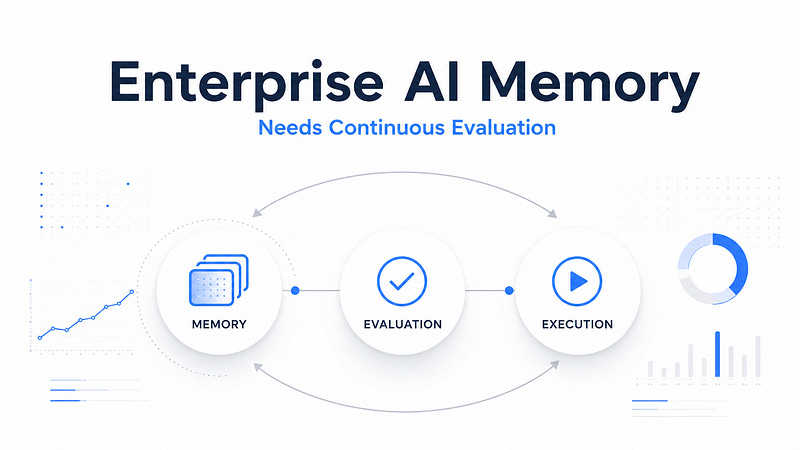
Evidence enters through controlled sources. The system decides what can become memory. The agent uses approved memory during execution. Evaluation checks both the result and the memory path that produced it. Failures feed back into policies, tests, and memory rules.
Google Research’s ReasoningBank offers one technical example. It stores lessons derived from successful and failed agent trajectories, then retrieves those lessons for later tasks. Its evaluation found gains in task success and fewer execution steps compared with memory-free baselines on selected benchmarks.
The management lesson is broader: memory quality depends on what the organization chooses to preserve, reject, update, and forget. For enterprise leaders, AI measurement should therefore move from model quality toward system quality.
Practical takeaways
Classify memory by authority. Separate verified enterprise knowledge, working state, user-provided information, external evidence, and inferred experience.
Evaluate memory behavior. Test retrieval accuracy, stale-memory use, contradiction handling, forgetting, and source traceability.
Gate persistence. Do not let every agent observation become durable memory.
Measure execution outcomes. Track task completion, policy violations, human overrides, bad-memory retrievals, tool errors, and recovery behavior.
Conclusion
Enterprise AI memory can improve continuity and learning, but persistence without evaluation creates accumulated risk. The stronger architecture connects memory, evaluation, and execution through explicit controls.
For CEOs, CIOs, and CTOs, the goal is not to give agents the largest possible memory. It is to build memory that is selective, traceable, testable, and safe to act on. When evaluation governs what the system remembers and how that memory affects execution, enterprise AI becomes easier to audit, improve, and scale.
Replies
Be the first to reply
Have a question or a thought to share? Add a comment above to start the conversation.