

AI Evaluation Metrics: Why One Score Is Not Enough
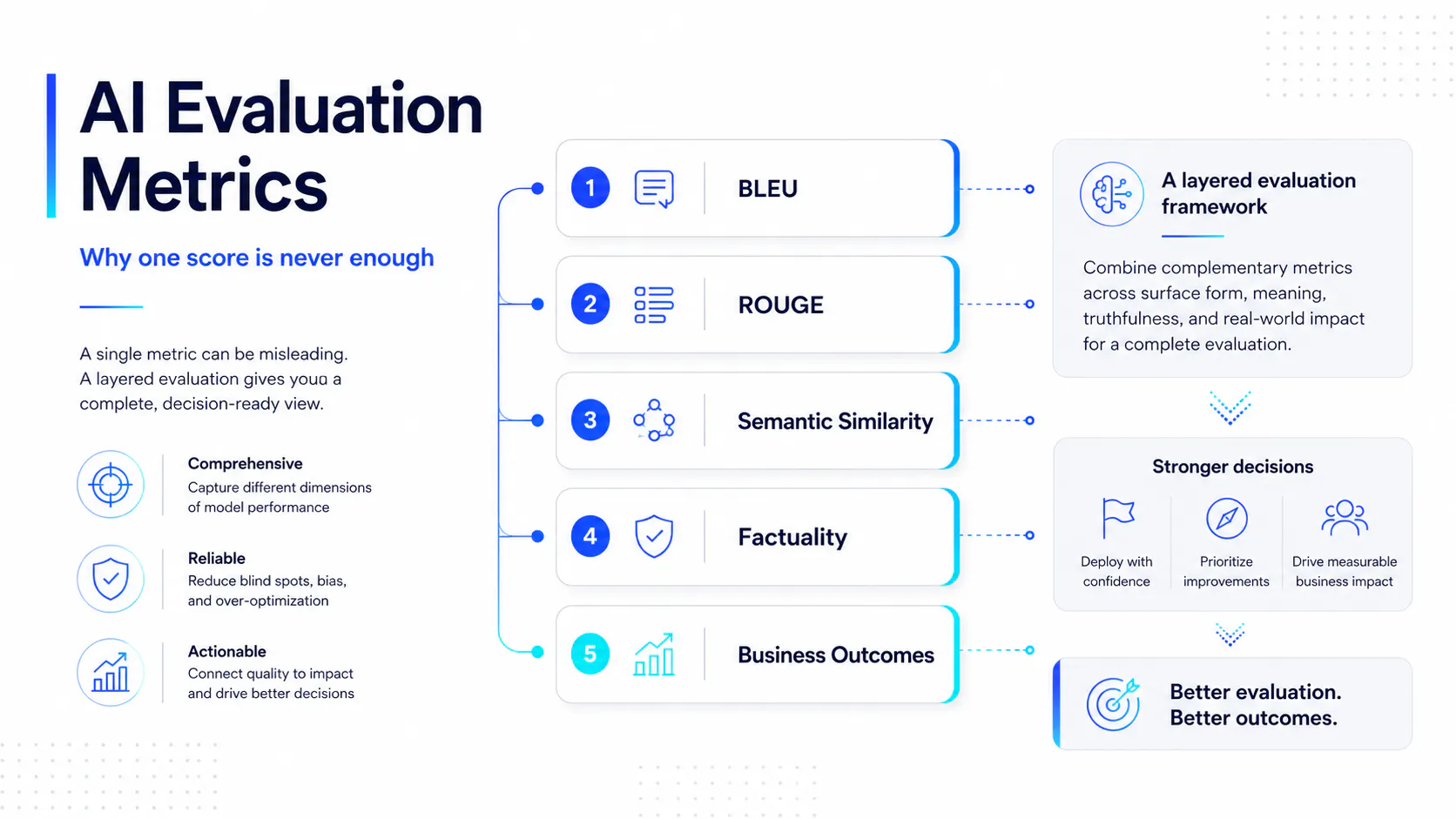
Some AI teams argue that metrics such as BLEU and ROUGE belong to an earlier era of natural language processing. Modern language models can paraphrase, reason across documents, and generate answers in many valid forms. A metric based on matching words may seem too limited for such systems.
That criticism is valid, but removing lexical metrics creates another problem.
Enterprises still need fast, stable, and low-cost ways to detect changes in AI output. BLEU and ROUGE can support that need. The mistake is not using these metrics. The mistake is treating one score as proof that an AI system works.
A reliable evaluation strategy must measure several dimensions, from wording and content coverage to factual accuracy and task completion.
Why Automated Evaluation Still Matters
Human review provides rich feedback, but it does not scale across every model update, prompt revision, retrieval change, or software release.
Consider an AI system that processes thousands of customer requests each day. A minor change to its prompt may improve one use case while damaging another. A new model may produce smoother text but omit required policy details. An updated knowledge base may improve recent answers while weakening older workflows.
Teams need automated tests that can run across a fixed evaluation set before each release.
Lexical metrics remain useful because they are:
Fast to calculate
Easy to reproduce
Low in computing cost
Suitable for regression testing
Clear enough to support failure analysis
They can tell teams that something changed. They cannot always explain whether the change made the system better.
BLEU and ROUGE Answer Different Questions
BLEU and ROUGE both compare generated text with one or more reference texts. However, they approach the comparison from different directions.
BLEU Focuses on Precision
BLEU was created for machine translation. It checks how many words and word sequences in the generated text also appear in approved reference translations.
It also applies a brevity penalty. This reduces the score when a system produces an output that is much shorter than the reference.
BLEU can help answer questions such as:
Did the model preserve approved terminology?
Did the wording move away from the reference set?
Did a new model version produce shorter outputs?
Did translation quality change under the same test conditions?
This makes BLEU useful for controlled translation, product descriptions, standard service messages, and technical documentation.
However, a higher score does not prove that the output is accurate or useful. A valid paraphrase may receive a low score because it uses different words. An incorrect statement may still receive a high score if it copies enough language from the reference.
A detailed guide to the BLEU score and what it measures and misses explains why businesses should use it as a diagnostic metric rather than a universal quality grade.
ROUGE Focuses on Content Overlap
ROUGE was developed for text summarization. It measures how much of a human-written reference summary appears in a generated summary.
Common versions include:
ROUGE-1 for individual word overlap
ROUGE-2 for two-word sequence overlap
ROUGE-L for the longest matching word sequence
Recall, precision, and F1 variants for different evaluation goals
ROUGE can help determine whether a summary includes expected topics, entities, actions, or phrases.
For example, an executive meeting summary may need to include a delayed product launch, an assigned owner, and a revised deadline. ROUGE can check whether language linked to those details appears in the generated output.
Yet overlap does not confirm meaning. A generated sentence that says, “The launch is not delayed,” may share many words with a reference that says, “The launch is delayed.”
Teams evaluating summarization systems should understand how each ROUGE score for AI-generated summaries reflects a different aspect of lexical coverage.
Why Strong Scores Can Still Hide Weak AI
A metric becomes dangerous when decision-makers assume it measures more than it does.
Several failure patterns can create misleading results.
Valid Paraphrases Receive Low Scores
A reference may state:
The company reduced operating expenses during the second quarter.
An AI summary may state:
Second-quarter costs declined.
The meaning remains close, but the texts share few exact word sequences. BLEU and some ROUGE variants may give the output a weak score.
This creates a risk that teams optimize models to copy reference wording instead of communicating information well.
Incorrect Claims Receive High Scores
A model may reuse the right entities, dates, and terms while changing their relationships.
For example:
Reference: The compliance team approved the policy.
Generated output: The compliance team rejected the policy.
Most words match. The business meaning does not.
Lexical overlap cannot identify every contradiction, reversed relationship, or incorrect number.
Average Scores Hide Critical Failures
A system may perform well across common requests but fail on rare cases involving safety, compliance, finance, or customer rights.
A high average score can conceal those failures.
Teams should segment evaluation results by risk level, document type, department, language, and user intent. A failure involving a greeting should not carry the same weight as a failure involving a payment instruction.
Text Metrics Ignore Agent Actions
An AI agent can produce a fluent response while taking the wrong action.
It may:
Retrieve an outdated document
Select the wrong customer record
Call the wrong software tool
Skip a required approval
Enter incorrect data into a business system
Claim that it completed a task that failed
BLEU and ROUGE evaluate text. They do not measure whether the workflow succeeded.
Building a Layered AI Evaluation Stack
No single metric can cover every AI failure mode. Enterprises need a layered framework that connects technical evaluation with operational risk.
Layer 1: Lexical Comparison
Use BLEU, ROUGE, or exact-match checks to detect changes in wording, terminology, content coverage, and output length.
This layer works well for:
Regression testing
Controlled translation
Structured extraction
Template-based generation
Terminology compliance
Summary coverage checks
Keep the dataset, references, tokenization, preprocessing, and implementation fixed when comparing scores.
Layer 2: Semantic Similarity
Semantic metrics compare meaning rather than exact words. They can recognize that terms such as “reduce expenditure” and “lower costs” express similar ideas.
These metrics reduce the penalty placed on valid paraphrasing. However, semantic similarity still does not guarantee factual correctness. Two sentences can appear similar while containing different dates, quantities, or conditions.
Use semantic scores as another signal, not as a final verdict.
Layer 3: Factuality and Groundedness
Check whether each generated claim has support in the source material or approved knowledge base.
A groundedness test should examine:
Whether cited sources support the answer
Whether numbers match the source
Whether names and dates remain correct
Whether the output adds unsupported claims
Whether the model preserves exceptions and conditions
This layer has high value in retrieval-augmented generation, enterprise search, legal review, financial analysis, and policy-based assistance.
Layer 4: Deterministic Business Rules
Some requirements should not depend on a statistical score.
Use direct tests for rules such as:
Required fields must be present
Output must follow a defined JSON structure
Personal data must be removed
Approved terms must appear
Restricted terms must not appear
Citations must use a valid format
Monetary values must match the source
Human approval must occur before execution
Rule-based validation gives teams a clear pass or fail result for non-negotiable requirements.
Layer 5: Task and Workflow Success
The final question is not whether the AI produced similar text. It is whether the system completed the intended business task.
Measure outcomes such as:
Correct resolution rate
Successful tool calls
Retrieval accuracy
Approval compliance
Case completion time
Human correction rate
Escalation rate
User acceptance
Cost per completed task
These measures connect model performance with business value.
Layer 6: Human Review
Human evaluation remains necessary for high-risk and open-ended tasks.
Reviewers can assess tone, clarity, completeness, usefulness, and context in ways that automated metrics may miss.
A practical approach does not require people to review every output. Teams can route cases for review based on risk, low automated scores, conflicting metric results, or unusual system behavior.
How to Set Useful Evaluation Thresholds
There is no universal “good” BLEU or ROUGE score.
A score only has meaning within a defined test environment. Different languages, reference sets, tokenization rules, output lengths, and business domains can produce different results.
Instead of adopting a generic threshold, teams should:
Build an evaluation set from real business cases.
Include common, difficult, and high-risk examples.
Create references with domain experts.
Measure the current production system.
Compare new versions under the same conditions.
Review large score changes at the individual case level.
Connect technical scores with human judgment and task outcomes.
The production baseline matters more than an isolated industry number.
For example, a small decrease in ROUGE may be acceptable if human reviewers find that summaries became clearer and remained factual. A higher BLEU score may not justify a release if the new model starts copying outdated terminology.
Treat Metrics as Evidence, Not Decisions
BLEU and ROUGE still provide value. They offer fast indicators of lexical change, content overlap, and regression. They can help teams test large datasets before a release and identify cases that need deeper review.
Their value ends when organizations treat them as complete measures of intelligence, accuracy, or business performance.
A mature AI evaluation strategy combines lexical metrics with semantic checks, source validation, deterministic rules, workflow outcomes, and human review. Each layer covers a different risk.
The goal is not to find one perfect score. The goal is to build enough evidence to decide whether an AI system is accurate, controlled, and ready for real work.
___________
AIQuinta - An Agentic Enterprise Platform, where your knowledge base powers AI.
- Website: https://aiquinta.ai/
- Email: info@aiquinta.ai
Replies
Be the first to reply
Have a question or a thought to share? Add a comment above to start the conversation.