


BrunoThe Git-native API client. Local-first, open source.


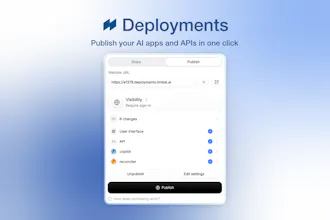

The architectural standout of Timbal AI is its dual-engine approach to agentic systems, cleanly bridging the gap between non-deterministic LLM logic and rigid business workflows through its Action Control Engine (ACE). Instead of trapping developers in fragile prompt chains, it provides a highly reliable behavioral runtime environment that compiles down to clean, exportable code. The addition of their native Hybrid DB engine—which unifies relational structures with vector similarity indexes—drastically simplifies complex enterprise RAG setups without forcing teams to patch together separate database infrastructure.
While the runtime execution layer is incredibly powerful, the initialization onboarding loop remains steep for teams accustomed to traditional REST endpoints. The internal documentation and step-by-step edge-case error tracing are still maturing, meaning debugging multi-agent loop failures mid-stream occasionally requires digging into underlying container log levels rather than reading a clean error matrix on the dashboard. Additionally, introducing more native, role-based configuration templates directly within the UI setup would significantly speed up development timelines for standard enterprise use cases.
I’ve heavily evaluated visual workflow orchestrators like n8n and Make, alongside code-first framework setups like LangChain or CrewAI. While visual canvas platforms handle standard API integrations beautifully, they quickly bottleneck when dealing with autonomous state machine loops or complex code-level logic. On the flip side, code-only frameworks lack native visual tracing and observability, making debugging production token drift a massive chore. I chose Timbal AI because it acts as an unrestrictive, open ecosystem—giving teams visual orchestration layout capabilities without creating proprietary vendor lock-in or imposing commercial scaling limits.
Unlike platforms that hide logic behind "black box" UI flows, Timbal offers a developer-first experience where agents, workflows, and tools are defined as code. The ability to export everything to clean, readable Python code is a massive selling point it avoids vendor lock-in and allows for local version control.
The ACE (Action Control Engine): This is the killer feature. By inserting a behavioral runtime as a proxy, it provides a deterministic layer that most LLM applications lack. Achieving "consistent outcomes" in production is the #1 pain point for AI devs, and solving this at the infrastructure level rather than the prompt-engineering level is the right architectural move.
As a new platform, the library of "native connectors" is growing, but it doesn't yet have the breadth of long-standing players like Zapier or Make.
While the current docs are clean, deep-dive examples for highly custom, non-standard architectures (complex async orchestration for high-load environments) are still maturing.
While the CLI is solid, further integration with local containerization (like Docker Compose) for simulating production-environment networking would be a welcome addition for local testing.
I have evaluated various agentic frameworks like Pydantic AI (for its strict typing and reliability) and LangChain/LangGraph (for the ecosystem depth). I have also looked at automation tools like n8n and Make.
I chose Timbal because the alternatives often force a choice between "pure code" (which requires building your own monitoring, tracing, and governance from scratch) or "no-code tools" (which are difficult to version control, audit, and integrate into enterprise CI/CD pipelines). Timbal provides the governance and observability layer of a professional platform while keeping the "source of truth" in code. It allows me to build complex Telegram bots and high-load backend agents without spending 40% of my time on infrastructure plumbing.

Congrats on the launch!
I spend most of my day talking to enterprise teams who are stuck exactly where you're describing: impressive demo, then six months of stitching together retrieval, observability, and governance before legal will even let it near production. The human in the loop piece is what caught my eye, since "who approved this agent's decision" is usually the question that kills deals late in procurement.
Curious how long your average enterprise sales cycle is now that you've built compliance in from the start, has it actually gotten shorter?

@pablo_martin6 Yes! Very glad that this part jumped out, because it is exactly one of the reasons why we built human-in-the-loop the way we did. The problem of "Who approved this" used to blow up procurement conversations late in the process, while now it's just logged at the step level, so it's a much quicker turnaround!


the trace-at-every-step answer to Shubham's question is the part that sold me, that's the actual difference between a demo and something a team will trust in production. one thing I'd want to understand before committing though: once retrieval, orchestration, UI, observability and evals all live in one core, how painful is it to rip out just one piece later if a team outgrows it or needs something more specialized, or is the whole pitch that you shouldn't need to
@galdayan The pitch isn't "you'll never need to rip anything out," it's that ripping something out doesn't leave you stuck.
Everything in Timbal, agents, workflows, integrations, compiles down to clean, readable code you own. Nothing is a black box abstraction that only makes sense inside our platform. So if a team outgrows the UI builder, or needs a more specialized eval setup than what we ship, you're not migrating off a proprietary format, you're working with code you can already read, edit, run locally, or self-host.
In practice, most teams don't rip pieces out entirely, they go deeper into code for the specific piece that needs more control while keeping the rest running natively (same pattern Gaspard asked about for interfaces earlier in this thread)

@pedrolivares — the part that resonates: making the resilience logic — per-step retries, primary→secondary model fallback, human-in-the-loop — a property of the runtime instead of glue code every team rewrites and half-tests.
I've watched agent projects die right in that "between the tools" seam, so having ACE enforce expected behavior at each node and trace every retry/fallback is the piece I'd actually trust in production.
Model-agnostic with the fallbacks baked in is the right call too.
@pedrolivares @akbar_b Totally agree Akbar!
On tracing, every decision runs through ACE, which sits as a proxy on every step, not just logging after the fact. So when something unexpected happens, you're not reconstructing what occurred from scattered logs, you pull the trace directly, step by step, model calls, tool calls, retries, fallbacks, all timestamped and ordered.
@pedrolivares @inescastillo Proxy-on-every-step is the right call — the trace becomes a first-class artifact instead of something you reconstruct from scattered logs after the fact. The beat I'd love to know: is that ordered trace replayable? If I can re-run a captured trace to reproduce a fallback that fired once, "why did the agent do that" turns from archaeology into a deterministic repro — which is the hard part of debugging non-deterministic runs.

"prototypes into production systems" is exactly the right problem to focus on. the graveyard of AI demos that never made it to real users is huge and the gap is almost never the model quality. it's observability, governance, eval pipelines, and the ten other boring things that prototype tools don't include. curious how the governance layer works in practice though. when an agent does something unexpected in production, how quickly can you trace back through the decision chain to understand why it happened?
@shubham4real Thanks Shubham! It's super fast in practice it's like two clicks. You pull up the execution and see every step the agent took, and for each one the exact input and output. So when something looks off, you don't ned to reconstruct what happened, you just open the trace and see it directly, which makes everything so much more easier!

For teams already using separate best-of-breed tools, like LangSmith for evals, Pinecone for retrieval, and their own orchestration layer, what's the actual migration story? "One platform" is compelling when starting fresh but most teams evaluating this have existing infrastructure they'd be replacing, curious whether Timbal is designed to coexist with those or replace them entirely.

@ansari_adin Coexistence first, replacement over time, that’s the realistic path, not a forced rip-and-replace.
Most teams don’t tear out LangSmith, Pinecone, and their orchestration layer on day one. New agents and workflows get built natively on Timbal, where evals, tracing, and ACE are already part of the runtime instead of three separate tools bolted together, that’s usually the first piece to get replaced since it carries the most maintenance burden.
Retrieval tends to move last, migrating a production vector store is real, risky work, so existing infra typically stays until there’s an actual reason to consolidate it.
What’s your current orchestration setup look like? That’s usually what determines how a migration would go in practice.

I've built a few AI workflows recently and i've realized the hardest part isn't getting the first demo working it's everything that comes afer. i love that Timbal is focusing on the production side instead of stopping at the prototype.
@tessa_lynch Tessa, you nailed the exact insight the whole company is built on. The demo is the easy 10%, everything after is where projects go to die.
And it's actually more than production-grade workflows. The full picture:
Native tools across the stack, so you're not maintaining a zoo of integrations. Proprietary infrastructure on AWS with one-click deployments, no DevOps ceremony between you and production. Compliance built in from day one: ISO 27001, SOC 2 Type II, NIS2, because for enterprise that's not a nice-to-have, it's the entry ticket.
And the part that ties it together: you can create all of it in natural language.
Workflows, agents, interfaces, deployments. Describe what you need and Composer builds it on that same production-grade foundation, so "prototype" and "production" stop being two different projects.
@tessa_lynch @pedrolivares Thanks for the kind words, Tessa! That's really the core belief behind everything we're building. We agree that the demo is the fun part, but then the production part is where most teams actually get stuck, very happy that the focus comes through :)

what stood out to me is that you're thinking about monitoring and evaluation from the start those are usually the things people only worry about after they've already shipped.
@vincentbanzpk4 Exactly what we're tackling, Vincent. Retrofitting monitoring after shipping is where most AI projects stall, so we made it a property of the runtime instead of an afterthought.
Context on why: we're enterprise-focused, and that market doesn't forgive missing observability or governance. The nice side effect is that SMEs and agencies get the same performance and security machinery out of the box, stuff they'd normally never have the resources to assemble. The reliability layer is a byproduct of building for the hardest customers first.
@vincentbanzpk4 @pedrolivares totally agree and appreciate you noticing that, Vincent. It's easy to leave monitoring and evals for later and then later never comes... So baking it in from day one was a deliberate call on our end to tackle this specific issue 🙌
 Langchain
 n8n
n8n Make
Make

Timbal AI
Makimum, this might be the most precise description of Timbal anyone outside the team has written. "Governance and observability of a professional platform while keeping the source of truth in code" is exactly the position we're fighting for, and the fact that you arrived there after evaluating Pydantic AI, LangGraph, n8n and Make makes it mean even more.
Also glad ACE landed the way it did. Solving consistency at the infrastructure level instead of the prompt level was a deliberate architectural bet, and hearing a developer call it out as the killer feature validates a lot of hard decisions.
On your improvement points, all three are fair and all three are on our radar:
Connector breadth: growing fast, and in the meantime Composer can generate custom connectors for anything with an API, which covers a lot of the long tail while the native library catches up.
Deep-dive docs for complex async orchestration and high-load setups: agreed, this is where our docs are thinnest. It's exactly the kind of content we want to build from real production cases like yours, so if you're up for it, I'd love to hear more about your high-load agent setup.
Docker Compose is actually natively supported thanks to our Timbal CLI. Docs reference here: https://docs.timbal.ai/quickstart
Thanks for taking the time to write something this thorough. Reviews like this shape the roadmap more than you'd think.