
Theysaid is more than a survey, it's an opportunity to engage your customers, employees, donors, and etc. Training AI takes less than 1 min by pointing it to URL or internal doc. Your audience can answer and ask questions as if they are talking to you!
This is the 4th launch from Theysaid. View more

TheySaid 4.0
Launching today
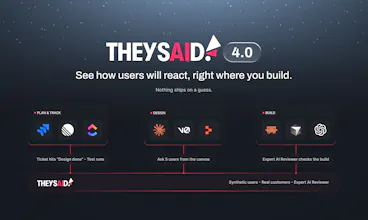
Put what you’re building in front of real customers or synthetic users trained on them when you need an answer in minutes without leaving Claude, Cursor, or Jira. Nothing ships on a guess.



Free Options
Launch Team / Built With


CloudflareStill paying to deploy your apps? Try Cloudflare Workers for free
Promoted


 Typeform

Hey Product Hunt 👋
I’m Chris, co-founder of TheySaid. Years ago I built the original UserTesting, so I’ve spent most of my career helping teams watch real people use their products.
Here’s what changed: your team now ships more decisions than ever (designs, tickets, PRs), but checking them with customers still means scheduling, recruiting, and waiting. So it gets skipped. We call the result Validation Debt: the cost of decisions you shipped without customer evidence.
TheySaid 4.0 lets you see how users will react, right where you build. Ask from Claude Design, v0, Replit, Bolt or Lovable, or have it run automatically when a Jira, Linear, ClickUp or Monday ticket finishes design. Then watch real people or synthetic users try what you just made.
What’s new:
Synthetic users: that actually use your product, on screen and out loud. Each starts from a model trained on 100,000+ hours of real usability sessions, then is tuned to your customers with the data you choose: call recordings, surveys, support tickets, CRM.
Audiences: define your real and synthetic customer groups once, and anyone in your org can reuse them.
MCP + Ticket Testing: feedback and a fix-it prompt inside your build tools, plus validation that triggers itself when design is done. No one has to remember to ask.
AI Companion: tell it what you need, and it does the work.
Experience Hub: always-on scoring of your critical customer experiences, with what to fix next.
Skills: reusable prompts for summaries, cohort analysis, and reports. Build it once. Run it forever.
Plus mobile app testing, clips and highlight reels, screeners, response quality monitoring, a unified test builder, a redesigned UI, and more.
Stop shipping decisions nobody validated. 🚫
Try 4.0 FREE → https://www.theysaid.io/v4
And tell me: when you build with AI today, how do you find out whether customers get it? Or do you skip that step?
Thanks @hamza_afzal_but! 🙌 Synthetic tests are quick. Exactly how long one takes depends on the length of your test: a short flow with a few tasks comes back fast, and longer tests with more steps take a bit more time. Here’s how it works:
Setup (about a minute): point TheySaid at your URL or prototype. You can also launch straight from Claude, Cursor, Figma, or a Jira/Linear/ClickUp ticket.
Test plan: the AI drafts the tasks and questions. You review, tweak if you want, and approve.
Run: the synthetic testers go through your flow in parallel.
Results: you get prioritized usability issues with fix prompts you can paste directly. If you launched from a ticket, they’re posted back to that ticket.
Grab the 10 free synthetic tests and let us know how long yours takes!
@hamza_afzal_butt you're going to love MCP! Go into Claude --> Settings --> Connectors. Search for TheySaid and you'll be able to connect your account.
Then as you're vibe coding or using Claude design, you can just launch your tests in the background as you continue working.
Tests usually run in 5-30 minutes, depending on how complex your product is.
@hamza_afzal_butt adding some real numbers to Chris's 5-30 min. i pulled our last 30 days of AI tester sessions and the median one runs about 10 minutes, most land somewhere between 5 and 18. the spread is mostly how much there is to explore, a signup flow is quick, a full shopping journey where the tester compares products and reads reviews takes a lot longer. and since they all run at once and you're not watching it live, it's usually a "kick it off, grab a coffee" thing
Seeing synthetic users actually go through the product is pretty cool. It’s one thing to ask AI for feedback, but another to see where people might get stuck. Congrats on the launch!
@henry_habib thanks Henry! yeah that was the whole point for us. a model reviewing a screenshot will happily tell you the page looks fine, but once a tester actually has to click through, fill the form and get to the end, you see the exact spot where it hesitates or goes back. and you get it as a screen recording with them talking out loud, so you can just watch the moment instead of reading a summary. what are you building right now?
@henry_habib yes! We're the first company in the world to bring offer synthetic agents that record their screen and voice as they do tasks on your app, prototype, claude design, product or website. I think you'll be blown away by what you can do with synthetic.
@chrishicken This is looks useful! Can it help small teams test Ideas without spending hours on user research?
@rohit62661 yes, small teams are honestly who we had in mind. the slow part of research is usually recruiting and scheduling, not the testing itself. here you point it at a url or a prototype, the AI drafts the tasks and questions, you approve, and a couple of AI testers click through it while you keep working. most sessions we've run in the last month came back in roughly 5 to 18 minutes. you can do the same with real people too when you want that extra confidence. what kind of idea are you trying to test?
Yes @rohit62661! You can get real feedback without blocking off a week for research. The 10 free synthetic tests are a great place to start.
Nice Work @chrishicken & the team. Can't wait to take it for a spin
Thanks Umar! When you try it, I'd start with a quick synthetic run on something you shipped recently. A couple of AI testers will click through it in a real browser and talk out loud while the screen records. What are you building these days? Happy to suggest a good first flow to test.
@umar_saleem go into Claude, then go to Settings --> Connectors. When you search for TheySaid, you'll be able to connect your TheySaid account, and launch all of your projects directly from Claude as you build.
Validation debt is a painfully good name for what happens when teams skip talking to users. Nice launch @chrishicken & team!
@harshyadav thanks :) We also say that we're your #1 defense against shipping AI slop to customers.
thanks @harshyadav ! honestly the fix is just making validation fire on its own, so when a ticket moves to the design-done status in jira, linear, clickup, asana or monday the AI testers kick off and post results right back in the ticket comments. nobody has to remember to ask. what does your team use for tickets?
Thanks so much @harshyadav ! Glad the name landed.
saw in the reviews that the voice mode gets people way more honest than a form, makes sense. how close do the synthetic users get to the real customers they’re trained on?
@aurelia_zambon on this page you can download a white paper we published on the results:
https://www.theysaid.io/v4
TLDR; Humans and Synthetic overlap between 85-90% of the time, once synthetic is trained on human data.
Having said that, you should just launch a test on your own. 20 humans vs 20 synthetic, and see the results for yourself!
@aurelia_zambon Adding one thing to Chris's point: the "trained on human data" part matters a lot. In our Dyson vs Shark study, each AI tester was built from one real shopper's session (their motivation, worldview and what they already knew going in). The biggest difference wasn't what they chose, it was how they shopped. AI testers were very diligent: more products compared, deeper into the reviews. Humans skimmed stars and stopped at "good enough." So synthetic gets you the direction fast, and real people add the taste and emotion. Running both side by side, like Chris said, is the best way to see it on your own product.
@chrishickenThank you for your reply. I've worked extensively with tools like lyssna.com, so I'm really interested in this approach to user research.
@aurelia_zambon oh nice, then you'll probably spot the differences fast. the way i think about it synthetic isn't a replacement for the human round, it's the first pass. AI testers click through the flow in a real browser and talk out loud while the screen records, so the obvious stuff gets fixed before real people ever see it. what kind of studies were you mostly running on lyssna?
@aurelia_zambon I've heard good things about their team. I was the 4th hire at UserTesting, and COO there for 8 years. So I'm as "OG" as it comes in this category, and I have a pretty good sense of where the category is headed. We've been building our synthetic technology for over a year ... it's WAY harder to make AI behave and think like humans than we expected.
When you try it out, let me know what you think.