
Every cold conversation is a missed deal, delayed project, or broken trust. Shram listens across your Mac - Gmail, Slack, WhatsApp, GMeet, etc - and resolves them before they slip. One click. No integrations.
This is the 3rd launch from Shram. View more

Minimi
Launched this week
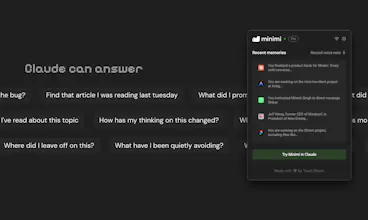
Every great Claude response starts with context. Minimi listens across your Mac - docs, calls, messages, tabs - and gives Claude the full picture. No prompting. All on-device and private.




Free
Launch Team / Built With


Shram
Shram
@jay_gadekar so excited to have built it alongside you and our team! <3
@jay_gadekar Many congratulations on the launch! :)
Really, really beautiful landing page, so cute, and I love the branding!
Minimi is your ambient memory for Claude, a Mac app that quietly captures everything you do on your computer (every tab, document, call, and Slack thread) and feeds it to Claude as live context.
Instead of manually briefing Claude or hunting through your history, you can just ask questions like "Who sent me the screenshot about the bug?" or "What did we decide in yesterday's meeting?" and Claude will know.
I endorse it because it's 50% more accurate than previous memory systems (54% vs 36% on the BEAM benchmark), keeps your memory on-device in a local vector database with nothing stored on the cloud, and lets you skip the extra prompting to get straight to answers.
This is exactly what AI assistants have been missing, true long-term memory that actually works while protecting your privacy.
Shram
@rohanrecommends - thanks Rohan. :)
Shram
@jay_gadekar @rohanrecommends thanks for this Rohan! Do share your feedback with us :)
@jay_gadekar Congrats! Love the idea, especially that it's ambient (aka frictionless). Sadly, I'm PC - any chance you'll be doing a PC version soon?
Shram
@jay_gadekar @anna_ludwinowski Hi Anna! At this moment we are not on PC - but will be there soon :)
Shram
@anna_ludwinowski - thank you! Support for PC is certainly on the roadmap - will release soon. :)
AutoSend
@jay_gadekar Started using Minimi since yesterday. I am impressed. Now I am actually looking forward to use Shram from Monday. Great going and keep up the momentum! 👏
Shram
@designerdada - thanks Akash - means a lot coming from you. Will keep you posted! :))
Product Hunt
Shram
@curiouskitty - the bet is on zero friction.
Manual notes and curated workflows ask you to decide what matters in the moment. Which means you're one busy day away from a gap. Most people don't take notes on the tab they skimmed or the offhand thing mentioned on a call - but that's exactly the context Claude ends up needing.
Ambient capture removes the decision. You don't curate, you just work - and Minimi builds the picture in the background.
Intentional memory is great for things you know you'll need. But most context isn't that - it's just ambient. That's the gap.
Shram
@curiouskitty Manual/Curates memory/workflow will miss out on things by default. Humans aren't perfect and hence Minimi ambiently capturing everything helps.
AISA AI Skills Test
the context bottleneck is real. most bad AI output i see is a missing-context problem, not a model problem, so this direction makes a lot of sense. the part id be curious about is signal vs noise. passively capturing everything across docs/calls/tabs is powerful, but the risk is feeding Claude confidently-irrelevant context. how you decide what's actually worth surfacing feels like the real moat here. on-device + private is a smart trust call too. nice work.
Shram
@ozandag Hi Ozan, even @zaid_mallik1 asked me the same question!
Here was my answer:
Shram
@ozandag Anyone can capture everything; the value is in what you choose to surface. We optimize for an accurate picture over raw recall, which is why we benchmark on BEAM and LongMemEval rather than recall-only tests — these run on very long conversations where the retrieval system has to surface only the relevant pieces. And keeping it on-device.
Shram
@ozandag We are super accurate with what to surface. The underlying tech of Minimi helps with the accuracy.
Shram
@ozandag Capturing everything is table stakes knowing what to show Claude, and when, is where it gets hard.
Shram
@ozandag You've named the actual hard problem. Capturing everything is easy. Knowing what's relevant to this conversation is the work.
The way we handle it: Minimi doesn't dump everything into Claude's context. It retrieves based on what you're currently doing - the app you're in, the conversation you're having, the doc you're editing. The surface area Claude sees is narrow and intentional, not a firehose.
The deeper moat is temporal + behavioural signal - what you've engaged with recently, what you keep returning to, what you've explicitly acted on. That's what separates useful context from noise. Still building on this, but it's the core of what makes the benchmark results hold up in practice.
Shram
@zaid_mallik1 In Minimi - updates, contradictions, and temporal order are handled as core behavior, not patched on.
It's why we measure ourselves on BEAM rather than the older recall-only benchmarks. BEAM runs at 1M and 10M token scale and can't be solved by a bigger context window, so it directly tests the staleness question.
We're at 54% vs the prior 36% SOTA, with most of the lead on the over-time tasks.
Short version: maintaining an accurate picture beats retrieving more, every time!
Shram
@zaid_mallik1 Hope Ojasvika's answer has clarified your question. Feel free to ask if there's anything else, Zaid.
Shram
@zaid_mallik1 Really the right question - and honestly the harder engineering problem. Retrieval is mostly solved. Accuracy over time will need more work.
The way we think about it: Minimi captures chronologically, so context has a timestamp. Claude can reason about recency - what you discussed last week vs last month - rather than treating everything as equally current. We're also working on explicit memory updates, where newer context can surface and deprecate older facts.
The bigger unsolved problem is knowing what you consider still true. That's more personal signal than technical - we're exploring ways to let users flag it directly.
Shram
@zaid_mallik1 Both matter. The real test is memory that stays true weeks in that's exactly what we're building for.
Shram
@veerhunt_agai Great question this is exactly what we're heads down on.
Shram
@veerhunt_agai - I understand. The benchmarks measure the efficacy of the memory layer we have built. It is pretty good! And as context grows, it continues performing just well enough. So you need not worry about it I would say :)
The "no re-explaining yourself" pain point is so real — I spend a chunk of every session giving Claude context it had yesterday.
Love the on-device angle too. Privacy-first local storage is the right call when your context includes work meetings and personal projects.
One question: any Windows roadmap? That's my main blocker for trying it today.
Shram
@dynatrading Hi Andy - the infrastructure we rely on - Accessibility - is not currently reliable for Windows, thus we have not gotten around making a windows version.
However building ambient memory for Windows is something we are absolutely going to get on very soon!
Shram
@dynatrading We went Mac-first to get the capture quality right every app, zero integrations, completely passive. Replicating that on Windows takes time to do properly.
Shram
@dynatrading Hopefully soon, Andy!
Shram
@dynatrading The re-explaining tax is real - most people just accept it as part of using AI. It shouldn't be.
On Windows - Mac-first was a deliberate call, not a limitation. The on-device architecture we've built runs close to the OS in ways that need platform-specific work. Windows is on the roadmap but we want to do it right. :)
Shram
@dynatrading we went Mac first to get the capture quality right. Would love your feedback when it lands!
Nice product! The on-device, you-pick-what-it-sees approach is the part that I think makes this actually look really usable. I spend my time in the Claude ecosystem too (building governance tooling around skills/access), so the granular per-app control especially caught my eye. Quick question: when you pause it or revoke an app, does the context it already captured from that app stay in the local store, or get dropped?
Shram
@tom_palmer_ux - thanks for writing back. When you pause - say for 5 or 10 min, your memory won't be created for that duration. Please feel free to ask more queries. Good day! :)
Shram
@tom_palmer_ux thank you for trying out Minimi! Please share your feedback with us soon :)
Shram
@tom_palmer_ux By pausing, we don't capture anything from that window from the moment you turn it on
Shram
@tom_palmer_ux Hi Tom, it stops from the moment you pause Minimi.