Launching today

Second Brain for AI
Persistent memory for Claude, ChatGPT & Cursor. Free.
188 followers
Persistent memory for Claude, ChatGPT & Cursor. Free.
188 followers
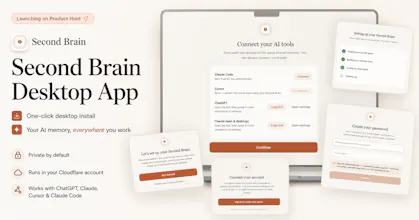
Every AI conversation starts from zero. Your projects, decisions, and preferences disappear as soon as you close the chat. Second Brain fixes that. It is a self-hosted memory layer that works with Claude, ChatGPT, Cursor, and any MCP client. You can store context once and recall it by meaning instead of keywords. It includes duplicate detection, semantic search, and a web UI. Built on Cloudflare, it offers a free tier and your data remains yours. MIT licensed.


Semantic retrieval over stored context beats keyword search for memory, and the dedup layer is a smart addition since AI workflows generate a lot of overlapping notes. We've wrestled with context window management in multi-step AI tasks too: deciding when to summarize vs. fetch older context is genuinely tricky. How does the similarity threshold work when memories partially overlap? Can users tune it?
Second Brain for AI
This is a strong wedge. The bit I’d be most careful with is treating “newer” as automatically more correct when memories conflict. For writing/product work especially, an old positioning decision might still be canonical while a recent one-off chat is just exploration.
A lightweight status layer could help a lot: canonical, draft, preference, deprecated, maybe source-linked. Then the model can say “I found the current rule” vs “I found a past note that may be stale,” instead of injecting both with the same confidence.
Second Brain for AI
@jim_jeffers Valid. Newer isn’t always more correct. A positioning decision from six months ago can absolutely outrank a throwaway idea from yesterday. The current contradiction logic does lean on recency too heavily for that case.
The status layer you’re describing (canonical, draft, deprecated) is exactly the right fix. It’s on the roadmap but not shipped yet. The honest answer right now is that importance scoring and explicit pinning partially address it, but a first-class memory status field would close the gap properly. Adding this to the backlog with your framing… it’s more precise than how we had it scoped.
curious how it handles conflicting memories. if you store an architecture decision then change it a month later, does it override or accumulate? stale context injected confidently is probably worse than no context at all
Second Brain for AI
what the actual setup experience looks like for someone who knows their way around cloudflare but isn't a backend developer. the github readme is usually where these projects lose 80% of potential users because the instructions assume a level of comfort with wrangler and environment variables that most people who would benefit from this don't have. is there a one-click deploy path or is it still a manual configuration process
Second Brain for AI
AISA AI Skills Test
persistent memory is the piece most AI tools are missing right now. you end up re-explaining context every session which kills the usefulness for anything beyond one-off tasks. curious how this handles conflicting memories when your thinking evolves over time — does it version or just overwrite?
Second Brain for AI
Agentmemory
Second Brain for AI
@rohit_ghumare Great project, truly impressive work!
The main difference is infrastructure. Agentmemory, from what I see, runs a local server that you have to manage.
Second Brain deploys to Cloudflare Workers and runs entirely serverless. There is no process to handle, no Docker, and no Node runtime. Your data is stored in your own Cloudflare D1 and Vectorize. One-click deploy, free tier, it's done.
There’s a different tradeoff: Agentmemory offers more features, while Second Brain is easier to run and own.
Second Brain for AI
Nice one @rahilpirani !
This can be run on-prem too?
Second Brain for AI