
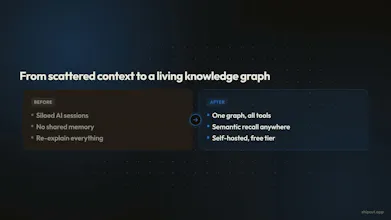
Every AI conversation starts from zero. Your projects, decisions, and preferences disappear as soon as you close the chat. Second Brain fixes that. It is a self-hosted memory layer that works with Claude, ChatGPT, Cursor, and any MCP client. You can store context once and recall it by meaning instead of keywords. It includes duplicate detection, semantic search, and a web UI. Built on Cloudflare, it offers a free tier and your data remains yours. MIT licensed.
This is the 2nd launch from Second Brain for AI. View more
Second Brain for AI v2
Launched this week
Second Brain remembers your projects, people, decisions, and preferences across Claude, ChatGPT, Cursor, Codex, and any MCP client. V2 automatically links related memories, follows those connections during recall, and distinguishes settled decisions from drafts and stale context. Open source and self-hosted in your Cloudflare account.


Free
Launch Team / Built With


Interesting take on memory. The part I keep running into with long lived AI memory is not storage, it's that old memories go stale and quietly become wrong later. Curious how v2 handles that, do memories decay over time or get re checked against newer context?
Second Brain for AI
@henry_s_jung v2 doesn't auto-decay, but every write checks against existing canonical memories. Contradictory new context surfaces immediately as a draft-vs-canonical pair, so stale info gets flagged the moment something newer conflicts with it. The trickier case is memories that were wrong from the start and never contradicted - that's a real gap we're thinking about.
Interesting idea. How do this scale efficiently? Is there an indexing or meta layer so as I have more info to save? What about "split personalities?" There's work info, personal info, hobby info, etc that tend to be fairly siloed. Does it figure out my silos over time?
Second Brain for AI
@markherschberg Vectorize keeps recall latency flat as memory grows. On silos: v2 doesn't auto-partition yet. You can tag memories by context, but the graph links across domains when memories are semantically close. Automatic partitioning is on the roadmap.
Cross-tool memory is the piece I keep wanting and keep not trusting, mostly because I can never see what it decided to remember. Does Second Brain let me look at and edit the actual memory it's built, or is it a black box I have to take on faith? The moment one of these quietly remembers something wrong I lose the whole thread, so the inspect-and-correct part matters more to me than the recall.
Second Brain for AI
@chielephant Not a black box. The web UI shows every memory: which tool wrote it, when, and its current status (canonical, draft, or deprecated). You can edit, unlink, or deprecate entries directly. Visibility came before recall in the design, for exactly the reason you named.
The "connects dots across tools" framing resonates — I've been working on cross-session memory for fictional characters and hit the same wall: memory needs to know what contradicts what, not just accumulate. Does Second Brain handle conflict detection when the same topic appears differently across tools, or is resolution left to the user?
Second Brain for AI
@avantigrowthlab Detection is automatic at write time. When Cursor writes something that conflicts with a canonical from Claude, both surface immediately as a draft-vs-canonical pair with source and timestamp attached. You see the tension the moment it's written. Resolution is yours to call - the system surfaces it, you settle it.
@rahilpirani That's a clean model — surfacing draft-vs-canonical at write time with source + timestamp is the right primitive. The case I keep hitting in my own domain (character memory for fiction) is a third one: not a hard conflict, but soft drift. "She's cautious" → "she took a risk once" → "she's a risk-taker." No single write trips a conflict detector, yet the canonical quietly erodes. Have you thought about drift as separate from hard conflict, or is that out of scope for tool-sync?
Second Brain for AI
@avantigrowthlab Drift is a distinct case v2 doesn't handle. Contradiction detection needs an opposing signal to fire; drift has none because every write is locally compatible. The fix would be semantic distance scoring on writes against canonical - flag "close but subtly different" for review rather than letting it through silently. Character memory for fiction is the clearest framing of this problem, and the same erosion pattern shows up in agent memory too.
Semantic distance from canonical is where I'd start too — the hard part is the threshold. Too tight and you flag legitimate arc (a character is allowed to grow); too loose and slow erosion still slips through. What's helped me: weight the distance by how load-bearing the fact is. A character's core wound drifting should scream; a peripheral preference shouldn't. Same in agent memory — a few facts are structural, most are disposable. Would you expose that as a per-canonical "stability" weight, or keep it uniform?
Nice upgrade for the second shot bro. How does it resolve the conflict? Does it deterministic? What happen if (Could I) revert to history question because of decision changes or bad responses?
Second Brain for AI
@mark_ph_m Not deterministic - conflicts surface both sides for you to decide. Nothing gets deleted: deprecated memories stay in the audit trail and can be restored from the web UI.
@rahilpirani that "own the data, own the overwrite decision" framing makes sense. flip side of it being my Cloudflare account - if a bug on your end (not user error) corrupts the graph, is recovery also on me to have set up my own D1 backups/point-in-time recovery, or does Second Brain ship some backup mechanism by default so self-hosting doesn't quietly mean "you're also now responsible for your own disaster recovery"
Second Brain for AI
@omri_ben_shoham1 D1 has built-in export tooling, so you can snapshot the database on a schedule. Second Brain doesn't ship a backup layer on top of that. The honest answer: self-hosted does mean you own disaster recovery. The risk is manageable - D1 exports are one command - but it's real. Adding a one-click export to the web UI is on the roadmap.
Finally a memory layer that actually feels useful across different tools. Set it up with my Claude and Cursor workflows and the semantic recall saved me from re-explaining a project setup I had already detailed the day before.
Second Brain for AI
@birgl1646637 The re-explaining tax is the whole reason this exists. Glad the cross-tool recall is cutting it already.