
Owlish
Reduce support volume with AI agents trained on your docs
134 followers
Reduce support volume with AI agents trained on your docs
134 followers
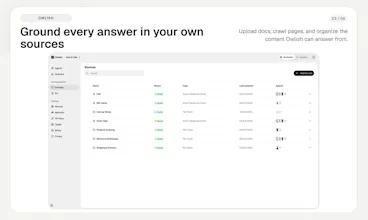
Owlish turns your website, FAQs, docs, and PDFs into an AI customer support agent that answers common questions, cites sources, uses approved replies, and hands off to a human when needed. It helps businesses reduce repetitive support volume, reply faster outside business hours, and give support teams the context they need to resolve harder conversations.




@mithunchevvi Hey Mithun, congrats on shipping 👋
The "hand off to a human when needed" line is the one I always want to push on with support agents — it's the make-or-break feature, and almost no one talks about how the decision actually gets made. Hand off too early and the agent is useless, too late and the customer is already frustrated.
What's the heuristic in Owlish? Confidence score below a threshold, certain question types (refunds, escalations, account-level changes), explicit user signals like "talk to a human," or all three layered? And does the human get the agent's reasoning + sources it tried, or just the conversation log? The latter is what most platforms ship, but the former is what makes the human actually faster.
Thanks, @artem_fedorovich. Great question! A handoff feature is only useful if the timing is sane.
In Owlish, the main signal is whether the agent can answer from the business’s knowledge base with enough confidence. If it can find a grounded answer, it should answer and cite the source. If it cannot find one, or the question needs human judgment even though related docs exist, it should hand off (e.g. the refund policy says “refunds are available within 30 days,” but the customer says they are at day 34 because the shipment arrived late).
There are a few layers on top of that:
explicit user intent: “talk to a human,” “connect me to someone,” etc.
sensitive or account-specific cases: refund exceptions, complaints, billing/account changes, escalations
repeated friction: the visitor is frustrated or stuck after the agent has tried to help
operator takeover: a human can jump in manually from the live inbox
On the operator side, we do not only show a raw chat log. The handoff lands in Owlish Helpdesk with the full transcript, sources/citations used in the conversation, the handoff reason, and an AI-generated operator brief with summary, intent, sentiment, and confidence where available.
I’m careful with the word “reasoning” though: we don’t expose hidden chain-of-thought. We expose the useful operational context: what the customer asked, what the agent tried, which sources were used, and why the conversation was escalated.
@mithunchevvi Solid answer - the "useful operational context vs hidden chain-of-thought" distinction is the right call. Most platforms either dump raw traces (overwhelms the operator) or hide everything (operator starts from zero). The middle is harder to ship but it's what actually makes humans faster.
The day-34 refund example is also a great test case for the "grounded answer exists but human judgment needed" layer. That's the failure mode most rule-based bots miss.
Good luck with the launch - will keep an eye on Owlish 🤝
Thank you,@artem_fedorovich. That’s exactly the gap I’m trying to avoid.
A raw trace is not useful to a support operator, but neither is a blank handoff. The operator needs the distilled context: what the customer wanted, what the agent found, which sources it relied on, and why it decided a person should step in.
And yes, the day-34 refund case is the kind of edge case I think AI support needs to handle honestly. The agent can cite the policy, but it should not pretend to make a judgment call the business has not delegated to it.
Appreciate you taking a close look! 😊🤝
This looks soli. Citing the sources used for the answers is a huge trust builder for customers who might otherwise be skeptical of AI chat replies. How fast does Owlish update its answers if a business modifies an existing FAQ or policy document on their site?
Interesting positioning.
Have you noticed businesses being more concerned about hallucinations or about losing their brand voice/personality in AI support interactions?
Hi, @surabhi_minocha!
Small sample size so far, but in the conversations I’ve had, accuracy tends to come up before brand voice.
A wrong answer about refunds, pricing, shipping, or policy can create a real support problem, so buyers want to know: “Will this make something up?” That’s why Owlish puts so much emphasis on source-grounded answers, citations, refusal, and human handoff.
Brand voice is the next layer. In the Agent Playground, teams can tune the agent’s instructions, personality, and system prompt until it sounds like their support team. And for high-stakes or recurring questions where they want exact wording, Direct Response feature lets them pin a specific answer the agent should use.
So the goal is both: accurate answers first, then answers that still feel like the business wrote them. Accuracy should never get sacrificed for personality.
The 'Direct Response' pinning feature is the most interesting design choice here. It lets businesses own the exact wording on high-stakes questions without losing the AI's ability to handle everything else. Curious what happens when a pinned response conflicts with a newer doc update. Does the pin always win?
Hi, @dhiraj_patel5! For the specific question it matches, yes, the Direct Response is treated as the canonical answer.
That is intentional. If a business pins wording for something high-stakes like refunds, cancellation, pricing, medical disclaimers, legal language, etc., I don’t want a later website crawl to silently reinterpret it.
The nuance is that the pin does not override the whole knowledge base globally. It only applies when the customer’s question matches that Direct Response. If the policy changes, the business should update or remove the pinned answer too. Direct Responses are editable in place, so that is the fastest update path.
Longer term, I’d like Owlish to surface potential conflicts, like “your pinned refund answer no longer matches your refund page,” because that is exactly the kind of drift teams should not have to discover from a customer complaint.
super!! is it possible to use the knowledge base built by the platform to be used in Vapi?
Thank you, @ashishkingdom! Not as a one-click connector today, but yes, this is technically possible.
The clean version would be a Vapi custom knowledge base integration: Vapi sends a search request during the call, Owlish searches the business’s Owlish knowledge base, then returns the relevant snippets or a pinned Direct Response for Vapi to speak.
Today, the practical path is to keep the same source material in sync across both systems. Owlish already has API/MCP surfaces for knowledge-base management, and a Vapi adapter is the kind of integration I’d like to support if enough voice-agent teams want it.
@mithunchevvi that sounds awesome!!
Looks beautiful, what starter kit/design system did you use?
Thank you, @uladzislau_rasliak! No purchased starter kit, but the base is shadcn/ui with the Luma/radix-luma style.
The console is custom-built on Next.js, React, Tailwind v4, and a shared @owlish/ui design system. I use Geist for typography, HugeIcons for icons, OKLCh color tokens, and a layout inspired by the OpenAI Platform console: gray sidebar, white rounded content surface, soft elevation, and pretty restrained UI.
I wanted it to feel more like a calm operator tool than a flashy AI landing page.
Hi, @lakshminath_dondeti!
Mintlify is primarily a documentation platform: publish and maintain docs, API references, and knowledge bases, with AI search/assistant features on top.
Owlish is more of a customer-support agent layer. It takes the knowledge a business already has — website, help docs, PDFs, FAQs — and uses it to answer customers in a web widget or support channels, cite sources, and hand off to a human when it shouldn’t guess.
So if a company’s docs are hosted on Mintlify, Owlish could treat those docs as a knowledge source. We’re not trying to replace the docs site itself.