
Owlish
Reduce support volume with AI agents trained on your docs
134 followers
Reduce support volume with AI agents trained on your docs
134 followers
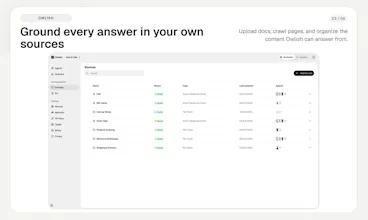
Owlish turns your website, FAQs, docs, and PDFs into an AI customer support agent that answers common questions, cites sources, uses approved replies, and hands off to a human when needed. It helps businesses reduce repetitive support volume, reply faster outside business hours, and give support teams the context they need to resolve harder conversations.




Free Options
Launch Team / Built With


Floot MCPBuild and ship web and mobile apps inside Claude or ChatGPT
Promoted
Congrats on the launch! The 'trained on your docs' angle is where this gets interesting, the quality of the underlying content structure determines almost everything about how well the agent performs. Have you found that doc quality is the #1 variable in how fast customers see ROI?
Thank you, @tonyspiro! I’d say doc quality is one of the biggest variables, with one caveat: doc quality determines the ceiling, while repetitive support volume determines how quickly the ROI shows up.
If the docs are clear, current, and structured around real customer questions, the agent gets useful very quickly: it can answer more confidently, cite the right sources, and hand off less often.
If the docs are vague, stale, or scattered across old pages and PDFs, the AI usually exposes that gap pretty fast.
That’s one reason citations matter so much to us. When an answer is weak, the business can see whether the issue was a missing source, stale content, unclear wording, or something that should be handled with a pinned Direct Response or human handoff.
So yes, content structure is huge. Fastest ROI usually comes from good docs + repeated support questions + a tight feedback loop for fixing gaps.
Congrats on the launch! 🎉 Reducing repetitive support volume while keeping a seamless human handoff is the absolute sweet spot for AI customer service. I love that it actively cites sources to keep answers trustworthy and grounded.
Quick question for the team: When a conversation requires a human handoff, how does Owlish notify the support team? Does it integrate directly into existing helpdesks (like Zendesk/Intercom) or channel notifications like Slack?
Thank you, @manal_essalek1! 😊 That is exactly the workflow we’re aiming for: AI handles the repeatable questions, but the conversation does not fall off a cliff when a human is needed.
Today, handoffs land in Owlish Helpdesk. The session moves into the team inbox with the full transcript, sources/citations, visitor context, and an unread state for operators. Operators get in-app/browser notifications and can claim the conversation, reply as a human, resolve it, or return it back to AI.
Slack is supported as a conversation channel, so a Slack thread can also flow into the same Owlish Helpdesk. Zendesk/Intercom-style native ticketing integrations are not live yet; they’re on the roadmap. For now, Owlish is the shared inbox for AI + human support, rather than just pushing tickets into an existing helpdesk.
Owlish is such an amazing name. Congrats on launch!
Thank you, @daniel_nwankwo! I liked that “Owlish” hints at being wise and knowledgeable, but still feels friendly. That fits the product pretty well: an AI support agent that should answer carefully, cite its sources, and know when to hand off to a human. :)
awesome idea. Congrats on your launch 🤘
Thank you, @naimz! I appreciate it! 😊